

Skip the double boiler, the marble slab, and the endless stirring. If you start with high-grade store-bought chocolate, you can bypass traditional tempering entirely.
Commercial baking bars and feves arrive already tempered—meaning their cocoa butter crystals are locked in the ideal Form V (Beta) structure. By heating the chocolate gently enough to melt it without crossing the threshold that melts those stable crystals, you keep the factory temper intact in under five minutes.
Step 1: Verify Your Chocolate is Pre-Tempered
Before starting, confirm your starting bar is properly tempered:
- Surface: Smooth and glossy, free of dull gray streaks or chalky patches (sugar or fat bloom).
- The Snap Test: Snap a piece in half. It must produce a sharp, clean audible “snap”—not a soft bend or crumbly break.
- Internal Texture: The exposed edge should be uniform and dense, without graininess.
- Step 2: The Low-Power Microwave Method
The secret lies in residual heat. Never melt chocolate completely in the microwave; let the final third melt off the heat from the warmth of the bowl.
-
Chop Evenly: Coarsely chop 1 lb (450g) of dark or semisweet tempered chocolate into uniform, bite-sized chunks. Uneven pieces heat at different rates and risk hot spots.
-
First Bursts (50% Power): Microwave in a microwave-safe glass or ceramic bowl at 50% power for 30 seconds. Remove and stir thoroughly with a silicone spatula.
-
Repeat in 30-Second Intervals: Continue microwaving at 50% power in 30-second bursts, scraping the bottom and sides each time. Even if the chunks look solid, the centers heat first—stirring redistributes that heat.
-
Pull at the 2/3 Mark: As soon as roughly two-thirds of the chocolate is melted and a few solid chunks remain, take the bowl out permanently.
-
Stir to Finish: Stir continuously for 1 to 2 minutes. The residual heat of the melted liquid will gently melt the remaining solids. If a few stubborn flecks remain after 2 minutes of stirring, microwave for a single burst of 5 to 10 seconds at 50% power, then stir again.
Critical Working Temperature Limits
If your chocolate exceeds the maximum temperature ceiling below, the Form V crystal matrix collapses and the temper is lost.
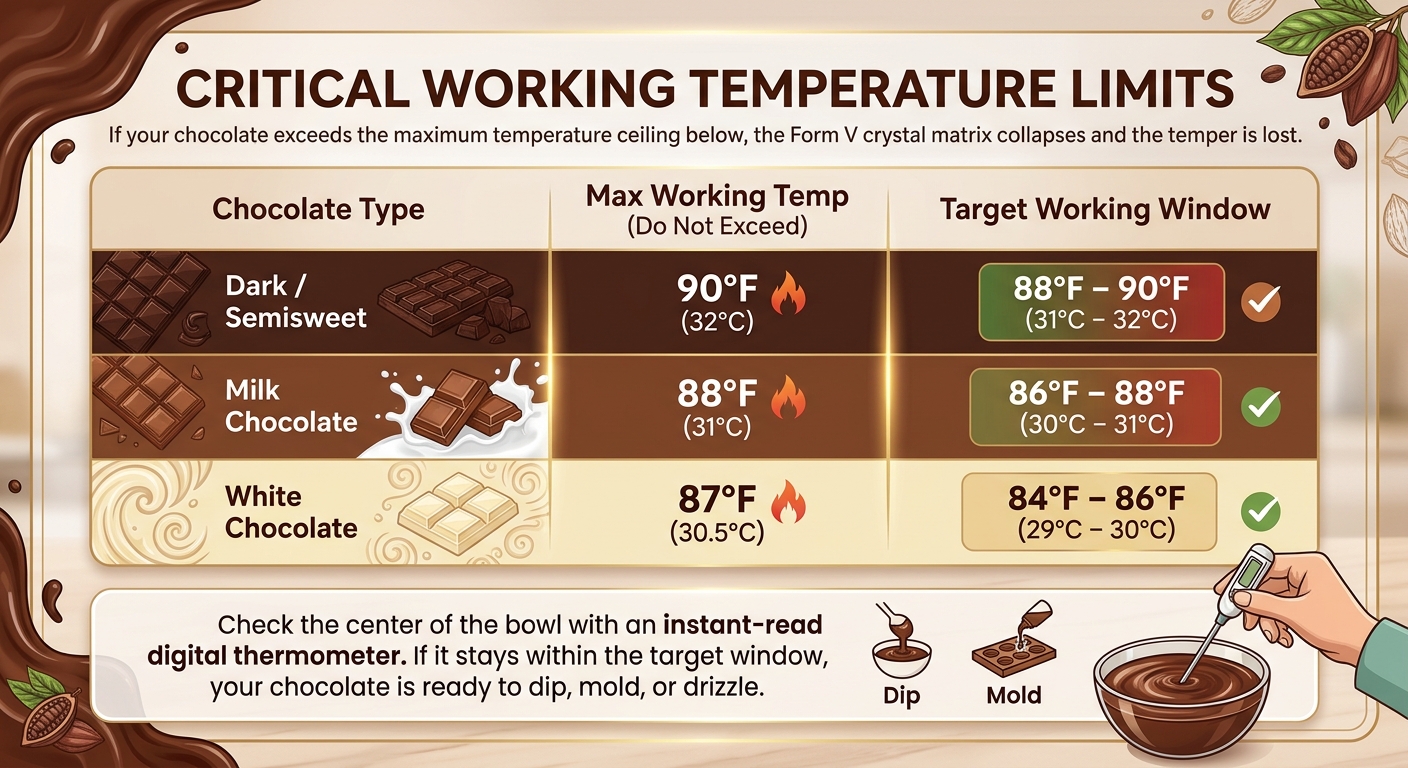
Check the center of the bowl with an instant-read digital thermometer. If it stays within the target window, your chocolate is ready to dip, mold, or drizzle.
Step 3: The 3-Minute Spot Test
Never coat a batch of truffles or confections without running a quick diagnostic test:
- Smear a thin spoonful of melted chocolate onto a piece of parchment or wax paper.
- Let it sit at cool room temperature (65°F–68°F / 18°C–20°C).
The Result:
- In Temper: Sets firm, shiny, and dry to the touch within 3 to 5 minutes. It will peel cleanly off the paper without leaving residue.
- Out of Temper: Remains tacky, dull, or soft after 5 minutes, or dries with mottled gray/white streaks. If this happens, stir in a handful of fresh, un-melted tempered seed chocolate to reintroduce stable crystal seeds, or restart the full seeding method.
The video at the start of the article demonstrates how to monitor temperature windows, avoid hot spots in the microwave, and run the parchment paper snap test in real time.