
The popular narrative of Christopher Columbus is one of the most persistent myths in American history. Generations of students grew up learning a simplified, heroic tale: a courageous explorer who set sail into the unknown, proved the world was round, and discovered America.
However, modern historical research tells a vastly different story.
When examined through primary historical sources—including Columbus’s own journals—the conventional narrative crumbles. Far from an innocent voyage of discovery, the 1492 expedition marked the beginning of centuries of violent European conquest, the transatlantic slave trade, and catastrophic population loss for Indigenous peoples.
To understand the full legacy of 1492, we must look past sanitized legends and examine the documented historical record.
The Myth of “Discovery”: Who Really Arrived First?
The phrase “Columbus discovered America” is fundamentally inaccurate for two key reasons: millions of Indigenous people already lived in the Western Hemisphere, and other transoceanic travelers preceded him by centuries.
1. Indigenous Civilizations Predated 1492 by Millennia
When European ships first sighted land, the Americas were home to complex, flourishing civilizations. From the thriving agricultural societies of the Caribbean to the massive urban centers of Mesoamerica and South America, Indigenous populations had rich histories, advanced engineering, deep astronomical knowledge, and extensive trade networks. Calling these continents “discovered” ignores the millions of people who already inhabited them.
2. Pre-Columbian Contact: The Norse at L’Anse aux Meadows
Columbus was not even the first European to set foot in North America. Archeological evidence excavated in the 1960s at L’Anse aux Meadows in Newfoundland, Canada, conclusively proved that Norse explorers led by Leif Erikson established a settlement in North America around 1000 AD—nearly 500 years before Columbus set sail.
Key Historical Reality: Columbus never set foot on the mainland of the United States. His four voyages concentrated entirely on the Caribbean, Central America, and South America.
3. The Economic and Religious Drivers Behind the Voyages
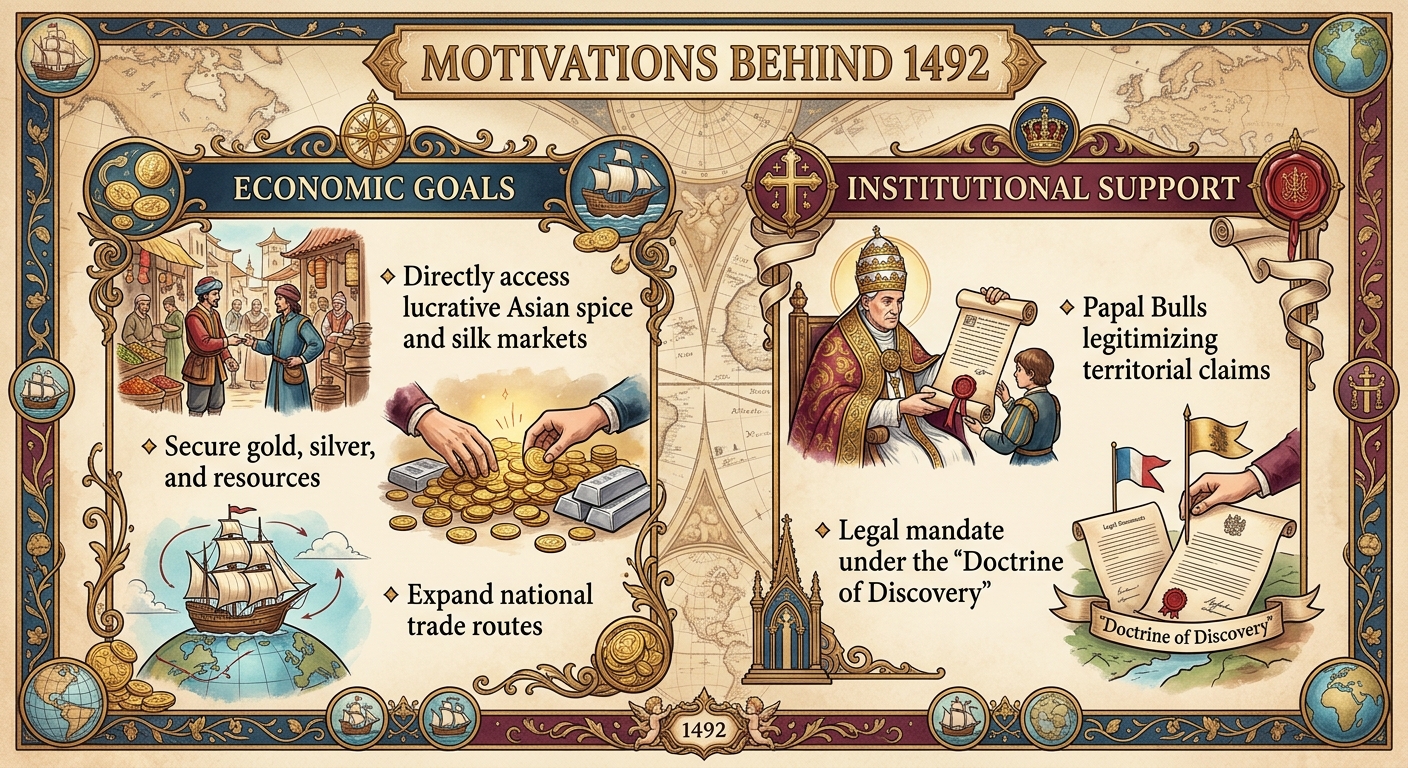
To understand why Columbus sailed, it is necessary to examine the geopolitical climate of late 15th-century Europe. The newly unified Spanish Crown—led by King Ferdinand and Queen Isabella—was eager to gain wealth and land after centuries of regional conflict.
The Legal Framework: Papal Bulls and the Doctrine of Discovery
European powers relied on religious authority to legitimize their territorial claims. Through decrees like the 1455 Romanus Pontifex and the 1493 Inter Caetera issued by Pope Alexander VI, the Catholic Church granted European nations exclusive rights to claim lands not inhabited by Christians.
This legal and religious framework later evolved into the Doctrine of Discovery—a concept that stripped Indigenous peoples of property rights and justified subjugation under the banner of conversion and empire.
The Origins of the Transatlantic Slave Trade
One of the most documented aspects of Columbus’s legacy is his role in establishing the transatlantic slave trade.
Upon establishing a foothold on the island of Hispaniola (present-day Haiti and the Dominican Republic), Columbus sought ways to make his expeditions profitable for the Spanish Crown. When vast quantities of gold failed to materialize, he turned to human trafficking.
-
Forced Labor System: Columbus instituted the encomienda system, which granted Spanish settlers forced Indigenous labor. Native Taíno and Arawak people were compelled to mine for gold and cultivate crops under extreme conditions.
-
Mass Kidnapping: In 1495, Columbus rounded up over 1,500 Taíno people, sending hundreds on ships back to Spain to be sold in European slave markets.
-
Brutal Enforcement: Primary accounts document harsh punishments for those who failed to meet impossible gold quotas, alongside rampant violence against native populations.
Historian James Loewen highlights that Columbus dispatched more Indigenous slaves across the Atlantic than any other single individual of his era.
The Human Toll on Hispaniola
The arrival of European colonizers brought catastrophic consequences to the Indigenous inhabitants of the Caribbean. A combination of brutal forced labor, extreme violence, and introduced European diseases destroyed native populations within decades.
Eyewitness Accounts: Bartolomé de las Casas
Much of what history records about this period comes from Bartolomé de las Casas, a Spanish Dominican friar who originally participated in the colonization effort before becoming a fiercely vocal advocate for Indigenous rights. Las Casas documented the extreme brutality of the Spanish conquest in his multi-volume works, detailing the rapid destruction of Taíno society.
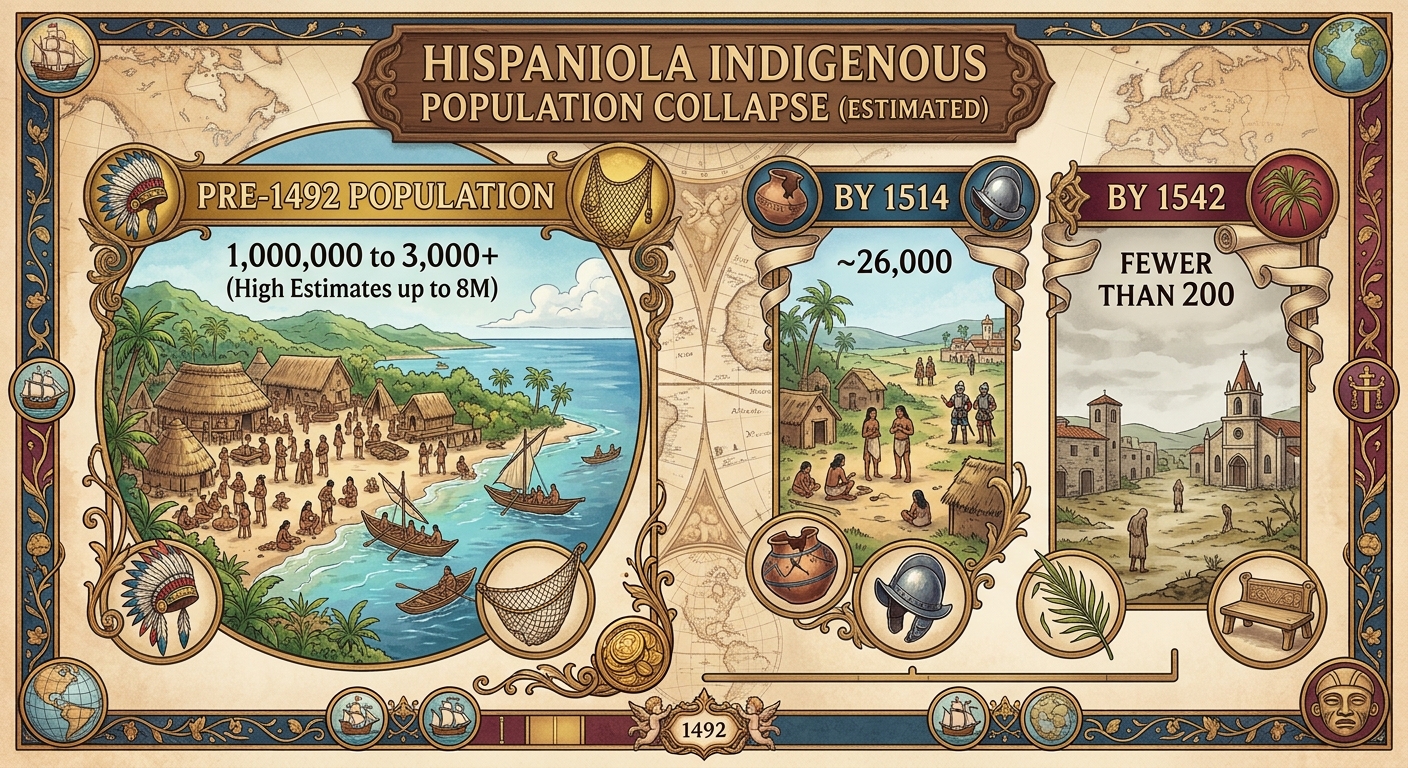
Because forced labor and disease decimated the local Taíno populations, European powers began forcibly importing enslaved Africans to the Caribbean, cementing a centuries-long legacy of transatlantic human trafficking.
Why Historical Perspective Matters Today
Revisiting the history of Christopher Columbus is not about changing the past; it is about accurately understanding its lasting impact on the present.
For Indigenous communities across the Americas, the long-standing celebration of Columbus Day represented the sanitization of historical trauma. In response, modern educational standards, historians, and local governments have shifted focus toward historical accuracy—leading many regions to celebrate Indigenous Peoples’ Day instead.
By setting the record straight, society moves away from national myths and toward a nuanced understanding of how modern global trade, law, and demographic shifts were forged.
Key Historical References & Further Reading
-
Getches, David H., et al. Cases and Materials on Federal Indian Law. Thomson West Publishers, 2005. (Details on the legal precedent of the Doctrine of Discovery).
-
Loewen, James W. Lies My Teacher Told Me: Everything Your American History Textbook Got Wrong. Simon & Schuster, 1995. (Analysis of textbook mythologies around Columbus).
-
Zinn, Howard. A People’s History of the United States. Harper Perennial, 2003. (Documentation of primary source accounts from Columbus and Las Casas).