

Is it tuh-MAY-toh or tuh-MAH-to? Regardless of how you pronounce it, this nutrient-dense botanical fruit—treated as a culinary vegetable—is an irreplaceable cornerstone of global gastronomy. From rustic Italian pasta sauces and Mexican salsas to canned soups and fresh garden salads, the tomato is one of the most widely consumed crops on Earth.
Yet, for centuries across Western civilization, the tomato was shunned, feared, and branded as a deadly poison.
Long before European explorers set eyes on the plant, wild ancestors of the tomato (Solanum lycopersicum) grew along the western coast of South America, spanning regions of modern-day Peru, Ecuador, and Bolivia. These wild predecessors produced tiny, cherry-sized berries that were predominantly yellow or green rather than red.
The Aztec Connection: Tomatl
Around 500 BC, Mesoamerican civilizations—most notably the Aztecs—began actively cultivating and selectively breeding the plant.
-
Etymology: The English word tomato comes directly from the Spanish tomate, which was derived from the Nahuatl (Aztec) word tomatl, meaning “plump fruit”.
-
Early Culinary Use: Unlike Europeans centuries later, the Aztecs integrated tomatoes directly into their daily diet, combining them with chili peppers and squash seeds to create early predecessors of modern salsas.
When Spanish conquistador Hernán Cortés witnessed tomatoes growing in the royal gardens of Tenochtitlan (Montezuma’s capital) in 1519, Spanish sailors harvested seeds to take back across the Atlantic.
The European Arrival: Misconceptions and Botanical Myths
When tomato seeds arrived in 16th-century Europe, they were greeted with deep skepticism rather than culinary enthusiasm. While Mediterranean nations adapted to the new plant relatively quickly, Northern Europe feared it for over two centuries.
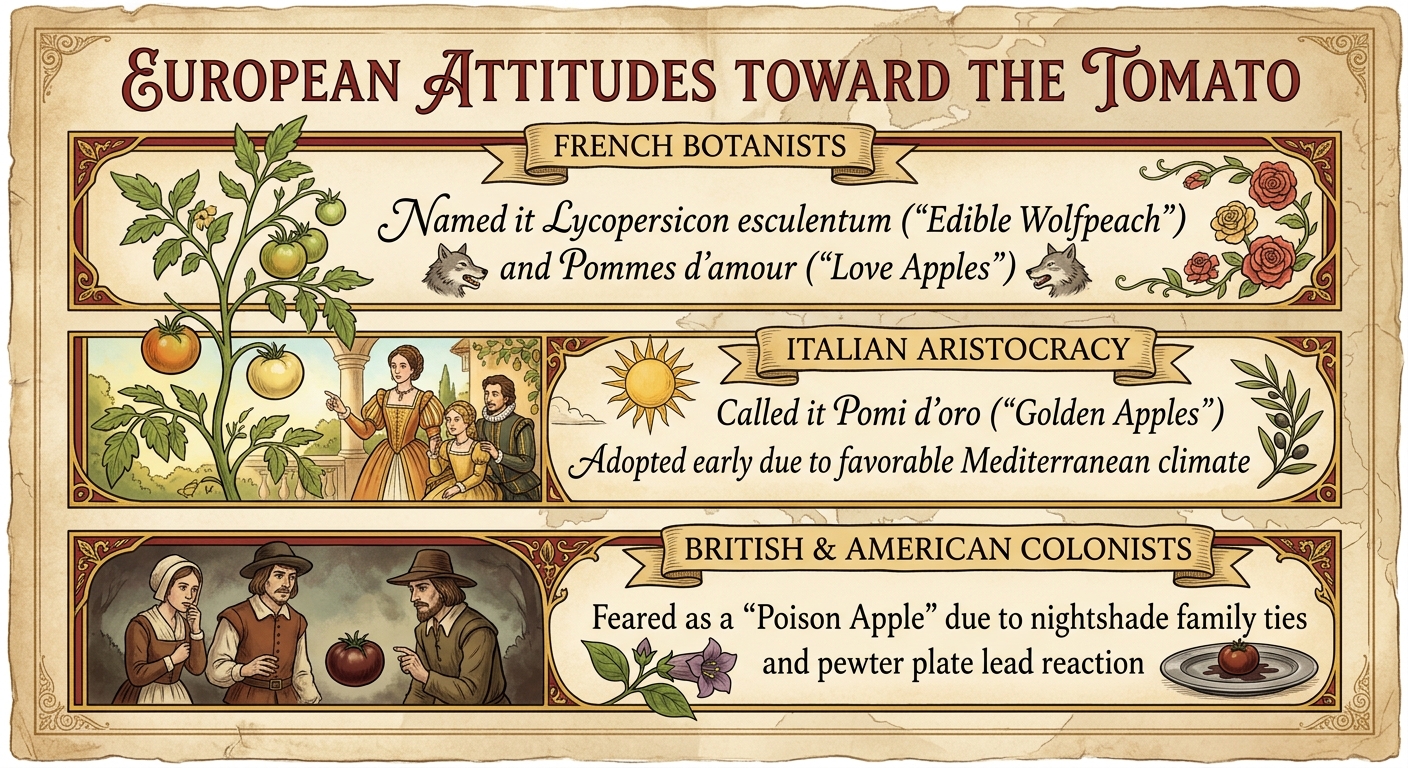
Why Was the Tomato Feared as Poisonous?
The widespread fear of the tomato stemmed from a combination of scientific taxonomy, aristocratic tableware, and botanical error:
-
The Deadly Nightshade Connection: The tomato belongs to the Solanaceae family, which includes toxic plants like belladonna (deadly nightshade), mandrake, and henbane.
While the leaves and stems of tomato plants do contain toxic glycoalkaloids (solanine and tomatine), the ripe fruit itself is completely harmless. -
The “Poison Plate” Phenomenon: Wealthy Europeans in the 1500s and 1600s ate off pewter tableware, which contained high levels of lead. The high acidity of tomatoes leached lead out of the plates, causing severe lead poisoning in aristocratic diners. The acidic tomato received the blame instead of the toxic dinnerware.
-
Botanical Misnomers: French botanist Joseph Pitton de Tournefort assigned the botanical name Lycopersicon esculentum—translating to “edible wolfpeach.” The “wolfpeach” designation referenced ancient Greek writings by Galen regarding poisonous plants used to bait wolves.
-
The Herbalist Fallacy: In 1597, English herbalist John Gerard published a hugely influential work plagiarizing continental botanical texts.
He declared the entire tomato plant “rank and stinking” and poisonous. Gerard’s writings established a British and North American superstition that persisted well into the 1830s.
The Turnaround: How the Tomato Conquered Global Cuisine
Despite lingering fears in Britain and New England, Southern European cultures embraced the fruit.
The Mediterranean Adoption
Italy became the first European nation to cultivate and integrate tomatoes into daily regional cuisine. Italian herbalists recorded culinary uses as early as the mid-1500s. Known as pomi d’oro (“golden apples”), early Italian strains were predominantly yellow, providing the foundation for iconic Mediterranean dishes.
In France, the fruit earned the moniker pommes d’amour (“love apples”) due to a popular belief that its vibrant color and juicy texture possessed aphrodisiacal properties.
Industrial Preservation and the Canned Tomato Revolution
By the mid-19th century, public perception shifted rapidly across North America as medical journal articles praised the tomato’s health benefits. However, the true catalyst that turned the tomato into an everyday household item was the rise of industrial preservation and canning.
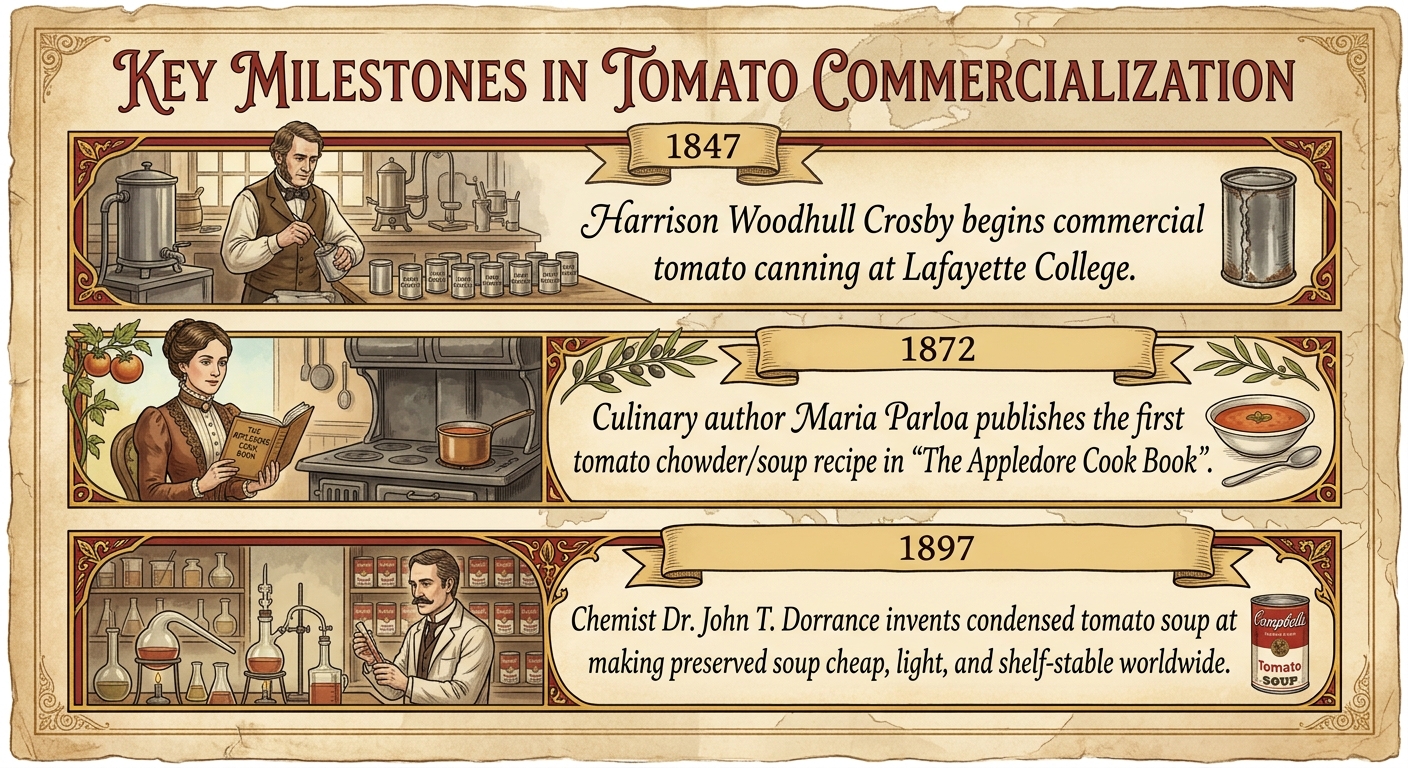
Why Tomatoes Were Ideal for Early Canning
Unlike low-acid vegetables that required complex pressure sterilization to prevent spoilage, the natural acidity of the tomato (pH between 4.0 and 4.6) prevented bacterial growth. This made tomatoes the easiest, safest, and most cost-effective crop for early canning operations during the late 19th century.
Maria Parloa and Campbell’s Innovation
While culinary author Maria Parloa published one of the earliest documented American recipes for tomato soup in her 1872 Appledore Cook Book, commercial soup was expensive to ship because of its water weight.
In 1897, Dr. John T. Dorrance, a chemist working for the Joseph Campbell Preserve Company, developed a process to eliminate half the water content, inventing condensed tomato soup.
Today, food science reinforces what early Mesoamerican civilizations recognized centuries ago: the tomato is a nutritional marvel.
-
Lycopene: Tomatoes are the primary dietary source of lycopene, a powerful carotenoid antioxidant linked to reduced risks of cardiovascular disease and certain forms of cancer.
-
Bioavailability: Unlike many raw vegetables whose nutrients degrade when cooked, the lycopene in tomatoes becomes more bioavailable to the human body after thermal processing and canning.
-
Essential Micronutrients: A single tomato provides roughly 28% of the daily recommended intake of Vitamin C, alongside significant amounts of potassium, folate, and Vitamin K.
Conclusion
From an ornamental “wolfpeach” feared by 16th-century European aristocrats to an essential ingredient powering global food industries, the history of the tomato reflects human adaptability and industrial progress. What was once shunned as a “poison apple” stands today as one of the most versatile, cultivated, and celebrated foods on Earth.