
A holiday feast or Sunday roast should end with happy memories—not a nightmare case of foodborne illness. Raw poultry (including turkey and chicken) frequently carries harmful pathogens like Salmonella and Clostridium perfringens.
Whether you are hosting Thanksgiving, roasting a whole bird for the family, or prepping meal-prep turkey breasts, follow these core kitchen safety rules to keep your kitchen clean, safe, and delicious.
The Four Golden Rules of Safe Turkey Preparation
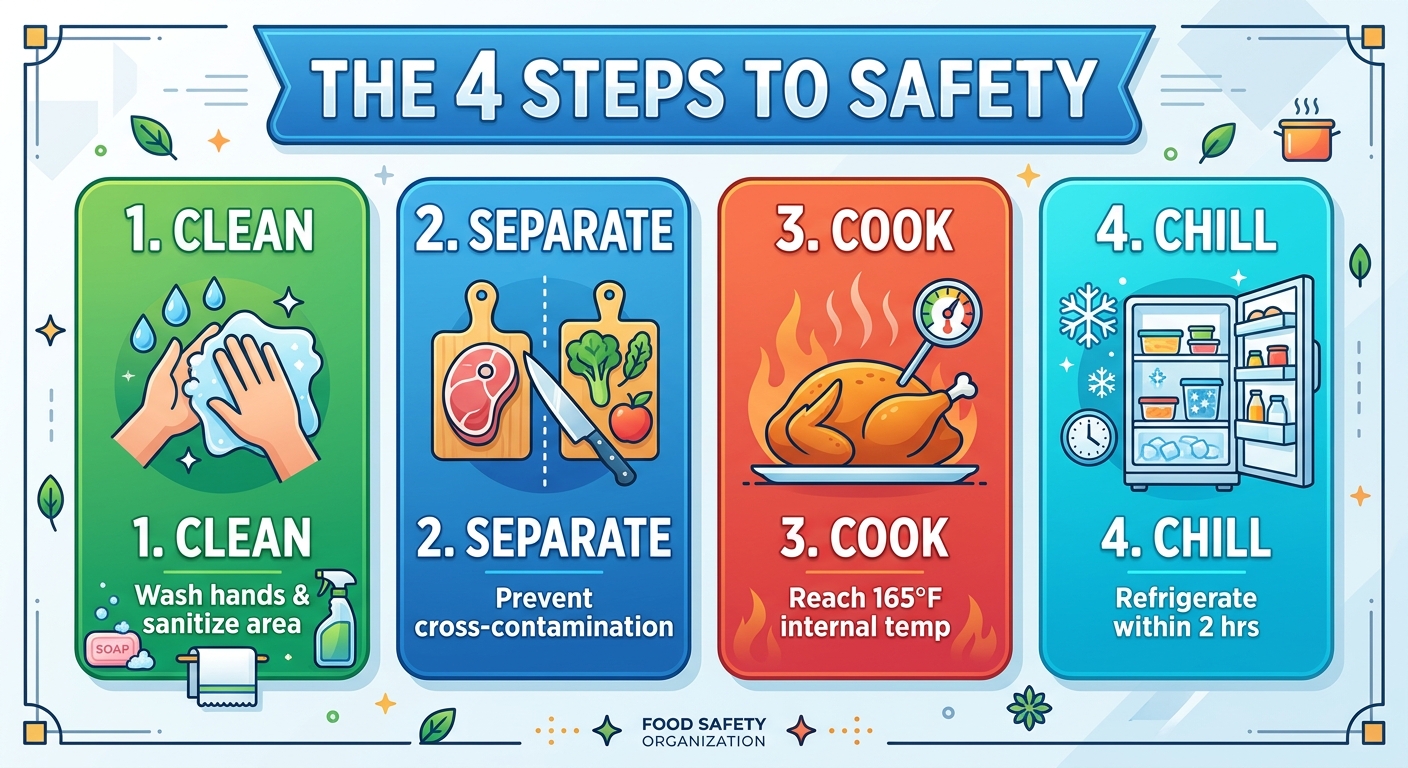
1. Never Wash Your Raw Turkey
It sounds counterintuitive, but do not wash raw turkey in the sink. Research shows that rinsing raw poultry under running water splashes invisible bacteria across sinks, faucets, countertops, and nearby dishware up to three feet away. Cooking the meat to the proper internal temperature is the only proven way to destroy harmful bacteria.
2. Thaw Safely (Ditch the Countertop Method)
Leaving a frozen turkey on the kitchen counter allows the exterior meat to enter the Danger Zone (40°F to 140°F) where bacteria multiply rapidly—even while the center remains frozen solid.
-
Refrigerator Thawing (Safest): Allow 24 hours of fridge time for every 4 to 5 pounds of turkey.
Place the bird in a deep tray on the bottom shelf so juices cannot drip onto other foods. -
Cold Water Thawing (Fast): Submerge the wrapped turkey in leak-proof plastic in a sink of cold tap water, changing the water every 30 minutes (allow 30 minutes per pound).
3. Prevent Cross-Contamination
-
Dedicated Boards & Knives: Use a separate cutting board exclusively for raw poultry.
-
Sanitization: Clean all cutting boards, utensils, and surfaces immediately after use with hot, soapy water. Follow up with a mild kitchen bleach solution (1 tablespoon unscented liquid bleach per gallon of water) for true sanitization.
-
Handwashing: Wash hands with soap and warm water for at least 20 seconds after touching raw poultry.
4. Stuffing Safety
If you choose to cook stuffing inside the bird, do not stuff the turkey ahead of time.
Pro Tip: For ultimate safety and crispier results, bake your stuffing separately in a casserole dish.
🌡️ Internal Temperature & Resting Guidelines
Visual cues like clear juices or golden skin are unreliable indicators of doneness. The only guaranteed way to confirm your turkey is safe to eat is by using a digital instant-read food thermometer.
-
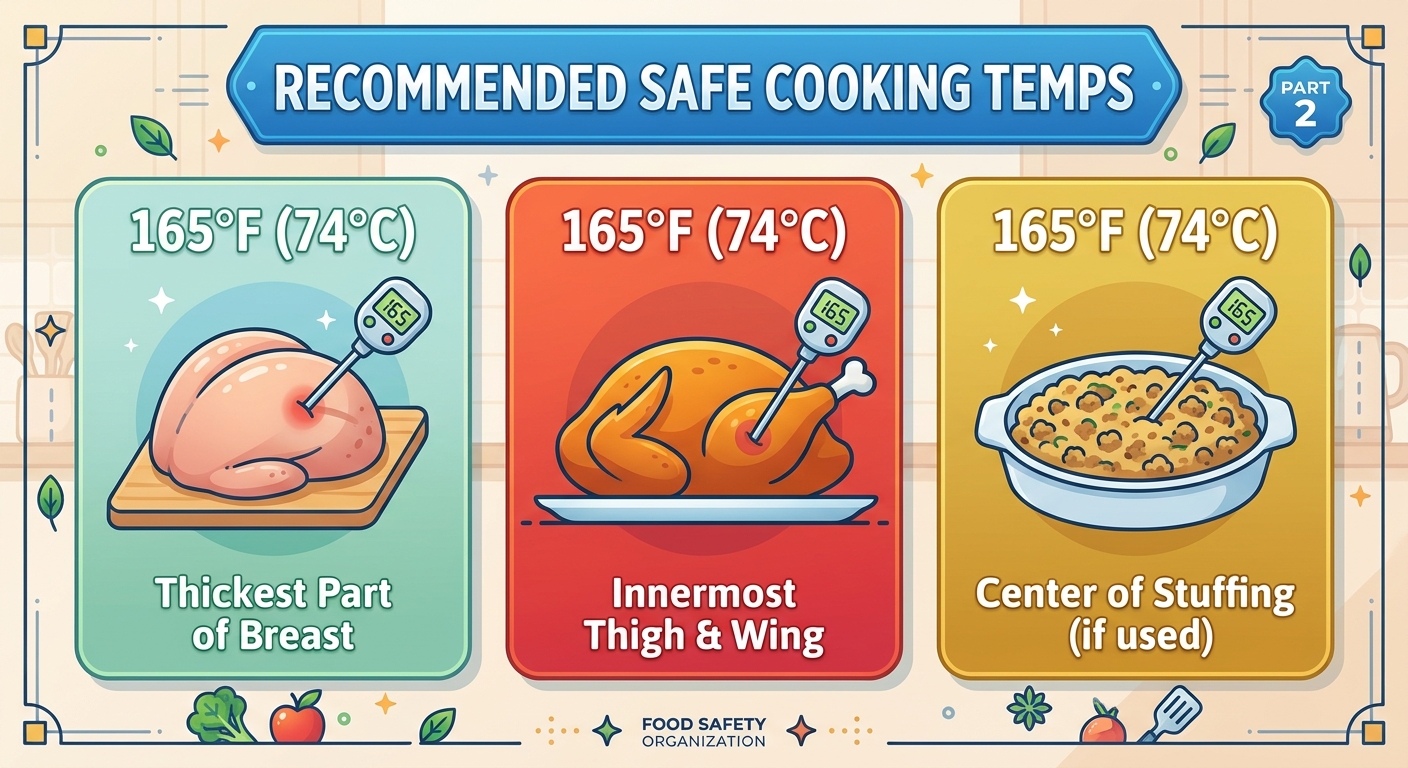
Where to Test: Insert the thermometer probe into the thickest part of the breast, the innermost part of the thigh, and the thickest area of the wing without touching bone. If stuffed, test the very center of the stuffing mixture as well.
-
The Target Temperature: According to the USDA, all poultry and stuffing must reach a minimum internal temperature of $165^\circ\text{F}$ ($74^\circ\text{C}$).
-
Resting Time: Allow the cooked turkey to rest for 15 to 20 minutes before carving. This permits carryover cooking to settle and re-distributes juices throughout the meat for maximum flavor.
❄️ Safe Leftover Storage Rules
The clock starts ticking as soon as the turkey comes out of the oven.
-
The 2-Hour Rule: Refrigerate all leftover meat, stuffing, and gravy within 2 hours of cooking (or 1 hour if exposed to temperatures above 90°F).
-
Shallow Containers: Carve large portions into smaller, shallow containers so the meat cools rapidly in the fridge.
-
Consumption Window: Eat refrigerated turkey leftovers within 3 to 4 days.
Freeze leftovers for longer storage (up to 3–4 months for best quality). -
Reheating: Reheat all turkey meat and dishes to an internal temperature of 165°F before serving.
❓ Frequently Asked Questions (FAQ)
Can I eat undercooked turkey if it looks pink?
Turkey meat near the bone or in young birds can sometimes retain a pinkish hue even when fully cooked. However, you should never judge by color alone. Always verify with a thermometer that every section has reached at least 165°F.
How long can raw turkey sit out at room temperature?
Raw turkey should never sit in the “Danger Zone” (40°F – 140°F) for more than 2 hours. Bacteria can double in quantity every 20 minutes in warm conditions.
Any ready-to-eat food (like cheese, salad, or fresh fruit) touched by raw poultry juice must be discarded immediately to prevent severe food poisoning.
Here are the primary authoritative sources and official guidelines referenced for this article:
-
USDA Food Safety and Inspection Service (FSIS):
Turkey Basics: Safe Thawing -
USDA FSIS:
Turkey Basics: Safe Cooking -
Centers for Disease Control and Prevention (CDC):
Poultry and Food Safety -
CDC:
Foodborne Illness & Food Poisoning -
USDA FSIS:
Leftovers and Food Safety


This is an original creative work by Salty Vixen. This story/article, including its characters, plot, and descriptive content, is protected by copyright law. Unauthorized copying, sharing, reposting, or reproduction in any format is strictly prohibited. This content may not be used for AI training, data scraping, machine learning, or any form of artificial intelligence development without explicit written permission from © 2026 Salty Vixen Stories, Inc. — All rights reserved.. Violators will be pursued to the fullest extent of the law.