

Whether you are watching your carbohydrate intake, trying to avoid sugar-induced headaches, or simply steering clear of empty calories, finding a low-sugar wine comes down to one major factor: residual sugar (RS).
Where Does Sugar in Wine Come From?
Wine begins with grapes, which are packed with natural sugars (glucose and fructose). During fermentation, yeasts consume these natural sugars and convert them into alcohol and carbon dioxide.
-
Dry Wines: If fermentation is allowed to run its course, nearly all the sugar is converted into alcohol, leaving very little residual sugar behind.
-
Sweet Wines: If fermentation is stopped early (either by chilling the wine, filtering out the yeast, or adding high-proof spirits), natural sugars remain in the liquid, resulting in a sweeter taste.
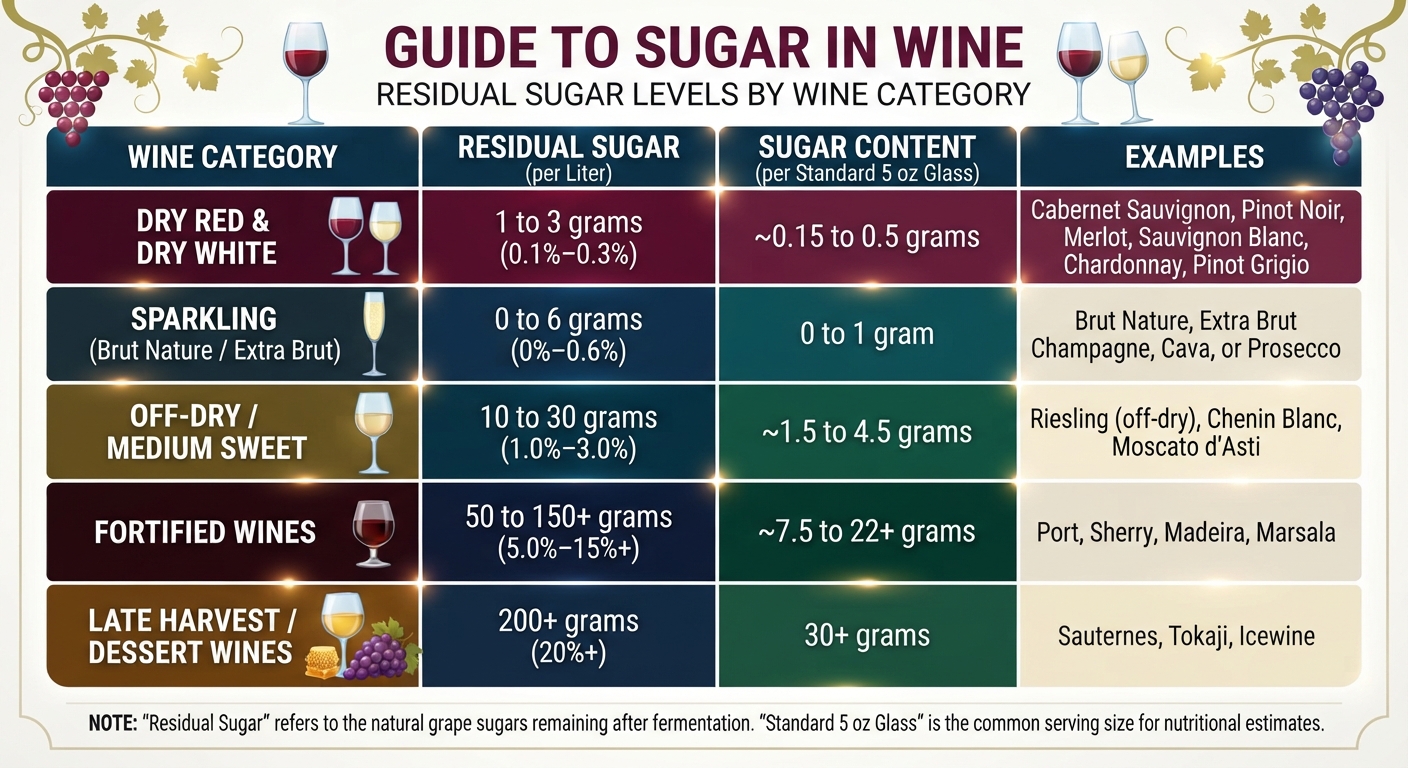
Wine Sugar Breakdown by Style
When searching for the lowest-sugar options on store shelves, wine is categorized by how much residual sugar remains per liter:
Practical Tips for Buying Low-Sugar Wine
-
Check the Alcohol by Volume (ABV): As a general rule of thumb, dry wines with lower alcohol levels (around 11% to 13.5% ABV) or higher alcohol levels (above 14% ABV for fully fermented dry reds) have fermented out most of their sugar. Wines in the middle zone (9% to 11% ABV) often retain a noticeable amount of sweetness.
-
Look for Key Buzzwords on Labels: Terms like “Brut Nature,” “Zero Dosage,” or “Bone Dry” indicate that virtually no sugar was added after fermentation. Avoid words like sec, demi-sec, sweet, fruity, or late harvest.
-
Know Your Grapes: Certain white wine grapes naturally lean toward a sweeter profile unless labeled explicitly as dry (such as Riesling, Gewürztraminer, and Torrontés). Sticking to crisp white varietals like Sauvignon Blanc, Albariño, and Pinot Grigio is a safer bet.
Here is a curated list of specific wine varieties known for having the lowest residual sugar content (typically ranging from 0 to 1 gram of sugar per standard 5-ounce glass):
1. Dry Red Wines
-
Cabernet Sauvignon: A full-bodied red that is heavily fermented, leaving almost no residual sugar.
-
Pinot Noir: Light to medium-bodied with minimal sugar and earthy or fruity flavor profiles.
-
Merlot: A smooth, velvety red that is thoroughly fermented out to dryness.
-
Syrah / Shiraz: Rich and bold, with robust flavors and very low sugar content.
-
Tempranillo: A classic Spanish red that stays completely dry after fermentation.
2. Dry White Wines
-
Sauvignon Blanc: Crisp, refreshing, and high in acidity with virtually zero residual sugar.
-
Chardonnay: Unless labeled as a sweet or late-harvest style, traditional oaked and unoaked Chardonnays are very low in sugar.
-
Pinot Grigio / Pinot Gris: A light, zesty white wine with minimal residual sugar.
-
Albariño: A bright, coastal white wine that is bone-dry and crisp.
-
Grüner Veltliner: Known for its peppery, citrus notes and very low sugar levels.
3. Dry Sparkling Wines
-
Brut Nature / Brut Zero: The driest category of sparkling wine, containing virtually zero added sugar (0–3 grams per liter).
-
Extra Brut: Extremely dry, with only a tiny fraction of residual sugar.
-
Brut Champagne, Cava, or Prosecco: Standard “Brut” styles are fermented dry and are great options for low-sugar celebrations (under 1.5 grams of sugar per glass).


This is an original creative work by Salty Vixen. This story/article, including its characters, plot, and descriptive content, is protected by copyright law. Unauthorized copying, sharing, reposting, or reproduction in any format is strictly prohibited. This content may not be used for AI training, data scraping, machine learning, or any form of artificial intelligence development without explicit written permission from Salty Vixen Publishing LLC. Violators will be pursued to the fullest extent of the law.
