
If you Google “how to roast a turkey,” you’re wading into a sea of millions of panic-driven results. The annual obsession with achieving that “Norman-Rockwell perfect” bird—and the associated fear of someone whispering “dry bird” across the table—causes unnecessary holiday stress.
The truth is, while a turkey is raised to taste blandly consistent (like most commodity meats), you are in complete control of the final flavor and texture. Forget the fret and the sweat; success is simply a matter of choosing the right technique.
You can dress up your turkey however you like—brined, butter-basted, or dry-rubbed—but to avoid the dreaded dry meat, you need a method that respects the bird’s unusual anatomy.
Here are three tested roasting methods to ensure your turkey is moist, flavorful, and perfectly cooked, every single time.
1. The Slow-Roasting Method (The Traditional & Gentle Approach)
This method uses moderate, consistent heat to gently coax the turkey to perfection. It’s ideal for home cooks who prefer a set-it-and-mostly-forget-it approach.
Preparation Notes:
-
To Truss or Not to Truss: Trussing (tying the legs) ensures a more even cooking shape and keeps the leg joints tight. Cookbook writer and photographer James Peterson suggests simply tucking the wing tips under the breast and tying the drumsticks together—no fancy knots needed.
-
Stuffing: It’s generally advised not to stuff the turkey. By the time the stuffing reaches a food-safe temperature, the surrounding meat (especially the breast) is guaranteed to be dry. Cook your dressing separately!
-
The Roasting Bed: Instead of a metal rack (which burns drippings), scatter coarsely chopped aromatic vegetables (like onions and carrots) and the turkey tail, cut in half, in the ro bottom. Prop the turkey directly on top of this bed to collect clean juices.
Roasting Steps:
-
Cover the turkey breast with a triple layer of buttered aluminum foil to shield the delicate meat from the initial heat.
-
Roast in a 350°F oven for 1 hour.
-
Timing: Unstuffed turkeys take approximately 8 minutes per pound, while stuffed turkeys take 10 to 12 minutes per pound.
-
Temperature Check: Never rely on the plastic pop-up timer. Use a digital read thermometer. The turkey is done when the internal temperature in the thickest part of the thigh (avoiding the bone) reaches 165°F (though some professionals prefer pulling it slightly earlier at 160°F).
-
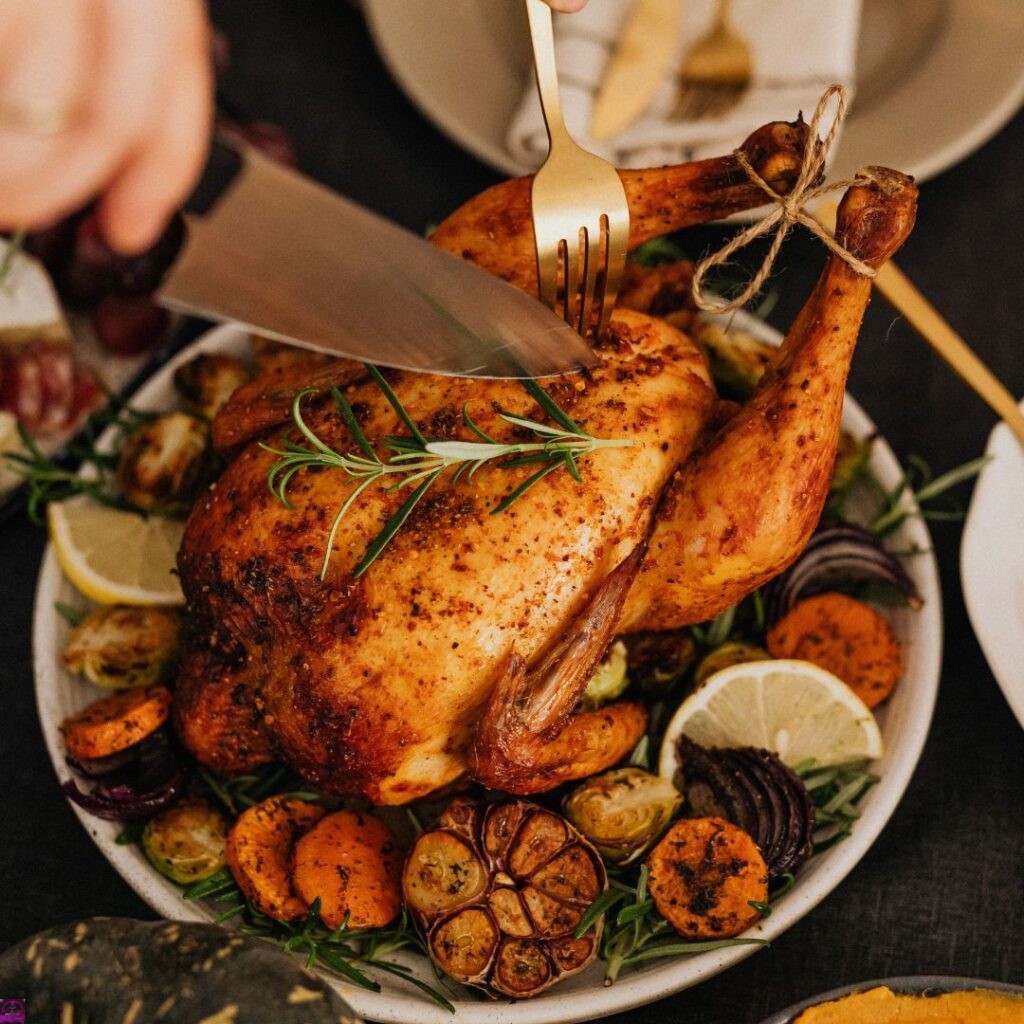
Resting: Remove the turkey from the oven and allow it to rest for 30 minutes before carving. This crucial step lets the juices redistribute, resulting in moist meat.
2. The High-Heat Method (The Quick & Crispy Approach)
Championed by cookbook author Barbara Kafka, this unconventional method uses extremely high heat to crisp the skin quickly and dramatically reduce overall cooking time.
Preparation Notes:
-
Size Matters: This works best for smaller, 15-pound unstuffed turkeys.
-
Trussing: The bird should be unstuffed and untrussed.
-
Prep: Chop off the wing tips (use them for gravy stock). Pat the turkey thoroughly dry inside and out, then season generously with salt and pepper, also inside and out.
-
No Rack: Simply place the turkey directly into the roasting pan.
Roasting Steps:
-
Preheat the oven to a scorching 500°F.
-
Place the turkey into the oven, drumsticks first, and roast for about 2 hours.
-
Movement is Key: At 500°F, fat renders quickly. You must use a spatula to move the bottom of the turkey every 20 minutes to prevent the skin from sticking and burning.
-
Shielding: If the skin gets too dark before the meat is done, cover the breast with a doubled piece of aluminum foil.
-
Doneness: Rely on an internal temperature reading of 165°F in the thigh.
-
Resting & Sauce: Transfer the turkey to a platter and let it rest for 20 minutes. Degrease the pan juices, add a cup of hot water or stock, and bring to a boil on the stovetop. Reduce by half for a quick, flavorful jus.
3. The Deconstructed Method (The Precise & Even Approach)
Julia Child noted that a turkey’s structure makes it difficult to roast the whole bird evenly. By deconstructing it, you can cook each section to its peak perfection. This is the most precise method.
Preparation Notes:
-
Separation: Cut off the legs and thighs. Bone the thighs and stitch them back together with a trussing needle.
-
The Breast: Snip out the breastbone and sew the breast meat back together.
-
The Roaster: The uncooked stuffing can be mounded in the roasting pan.
-
The Drip Pan: An ingenious heavy-duty sheet of aluminum foil is shaped into a drip pan, on top of which the trussed turkey breast is nestled.
Roasting Steps:
-
Roast the breast and drumsticks separately at 325°F.
-
Basting: The pieces are basted frequently with oil and pan juices to keep them moist.
-
Assembly: Once each piece reaches the target internal temperature, the turkey is re-assembled onto a platter for carving at the table.
Seasoning and Gravy
These three methods all produce exceptional results. The final seasoning is entirely up to your taste. Traditional flavors include sage and thyme, but experiment with unique choices like fennel seed, coriander, or herbes de Provence to give the mild meat new character.
Likewise, you can stick with tradition by making a brown gravy from the pan juices, or add chopped heart and gizzard for a rich giblet gravy.
Whichever technique you choose, your roasted turkey never needs to be dry or tasteless again.


This is an original creative work by Salty Vixen. This story/article, including its characters, plot, and descriptive content, is protected by copyright law. Unauthorized copying, sharing, reposting, or reproduction in any format is strictly prohibited. This content may not be used for AI training, data scraping, machine learning, or any form of artificial intelligence development without explicit written permission from © 2026 Salty Vixen Stories, Inc. — All rights reserved.. Violators will be pursued to the fullest extent of the law.
