
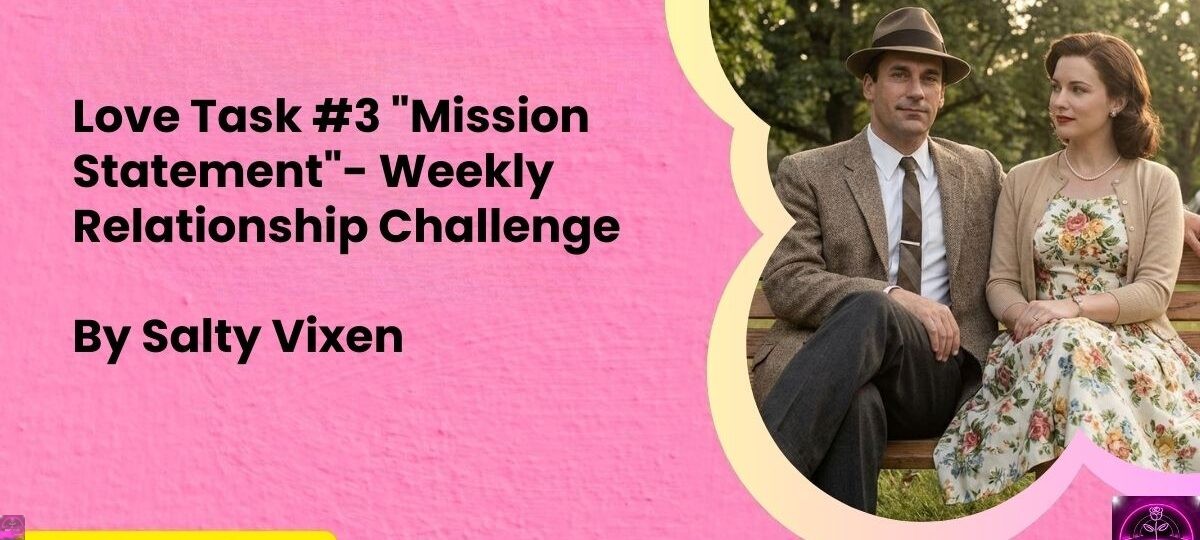
A weekly relationship challenge to define your shared purpose and values
Every major company has a mission statement. Apple. Nike. Google. Amazon. They all have a few sentences that define why they exist and what they stand for.
Why? Because clarity of purpose keeps everyone aligned. When shit gets hard, when decisions need to be made, when priorities conflict—the mission statement is the north star that guides everything.
Now here's a wild thought: What if your relationship had one?
Most couples coast through life together without ever articulating what they're actually trying to build. They assume they're on the same page because they love each other. They hope their partner values the same things they do. They figure it'll all just... work out.
And then ten years later, they're fighting about things that reveal they were never aligned in the first place. One person thought the relationship was about building a family. The other thought it was about adventure and freedom. Both are valid—but they're fundamentally different missions.
This week's Love Task is about getting on the same page.
You're going to create a mission statement for your relationship. Together. In writing. Something you can both point to when things get confusing and say, "This is what we're building. This is what we stand for."
It might feel corporate or cheesy at first. Do it anyway. Because the couples who know what they're building together? They're the ones who last.
What Is a Couple's Mission Statement?
A couple's mission statement is a short written declaration of your shared values, commitments, and relationship goals.
It answers questions like:
- What are we committed to bringing to this relationship?
- What values guide our decisions?
- How do we want to treat each other?
- What kind of partnership are we building?
- What do we stand for as a couple?
It's not a list of rules. It's not a contract with penalties. It's a shared vision that reminds you both what you're working toward when life gets messy.
Think of it as your relationship's constitution. When you're making big decisions—moving cities, having kids, career changes, how to spend money, how to handle conflict—you can refer back to this and ask: "Does this align with who we said we wanted to be?"
Here's why it actually matters:
Without a mission statement, you're operating on assumptions about what your relationship is for. You assume your partner values the same things you do. You assume you're building the same kind of life.
But assumptions are where relationships fall apart.
A mission statement forces you to:
- Articulate what you actually value (not what you think you should value)
- Discover where you're already aligned
- Identify where your visions differ
- Create a shared language for your relationship
- Have a reference point when conflicts arise
Is it corporate? Sure. But corporations use mission statements because they work. Clarity of purpose reduces conflict and keeps everyone moving in the same direction.
Your relationship deserves the same intentionality.
How to Create Your Couple's Mission Statement (Step-by-Step)
Step 1: Set Aside 60-90 Minutes of Uninterrupted Time
This isn't a quick conversation. You need real time to think, write, discuss, and refine.
Create the right environment:
- No distractions (phones off or on silent)
- Comfortable space (couch, kitchen table, wherever you can talk)
- Optional: coffee, wine, snacks—whatever makes you both relaxed
- Good energy (not exhausted, not stressed about other things)
Frame it as an event. "Saturday afternoon, we're creating our relationship mission statement." Make it feel important, because it is.
Step 2: Each Person Writes a Draft Mission Statement Individually
Before you try to create one together, each of you needs to figure out what you think the mission should be.
Grab paper or open a note app. Set a timer for 15-20 minutes.
Write down your thoughts in response to these prompts:
- What do I want our relationship to stand for?
- What values are most important to me in a partnership?
- How do I want us to treat each other?
- What kind of life are we building together?
- What commitments am I making to this relationship?
- When we're old, what do I want us to be proud of?
Don't worry about making it perfect or "mission statement-y" yet. Just write what comes to mind.
Examples of things you might include:
- We prioritize honesty even when it's uncomfortable
- We support each other's individual growth
- We create a home filled with laughter and warmth
- We handle conflict with respect and patience
- We make decisions together as equals
- We choose each other every day, not just once
- We build a life of adventure and new experiences
- We create financial stability and security
- We raise children with love and intentionality
Write whatever feels true to your vision. You'll merge it with your partner's vision next.
Step 3: Share Your Individual Drafts
Now you read what each other wrote.
Take turns reading your drafts out loud, or exchange papers and read silently first. Whatever feels more comfortable.
As you share, notice:
- Where do we already agree? (Celebrate this!)
- Where do our visions differ? (Not bad, just different—discuss why)
- What did my partner include that I didn't think of?
- What values seem most important to each of us?
This isn't about judging each other's drafts. It's about understanding each other's vision for what you're building together.
Ask questions:
- "You wrote that adventure is important. What does that look like to you?"
- "I didn't expect you to prioritize financial stability so highly. Tell me more."
- "We both mentioned honesty. That feels like common ground."
Spend 15-20 minutes on this step. Really listen to what your partner is saying.
Step 4: Identify Your Shared Core Values
Look at both drafts. What themes show up in both?
Maybe you both mentioned honesty, respect, laughter, growth, partnership, loyalty, adventure, family, stability—whatever it is, write down the values that showed up in both of your individual drafts.
These are your non-negotiables. The things you both already agree are central to your relationship.
Start your mission statement here. These shared values form the foundation.
Step 5: Discuss and Integrate the Differences
Now address what didn't overlap.
Maybe you wrote about prioritizing family time, and they wrote about prioritizing career ambition. Maybe you emphasized emotional intimacy, and they emphasized financial security. Maybe you focused on spontaneity, and they focused on routine.
These differences aren't problems—they're opportunities.
Talk through why each of you values what you do. Find the common thread. See if you can incorporate both perspectives.
Example:
- You: "I want us to prioritize adventure and trying new things."
- Them: "I want us to create financial stability."
- Integration: "We commit to building financial security that allows us to pursue adventures together."
You're not erasing differences. You're finding the overlap and making space for both.
Step 6: Draft Your Final Mission Statement Together
Now you write the final version. Together. Out loud. Collaboratively.
Guidelines for writing:
- Keep it short - 3-5 sentences max. Longer than that and you won't remember it.
- Use "we" language - This is about your partnership, not individuals.
- Be specific enough to be meaningful - "We value love" is vague. "We choose honesty even when it's hard" is clear.
- Make it actionable - Not just what you believe, but how you'll behave.
- Make it authentic to you - Don't write what sounds good. Write what's true.
Format options:
Option 1: Values + Commitments
"We are [names], and we are committed to [value 1], [value 2], and [value 3]. By [action/behavior], we create a partnership that [outcome you're building]."
Option 2: Purpose Statement
"Our relationship exists to [purpose]. We commit to [how you'll achieve it]. We navigate challenges by [approach to conflict]."
Option 3: Simple Declaration
"We choose each other. We choose [value]. We choose [value]. We build [what you're creating together]."
Write it, read it out loud, revise until it feels right to both of you.
Step 7: Print, Frame, and Display It
A mission statement that lives in a drawer is useless.
Make it visible:
- Print it on nice paper
- Frame it
- Hang it somewhere you'll both see it regularly (bedroom, office, entryway)
You want to be reminded of what you're building. Especially on the hard days.
Some couples even make two copies—one for each nightstand, or one for home and one for the office.
The point: Keep it present. Keep it visible. Keep it alive.
Example Mission Statements
Example 1: Jerry & Tina
"We, Jerry and Tina, are dedicated to providing love, affection, understanding, commitment, faithfulness, and honesty to each other throughout our relationship. By successfully learning to love each other as we are, we create a partnership that can and will resolve any challenges, obstacles, or disagreements we may face."
Example 2: Adventure-Focused Couple
"We are committed to building a life of adventure, curiosity, and shared experiences. We support each other's individual growth while prioritizing our partnership. We handle conflict with honesty and respect, knowing that our love is stronger than any disagreement."
Example 3: Family-Focused Couple
"Our relationship exists to create a home filled with love, laughter, and safety. We commit to raising our children with intentionality, supporting each other's dreams, and choosing partnership over pride. We face challenges together, always."
Example 4: Growth-Focused Couple
"We choose each other. We choose honesty even when it's uncomfortable. We choose growth even when it's hard. We build a partnership where both of us become the best versions of ourselves, together."
Notice: Each one is different. Each one reflects the unique values of that couple. Yours should do the same.
Then you've discovered something important about your relationship.
If you genuinely can't find common ground on core values, that's information worth paying attention to.
Common areas of disagreement:
- One person prioritizes family/kids, the other prioritizes career/freedom
- One values spontaneity, the other values stability
- One wants emotional closeness, the other needs more independence
- One prioritizes financial security, the other prioritizes experiences
These aren't dealbreakers automatically. But they do require honest conversation about how you'll honor both perspectives.
Try this: "I hear that [their value] is really important to you. It's not my top priority, but I respect that it's yours. How can we make space for both?"
Sometimes compromise looks like: "We'll prioritize [their value] for the next 5 years while we're building [thing], then shift focus to [your value]."
If you genuinely can't find any overlap? That might mean you're building fundamentally different lives. And that's worth addressing before you're another five years in.
Absolutely change it! Relationships evolve.
What mattered to you at 25 might not matter the same way at 40. What you valued before kids might shift after you have them. Career priorities change. Life circumstances change.
Good rhythm for revisiting:
- Annually: Read it together on your anniversary or New Year's. Does it still feel true? What needs updating?
- After major life changes: New job, move, having kids, career shift, health crisis—big changes warrant a mission statement review.
- When it stops resonating: If you read it and think "This doesn't feel like us anymore," that's your cue to revise.
Think of it as a living document, not a tattoo. It should grow with you.
Explore why they're resistant.
Some people resist because:
- It feels too corporate or formal
- They're afraid of being vulnerable
- They don't want to commit things to paper
- They think it's unnecessary ("We already know what we stand for")
- They're conflict-avoidant and worried it'll lead to disagreement
Try reframing it:
"I'm not trying to make this corporate. I just want to make sure we're on the same page about what we're building. Can we spend 20 minutes talking about what matters most to both of us?"
Sometimes removing the "mission statement" label helps. Call it "our relationship values" or "what we stand for as a couple."
If they still refuse? That tells you something about their willingness to be intentional about your relationship. You can't force it. But you can decide how you feel about that.
That's entirely up to you.
Some couples keep it private—it's just for them. Others share it at their wedding or display it proudly in their home for guests to see.
Benefits of keeping it private:
- It's intimate, just between you two
- You can be more vulnerable without external judgment
- It doesn't become performative
Benefits of sharing it:
- It holds you accountable (friends/family know what you stand for)
- It inspires other couples to do the same
- It's a declaration of your commitment
There's no right answer. Do what feels authentic to your relationship.
Then you've got something to point to when you need to course-correct.
The mission statement isn't a test you pass or fail. It's a north star. When you drift off course, it helps you find your way back.
Example:
Your mission statement says "We handle conflict with respect and honesty." But then you have a fight where you both said hurtful things.
Instead of pretending it didn't happen, you can say: "Hey, we both said some shit last night that didn't align with how we said we wanted to treat each other. Can we talk about how to do better next time?"
The mission statement becomes the standard you're aiming for—not a weapon to beat each other with, but a reminder of who you're trying to be.
You won't live up to it perfectly. Nobody does. But having it there makes it easier to recognize when you're off track and choose differently next time.
Wedding vows are often generic and ceremonial. A mission statement is specific and operational.
Wedding vows: "I promise to love you in sickness and in health, for richer or poorer."
Mission statement: "We commit to handling conflict with honesty and respect. We prioritize our partnership while supporting each other's individual growth. We build financial security that allows us to pursue shared adventures."
See the difference? One is beautiful but vague. The other is actionable and specific to your relationship.
Also: You don't have to be married to have a mission statement. This works for any committed partnership.
Why Mission Statements Work
Here's what happens when you create a mission statement:
1. You discover assumptions
You might think you're on the same page, but when you actually articulate your values, you discover gaps. Better to find out now than ten years in.
2. You create shared language
When you've defined what "respect" or "partnership" or "honesty" means to both of you, you can reference it during conflict. "We said we'd handle disagreements with respect. This doesn't feel respectful."
3. You align on priorities
When you're making big decisions—where to live, how to spend money, whether to have kids—you can ask: "Does this align with our mission?" It simplifies complex choices.
4. You build accountability
It's harder to behave in ways that contradict your stated values when they're literally hanging on your wall. The mission statement keeps you honest.
5. You create a legacy
Years from now, you can look back and say, "We built this. We lived according to this. We actually did what we said we'd do."
Most couples never define what they're building together. They just hope it works out. A mission statement is the opposite of hope—it's intention.
And intention? That's what strong relationships are made of.
What to Do After This Week
Once you've created your mission statement:
- Print it - Don't let it live only on your phone
- Frame it - Make it beautiful, make it permanent
- Display it - Somewhere you'll both see it daily
- Reference it regularly - When making decisions, ask "Does this align?"
- Revisit it annually - Does it still feel true? What needs updating?
- Live it - The words don't matter if you don't actually follow through
And when you inevitably fall short of your mission (because you will, we all do), use it as a reminder to course-correct—not as a weapon to judge each other with.
Next week: Love Task #4 - Lover's Code of Conduct
You've defined your mission. Now you'll create the specific agreements that support it.
Have you created a couple's mission statement? What surprised you during the process? What made it into your final version? Share your mission statement (or parts of it) in the comments—let's inspire each other.
Part of the 52 Love Tasks: Weekly Relationship Challenges


This is an original creative work by Salty Vixen. This story/article, including its characters, plot, and descriptive content, is protected by copyright law. Unauthorized copying, sharing, reposting, or reproduction in any format is strictly prohibited. This content may not be used for AI training, data scraping, machine learning, or any form of artificial intelligence development without explicit written permission from © 2026 Salty Vixen Stories, Inc. — All rights reserved.. Violators will be pursued to the fullest extent of the law.
