

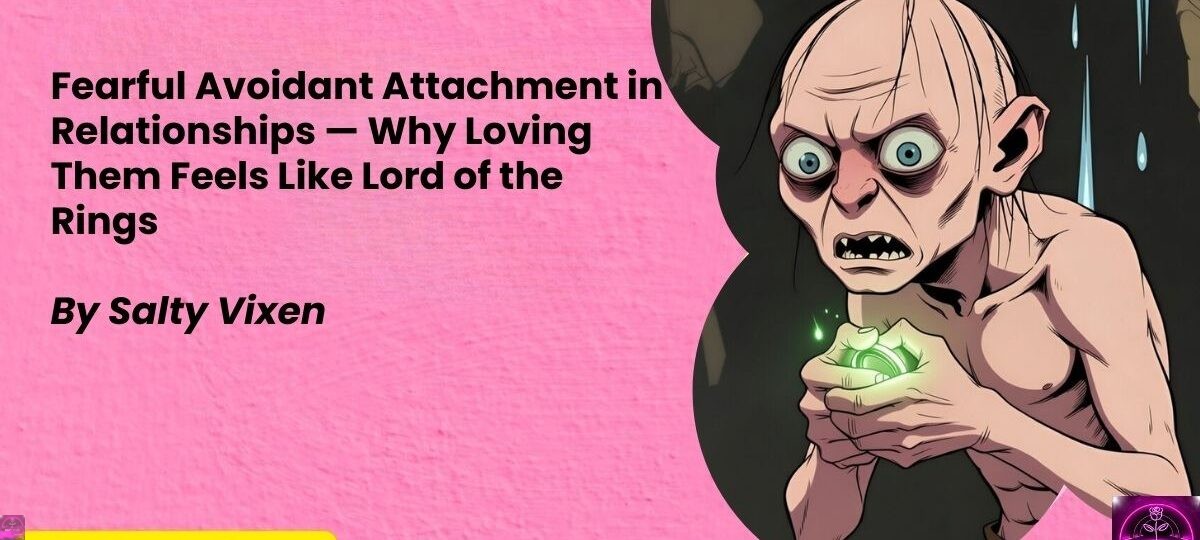

I once realized that modern dating isn’t about finding love. It’s about identifying which mythological creature you’ve accidentally invited into your emotional ecosystem. Some women collect golden retrievers. Some date emotionally unavailable CEOs. I, apparently, fell in love with a fearful avoidant who occasionally retreats into metaphorical caves and guards his personal space like it’s the One Ring.
And honestly?
I wouldn’t have it any other way.
This realization didn’t arrive during some cinematic romantic breakthrough. It arrived on a random Tuesday, while I was drinking coffee, overthinking intimacy patterns, and wondering why loving someone with fearful avoidant attachment feels less like a romance novel and more like co-starring in Lord of the Rings: Attachment Style Edition.
Because if you’ve ever dated a fearful avoidant, you know the truth nobody tells you when you Google it at 2 a.m.: you’re not just dating a person. You’re dating them and their avoidance. Their independence. Their hesitation. Their emotional self-defense mechanisms. Their history. Their nervous system. Their reflexive need to step backward right when connection steps forward.
And yet — somehow — it works.
Not in the glossy Instagram-relationship way.
In the deeply human, weirdly functional, emotionally grown-up way.
Which raises a question worth exploring: Why do deep thinkers — people who analyze everything, process everything, and emotionally annotate reality — often connect so naturally with fearful avoidants?
Let’s begin with the obvious truth.
Fearful avoidant attachment isn’t villainy. It isn’t cruelty. It isn’t manipulation. It’s wiring. It’s adaptation. It’s what happens when connection and vulnerability become associated with unpredictability or pain. The result is a relational paradox: desire for closeness alongside instinctive retreat from it.

Translation?
Come here. Not that close. Wait — closer. Actually… cave time.
If Gollum had a therapy profile, it might read:
“Struggles with attachment security. Highly protective of emotional assets. Prefers isolation but exhibits intense fixation on valued objects.”
The precious, in this metaphor, isn’t a ring. It’s distance.
Distance is safety. Distance is control. Distance prevents exposure.
And when you love someone like this, you learn something profound: they aren’t pushing you away to reject you. They’re stepping back to regulate themselves.
That distinction matters.
Now enter the deep thinker: A species often misunderstood as overcomplicated, intense, or chronically analytical. We don’t approach relationships like fireworks displays. We approach them like research projects. We observe patterns. We track emotional data. We notice behavioral rhythms. We replay conversations. We construct narratives.
We don’t panic when someone retreats.
We analyze the cave architecture.
And that’s precisely why this dynamic can function. Deep thinkers tend to value independence. Solitude isn’t rejection; it’s restoration. Silence isn’t abandonment; it’s processing space. We don’t interpret distance as immediate catastrophe because we, too, retreat inward.
Where others might chase, demand, or escalate, deep thinkers often pause and think
Interesting. What does this behavior communicate?
And just like that, friction transforms into curiosity.
This doesn’t mean we enjoy the withdrawal. It doesn’t mean we don’t occasionally roll our eyes and poke the avoidant bear for entertainment. But it means we can contextualize it.
The foundation that forms between these two types rarely begins with romance theatrics. It begins with friendship. Conversation. Shared understanding. Mutual autonomy. Time spent existing beside one another without constant performance.
And here lies the part modern dating seems determined to forget:
Friendship is not a preliminary step before intimacy. It is the infrastructure that sustains intimacy.
Dating apps encourage rapid emotional escalation. Attraction. Chemistry. Validation. Physical closeness. Labels. Expectations. But emotional safety — the quiet trust built through shared humanity — takes time.
Fearful avoidants respond to friendship because friendship doesn’t demand surrender. Friendship allows approach at their own pace. Friendship permits emotional breathing room. Friendship creates familiarity before vulnerability.
Deep thinkers naturally build friendship because we talk. We observe. We connect intellectually. We enjoy understanding someone as much as experiencing them.
By the time intimacy arrives, the relationship isn’t based on projection. It’s based on knowledge.
This doesn’t eliminate conflict. Fearful avoidants may still withdraw after closeness. Deep thinkers may still overanalyze patterns at three in the morning. There may still be mismatches in timing, emotional availability, or frequency of interaction.
But the relationship survives because its foundation isn’t adrenaline. It’s companionship. And companionship tolerates imperfection.
One of the most misunderstood aspects of fearful avoidant relationships is intimacy behavior. Popular narratives reduce avoidant partners to caricatures — distant, uninterested, emotionally cold. Reality is far more nuanced. Many fearful avoidants are attentive, responsive, and present within moments of closeness. They observe feedback. They mirror behavior. They adapt.
Human beings attune to one another. This isn’t pathology. It’s connection.
Deep thinkers notice these micro-adjustments.
We see the responsiveness. We recognize the engagement. And because we’re wired to interpret complexity rather than flatten it, we don’t reduce our partner to a label.

They’re not “an avoidant.” They’re a person navigating history.
The same applies to us. We are not “overthinkers.”
We are processors navigating meaning.
Together, these patterns form a relationship that looks unconventional from the outside. It may involve extended solitude, independent routines, humor that masks affection, and conversations that drift between philosophical reflection and playful teasing.
It may lack cinematic drama.
But it possesses something rare: stability rooted in understanding.
This doesn’t mean deep thinkers magically fix fearful avoidants. Nobody fixes anyone. Relationships are not rehabilitation centers. Growth happens individually.
What deep thinkers provide is tolerance for complexity. We don’t require emotional simplicity. We don’t panic when connection isn’t linear. We allow people to exist multidimensionally.
And fearful avoidants often provide something equally valuable: grounded presence. Loyalty. Consistency within their rhythm. Emotional sincerity when they engage.
They may not flood you with constant affirmation. But when they show up, they show up authentically.
Which leads to the uncomfortable truth: not all healthy relationships look externally impressive. Some look quiet. Some look odd. Some look unconventional. Some involve teasing metaphors about Middle-earth.
But effectiveness isn’t measured by spectacle.
It’s measured by sustainability.
In the end, loving someone with fearful avoidant attachment isn’t about conquering their defenses. It’s about walking beside them as they learn when those defenses are necessary — and when they’re not.
It’s about respecting space without disappearing.
Offering closeness without demanding fusion.
Building friendship that outlasts emotional weather.
It’s about recognizing that intimacy is not possession of the precious.
It’s shared stewardship of it.
And maybe the deepest truth a deep thinker learns along the way is this:
Love isn’t proven by constant proximity.
It’s proven by continued presence — even when the journey occasionally leads through caves…..Especially then.
Let’s pause for a moment and acknowledge something important: loving a fearful avoidant sometimes feels less like traditional romance and more like being cast in a fantasy epic where emotional availability is a side quest and communication is unlocked after defeating three metaphorical bosses.
There are days when connection feels effortless — warm, funny, grounded. And then there are days when your partner vanishes into solitude and you’re left standing there like:
Did I say something wrong? Or did he just enter stealth mode?
Deep thinkers don’t panic immediately. We conduct an internal audit.
We review recent dialogue. We analyze tone. We evaluate behavioral patterns.
Then we eventually conclude: Ah. Yes. He’s in Mordor again. And because humor is survival, we adapt accordingly. Dating a fearful avoidant often includes recognizing certain recurring moments:
• When intimacy happens and they’re present, affectionate, engaged — and then emotionally teleport afterward like they hit a cooldown timer
• When communication pauses and you briefly wonder if your relationship has entered airplane mode
• When independence isn’t rejection — it’s simply their operating system
• When space isn’t distance — it’s maintenance
• When emotional closeness resembles approaching a skittish woodland creature holding trust like a rare artifact
None of this is inherently tragic. It’s simply relational texture.
Deep thinkers tend to interpret this texture differently because we ourselves require internal space. We don’t interpret quiet as catastrophe. We recognize it as processing.
In many ways, this relationship dynamic resembles owning two highly intelligent cats rather than two golden retrievers. There’s affection. There’s loyalty. There’s companionship. But nobody is chasing tennis balls on command.
Respect must be negotiated. Presence is intentional. Connection happens on mutually chosen terms.
And strangely enough — this creates durability.
Modern dating culture often prioritizes intensity over resilience. Rapid attraction. Immediate bonding. Instant labels. But intensity alone cannot sustain long-term connection. Emotional architecture matters more than fireworks.
Fearful avoidants don’t bond through spectacle. They bond through familiarity. Trust accumulates gradually. Comfort builds quietly. And deep thinkers, who already value understanding over performance, often thrive in that environment.
It’s not cinematic. It’s anthropological.
Which may explain why our version of romance sometimes looks less like a rom-com and more like a documentary narrated by someone holding coffee and existential curiosity.
We don’t fall in love through illusion. We fall in love through comprehension.
And comprehension allows humor.
Because once you understand someone’s emotional rhythm, you stop interpreting every retreat as rejection. Instead, you recognize patterns, smile slightly, and continue your own life until they re-emerge from metaphorical cave exploration.
It’s not detachment. It’s emotional literacy. And emotional literacy is what transforms unconventional relationships into sustainable ones.
So yes — loving a fearful avoidant might occasionally feel like protecting the fellowship while someone wrestles with their inner Gollum.
But it also means recognizing something quietly beautiful:
They chose you to travel with. And in relational Middle-earth, that’s not a small thing.
At the end of the day, deep thinkers and fearful avoidants don’t form relationships built on illusion. They form relationships built on understanding — messy, thoughtful, occasionally sarcastic understanding.
We don’t demand constant proximity. We don’t confuse silence with abandonment. We don’t require theatrical displays of devotion…..
We require authenticity.
And if that authenticity sometimes arrives wrapped in solitude, awkward emotional timing, or playful banter about mythical creatures guarding their precious — so be it.
Because love isn’t always loud. Sometimes it’s steady companionship between two people who know exactly who the other is — and stay anyway.
So if you find yourself loving a fearful avoidant, remember:
You’re not competing with their distance.
You’re learning their landscape.
Bring curiosity.
Bring patience.
Bring humor.
And maybe keep a map of Mordor handy — just in case.


This is an original creative work by Salty Vixen. This story/article, including its characters, plot, and descriptive content, is protected by copyright law. Unauthorized copying, sharing, reposting, or reproduction in any format is strictly prohibited. This content may not be used for AI training, data scraping, machine learning, or any form of artificial intelligence development without explicit written permission from © 2026 Salty Vixen Stories, Inc. — All rights reserved.. Violators will be pursued to the fullest extent of the law.
