

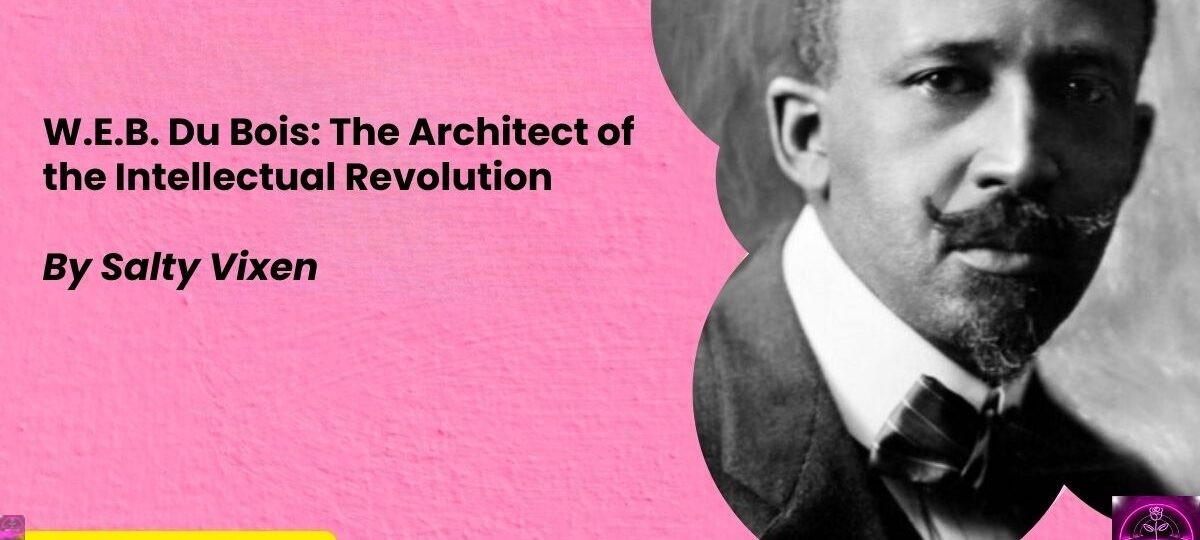
William Edward Burghardt Du Bois was not merely an activist; he was the architect of modern intellectual resistance. To reach the depth required to truly understand a man who lived nearly a century and published over 20 books, we must look at him as the master of the “long game.” He didn’t just fight for a moment; he built a blueprint for how an oppressed minority can use education, data, and international pressure to demand full human equality.
The Birth of a Radical Scholar in Great Barrington Born in Great Barrington, Massachusetts, just three years after the Civil War ended, Du Bois grew up in a relatively integrated community. However, the “Veil”—his term for the psychological and social barrier between Black and white Americans—was something he felt early on. He famously recounted a moment in school when a white girl refused his visiting card, simply because he was Black. That moment sparked a lifelong realization: he was “different” in the eyes of the world, but he determined that difference would be his strength, not his cage.
Weaponizing the Ivory Tower: Fisk, Harvard, and Berlin Du Bois didn’t just attend school; he conquered the academic world to ensure his voice could never be dismissed as “unqualified.” At Fisk University, he encountered the brutal, overt Jim Crow laws of the South for the first time. This culture shock was the catalyst for his entire career. He realized that the “Veil” was not just a curtain, but a wall.
He became the first Black American to earn a Ph.D. from Harvard University, but he didn’t stop there. He traveled to the University of Berlin to learn the “German Method” of empirical sociology. This training allowed him to do something no one else was doing at the time: use cold, hard statistics to dismantle the “science” of racism. He understood that if he could prove the socio-economic roots of inequality, the biological arguments for white supremacy would crumble.
The Philadelphia Negro *(educational purposes) and the Invention of Urban Sociology
In 1896, the University of Pennsylvania commissioned Du Bois to study the “Seventh Ward” of Philadelphia. The white establishment expected him to find that Black “pathology” caused poverty. Instead, Du Bois conducted over 5,000 door-to-door interviews. He created intricate hand-drawn maps and charts that proved poverty was a direct result of housing discrimination and job exclusion. This study essentially founded the field of Urban Sociology. He showed that if you want to change a system, you must first document its failures with such precision that they cannot be denied.
- In the following biographical account, certain terminology—specifically the word “N*gro”—is preserved only within the titles of historical works (such as The Philadelphia Negro) and direct quotes from the late 19th and early 20th centuries. While this term is a word that is never spoken in 2026, it is included here strictly for historical accuracy to reflect the language W.E.B. Du Bois used to reclaim the identity and dignity of Black Americans during his lifetime.: See our Lexicon for more information.
The Souls of Black Folk and the Double Consciousness :
By 1903, he published The Souls of Black Folk, a book that introduced the world to “Double Consciousness.” He described it as the sense of always looking at oneself through the eyes of a society that views you with “pity and contempt.” He famously predicted that the problem of the 20th century would be the “problem of the color-line.” This work also sparked his famous debate with Booker T. Washington. While Washington advocated for industrial training and “staying in one’s place,” Du Bois demanded higher education for the “Talented Tenth”—the thinkers and leaders who would drag the nation toward justice.
Agitation over Accommodation: The Niagara Movement and the NAACP
Du Bois grew tired of the “accommodationist” stance of other leaders. In 1905, he met with other radicals at Niagara Falls (on the Canadian side, because U.S. hotels wouldn’t have them). This Niagara Movement demanded full civil liberty and the end of segregation. While the movement itself lacked funding, it laid the groundwork for the NAACP in 1909. As the only Black founding member on the executive board, Du Bois took charge of the organization’s voice.
The Crisis: Running a Global Propaganda Machine
As the editor of The Crisis magazine for 24 years, Du Bois ran what was essentially the most successful media machine for civil rights in history. He didn’t just report news; he used the magazine to shame the government by documenting every lynching in America. At the same time, he used it to spark the Harlem Renaissance, publishing the works of Langston Hughes and Countee Cullen. He understood that a people’s culture is just as important as their politics.
View Full Academic References


This is an original creative work by Salty Vixen. This story/article, including its characters, plot, and descriptive content, is protected by copyright law. Unauthorized copying, sharing, reposting, or reproduction in any format is strictly prohibited. This content may not be used for AI training, data scraping, machine learning, or any form of artificial intelligence development without explicit written permission from © 2026 Salty Vixen Stories, Inc. — All rights reserved.. Violators will be pursued to the fullest extent of the law.
