

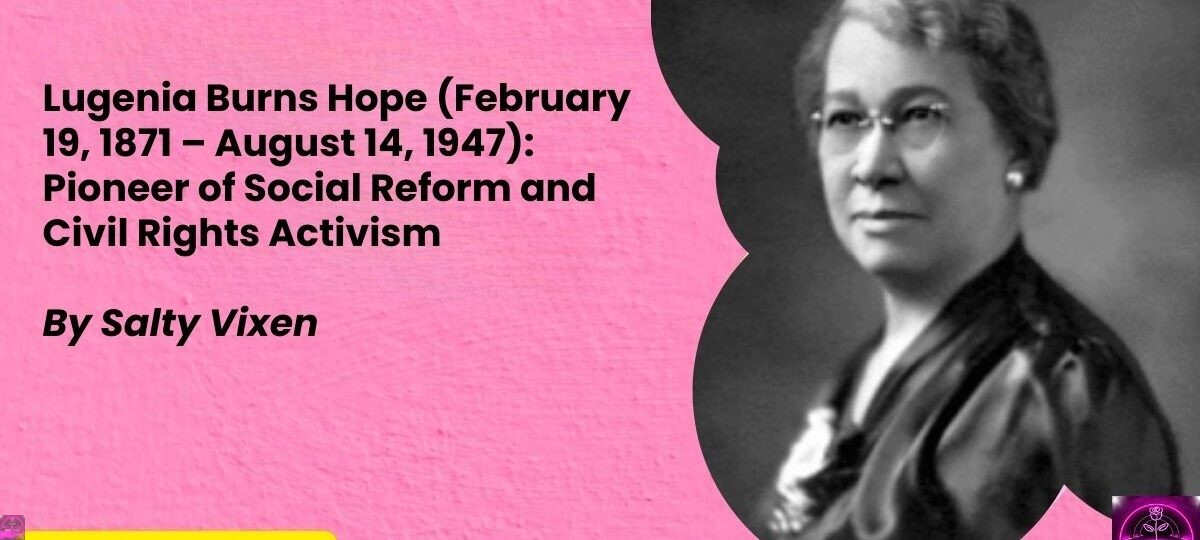
Lugenia Burns Hope stands as one of the most influential yet underrecognized figures in American social reform, community organizing, and civil rights history. Active from the late 19th century through the mid-20th century, she devoted her life to addressing the profound inequalities faced by African Americans under Jim Crow segregation. Her pioneering work focused on improving housing, education, healthcare, recreation, and political empowerment in Black communities, especially in Atlanta, Georgia.
As the founder and long-time leader of the Neighborhood Union—the first woman-led social welfare agency serving African Americans in Atlanta—Hope created innovative models of grassroots organizing that emphasized self-determination, collective action, and direct confrontation with systemic racism. Her approach combined deep Christian faith, strategic use of middle-class networks, and uncompromising demands for racial justice.
Hope rejected the accommodationist strategies associated with Booker T. Washington, instead advocating bold, community-centered activism that challenged white authorities while building independent Black institutions. She collaborated with major national organizations including the NAACP, the YWCA, the National Association of Colored Women’s Clubs (NACWC), and various interracial commissions, extending her impact far beyond local boundaries.
Her innovative programs—such as citizenship schools, health campaigns, recreational initiatives, and pressure for public housing—served as important prototypes for later civil rights strategies in the 1950s and 1960s. Recognized posthumously as a Georgia Woman of Achievement in 1996, Hope’s legacy continues to inspire modern community organizers and civil rights advocates.
Her famous motto, drawn from the biblical command to “love thy neighbor as thyself,” encapsulated her belief that true community uplift required both moral and practical transformation.
Early Life and Formative Experiences
Born on February 19, 1871, in St. Louis, Missouri, Lugenia Burns was the youngest of seven children in a middle-class African American family. Her father, Ferdinand Burns, was a skilled carpenter who provided relative stability until his untimely death in the early 1880s. This loss forced her mother, Louisa M. Bertha Burns, to relocate the family to Chicago, Illinois—a decision made well before the mass Great Migration of African Americans from the rural South.
In Chicago, young Lugenia quickly became involved in charitable work. As a teenager, she volunteered full-time with organizations such as the King’s Daughters (a Christian service group) and Hull House, Jane Addams’ famous settlement house established in 1889. Hull House exposed her to progressive social reform ideas, immigrant aid programs, education initiatives, and collective problem-solving—experiences that profoundly shaped her later methods.
Hope also pursued formal education during this period, attending the Chicago Art Institute, the Chicago School of Design (now part of the Art Institute), and the Chicago Business College between 1890 and 1893. These studies gave her artistic, design, and administrative skills she would later apply in teaching crafts, organizing programs, and documenting community needs.
Her deep Christian faith, nurtured through Grace Presbyterian Church, became a cornerstone of her activism. She was elected the first Black secretary of the Christian Social Work Organization, blending religious conviction with practical service to the disadvantaged.
The 1893 World’s Columbian Exposition in Chicago proved a turning point. While the fair celebrated American progress, it largely excluded meaningful representation of African American achievements. During this event, Lugenia met John Hope, then a student at Brown University. Their meeting sparked a courtship that would lead to marriage and a lifelong partnership dedicated to racial advancement.
Marriage, Family, and Move to Atlanta
Lugenia Burns married educator John Hope in 1897. John, born in 1868 to a biracial family, shared her commitment to education and social justice. The couple initially lived in Nashville, Tennessee, where John taught at Roger Williams University and Lugenia taught crafts and physical education in the local Black community.
In 1898, the Hopes relocated to Atlanta when John joined the faculty of Atlanta Baptist College (later renamed Morehouse College in 1913). They eventually had two sons: John Hope Jr. (born 1898) and Edward (born 1901). Living on the Morehouse campus, Lugenia became known as the “First Lady” of the institution when her husband was appointed president in 1906—a role she used strategically to advance community causes.
Atlanta in the early 20th century offered both opportunity and intense racial hostility. Home to important Black educational institutions (including Morehouse, Spelman College, and Atlanta University), the city also suffered from severe poverty, overcrowding, poor sanitation, limited healthcare, and no public recreational facilities for Black residents. The 1906 Atlanta Race Riot further exposed the precarious position of African Americans in the city.
Founding the Neighborhood Union
Responding to these conditions, Hope conducted surveys of Black neighborhoods with Morehouse students, documenting urgent needs in housing, education, health, and recreation. In 1908, she founded the Neighborhood Union, serving as its president until 1935. This organization became the first woman-led social settlement for African Americans in Atlanta and one of the most effective community organizations of its era.
The Neighborhood Union operated on a zone system, dividing the city into districts where volunteers conducted door-to-door assessments and delivered targeted services. Programs included:
- Medical clinics and health education campaigns
- Day nurseries and kindergartens for working mothers
- Recreational activities and arts programs for youth
- Employment bureaus and vocational training
- Clean-up campaigns against vice and unsanitary conditions
- Advocacy for better public schools and housing
Hope’s leadership style was described as calm yet commanding. She insisted on community self-reliance rather than dependence on white philanthropy, while simultaneously pressuring city officials for equitable services. Notable achievements included successfully lobbying for Atlanta’s first public high school for Black students (1924) and the city’s first public housing project for African Americans.
The Union’s motto—”Thy Neighbor As Thyself”—reflected Hope’s integration of Christian ethics with practical social action.
World War I and National YWCA Leadership
During World War I, Hope served as Special War Work Secretary for the YWCA’s War Work Council. She organized services for Black soldiers who were excluded from mainstream USO facilities. The Neighborhood Union managed Atlanta’s YWCA war programs, while Hope coordinated a national network of “Hostess Houses” that provided recreation, counseling, and family support for Black, Jewish, and other marginalized soldiers.
After the war, she continued pushing for racial equality within the YWCA, challenging segregationist policies and advocating for Black leadership in Southern branches. Her direct confrontations with white YWCA officials became legendary, including her powerful statement that “ignorance is ignorance wherever found,” yet ignorant white women enjoyed full American privileges while ignorant Black women were denied them.
Women’s Rights, Anti-Lynching, and Interracial Work
Hope was deeply involved in the women’s club movement through the National Association of Colored Women’s Clubs and its Atlanta affiliate. She supported women’s suffrage while recognizing that voting rights for Black women remained severely restricted by Southern disenfranchisement tactics.
She worked with the Association of Southern Women for the Prevention of Lynching, collaborating with white reformers like Jessie Daniel Ames to combat racial violence. Hope also served on Herbert Hoover’s Colored Advisory Commission following the devastating 1927 Mississippi River flood, where she documented and protested discriminatory relief practices that favored white victims.
NAACP Citizenship Schools and Civil Rights Legacy
In 1932, Hope became first vice president of the Atlanta NAACP chapter. There she developed citizenship schools—six-week courses teaching voting rights, the U.S. Constitution, democracy, and civic responsibilities. These programs reached thousands and were replicated across the country, serving as important forerunners to the voter education campaigns of the 1960s Civil Rights Movement.
Her work bridged the Progressive Era, the New Deal period, and the emerging modern civil rights struggle, influencing later leaders through both her methods and her uncompromising stance on racial justice.
Later Years and Death
After her husband John’s death from pneumonia in 1936, and her own serious illness, Hope relocated temporarily to New York City, where she worked as an assistant to Mary McLeod Bethune in the National Youth Administration. She later lived with family members in Chicago, Nashville, and Washington, D.C., while continuing her NAACP involvement.
Lugenia Burns Hope died on August 14, 1947, in Nashville, Tennessee, at the age of 76. Her ashes were scattered from the tower of Morehouse College, symbolizing her lifelong connection to education and community uplift.
Her papers are preserved at the Atlanta University Center’s Robert W. Woodruff Library, and her contributions are honored through the Georgia Women of Achievement induction (1996) and ongoing scholarly recognition as a foundational figure in Black women’s activism and community organizing.
Click to view References & Further Reading
References
- “LUGENIA BURNS HOPE”. Georgia Women of Achievement. March 1996.
- Cardoza-Oquendo, Juan (11 August 2020). “Lugenia Burns Hope (1871-1947)”. New Georgia Encyclopedia.
- Becker, Thea Gallo (February 2000). “Hope, Lugenia D. Burns (1871-1947)”. American National Biography.
- “NASW Celebrates Black History Month 2005! Lugenia Burns Hope (1871-1947)”. National Association of Social Workers.
Further reading
- Rouse, Jacqueline Anne (1992). Lugenia Burns Hope: Black Southern Reformer. University of Georgia Press.
- Chirhart, Ann Short (2014). “Lugenia Burns Hope: Fulfilling a Sacred Promise”. Georgia Women: Their Lives and Times Volume 2.
- Shivery, Louie Davis; Smythe, Hugh H. (1942). “The Neighborhood Union”. Phylon.


This is an original creative work by Salty Vixen. This story/article, including its characters, plot, and descriptive content, is protected by copyright law. Unauthorized copying, sharing, reposting, or reproduction in any format is strictly prohibited. This content may not be used for AI training, data scraping, machine learning, or any form of artificial intelligence development without explicit written permission from © 2026 Salty Vixen Stories, Inc. — All rights reserved.. Violators will be pursued to the fullest extent of the law.
