
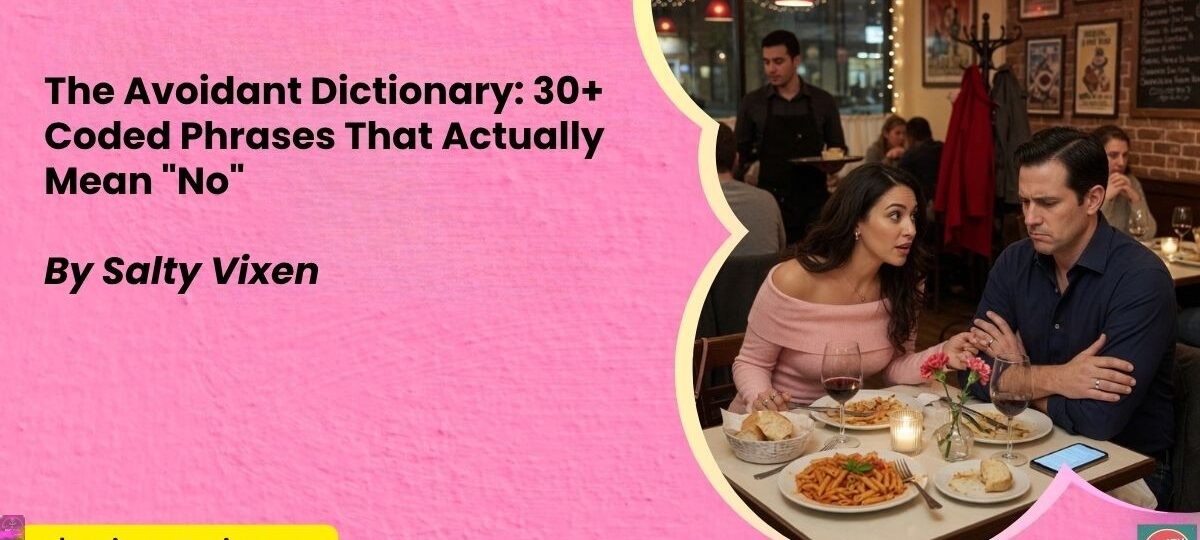
Have you ever walked away from a conversation feeling like you just agreed to something, only to realize later that you have no idea when—or if—it’s actually happening?
In the world of psychology and relationship dynamics, this is known as Deactivating Communication. For those with an Avoidant Attachment Style, saying a direct “no” can feel like a life-threatening vulnerability. Instead, they use a sophisticated set of linguistic “smoke bombs” to create distance while maintaining a facade of politeness.
This guide decodes the secret language of avoidant attachment, helping you spot a “no” before you spend weeks waiting for a “yes.”
1. Why Can’t They Just Say No?
Before we dive into the phrases, we have to understand the “why.” Avoidant individuals aren’t necessarily trying to be manipulative. Most of the time, they are practicing emotional self-preservation.
The Fear of Enmeshment: A direct “no” often leads to a “why not?” conversation. To an avoidant, that feels like an interrogation or an attempt to control them.
Conflict Phobia: Many grew up in environments where expressing a boundary resulted in emotional outbursts or shaming. “Maybe” feels safer than “No.”
The Autonomy Shield: By remaining vague, they keep the exit door cracked open.
2. The “Stall & Delay” Category
These are the most common phrases. They sound like logistics, but they are actually about buying time until the request expires.
“Let’s play it by ear.” (The gold standard of avoidant non-commitment.)
“I need to check my calendar.” (Translation: I’m checking to see if I can find an excuse.)
“Let’s touch base closer to the date.”
“I’m just not sure what my energy levels will be like then.”
“Can we talk about this when things are less ‘crazy’?”
“I’ll let you know.” (Usually, they won’t.)
“We’ll see.” (As we discussed, this is almost always a ‘no’ in disguise.)
“I’m still processing everything.”
“Let’s keep it spontaneous.”
3. The “Self-Sabotage” Refusal
These phrases frame the “no” as a personal defect, making it nearly impossible for the other person to push back without feeling like a “bully.”
“I’m just such a flake right now, you shouldn’t count on me.”
“I don’t want to hold you back from having a better time.”
“I’m in a really weird headspace.”
“I’m not good for anyone right now.”
“You deserve someone who can be 100% present.”
“I’m just a lone wolf by nature.”
“I tend to ruin things when they get too serious.”
“I’m not capable of giving you what you need.”
4. The “Intellectualized” Boundary
Avoidants are masters of using logic to mask emotional withdrawal. These phrases make the “no” sound like a rational, objective decision.
“It’s just not logical to plan that far ahead.”
“I think we’re moving a bit too fast, don’t you?”
“I need to focus on my career/health/goals right now.”
“Labeling things just complicates what we have.”
“I’ve always valued my independence over everything.”
“I don’t believe in ‘smothering’ each other.”
“We have different definitions of what ‘closeness’ looks like.”
5. The “Deflection” Tactics
When pressed for an answer, an avoidant person may turn the tables to make you the problem.
“Why are you so obsessed with a timeline?”
“You’re overthinking this again.”
“You’re being a bit needy/suffocating.”
“Can’t we just enjoy the moment?”
“I feel like I’m being interrogated.”
“You’re making a mountain out of a molehill.”
6. Spotting the “Silent No”
Sometimes, the “phrase” isn’t a word at all. In SEO terms, “Avoidant Ghosting” and “The Slow Fade” are high-intent behaviors.
The Digital Retreat: Leaving texts on read for 48+ hours when a request for commitment is made.
The Pivot: You ask about a weekend trip; they respond by sending a meme or talking about work.
The “Suddenly Busy”: A sudden influx of “work emergencies” or “family obligations” that only appear when intimacy increases.
7. How to Respond (Without Losing Your Mind)
If you are dealing with an avoidant partner or friend, stop looking for the “Yes” and start looking for the Lack of a “Yes.”
Use the “Soft Landing” Technique
Avoidants respond best when they don’t feel trapped. Instead of demanding a “Yes” or “No,” try:
“I’d love for you to come, but if you’re not feeling it, I totally get it. I’m going to make my plans by Tuesday, so let me know by then—otherwise, I’ll assume it’s a no this time!”
The Rule of Three
If you hear “We’ll see” or “Let’s play it by ear” three times in a row for the same topic, it is a “No.” Save your emotional energy and stop asking.
Conclusion: Value the Truth over the “Maybe”
The “Avoidant Dictionary” is a tool for clarity. While it can be painful to realize that “We’ll see” actually means “I’m not coming,” that realization is your ticket to freedom. You can stop waiting and start living.
Key Takeaway: In an avoidant relationship, ambiguity is a choice. If they wanted to say “Yes,” they would find a way to make it clear.


This is an original creative work by Salty Vixen. This story/article, including its characters, plot, and descriptive content, is protected by copyright law. Unauthorized copying, sharing, reposting, or reproduction in any format is strictly prohibited. This content may not be used for AI training, data scraping, machine learning, or any form of artificial intelligence development without explicit written permission from Salty Vixen Publishing LLC. Violators will be pursued to the fullest extent of the law.
