

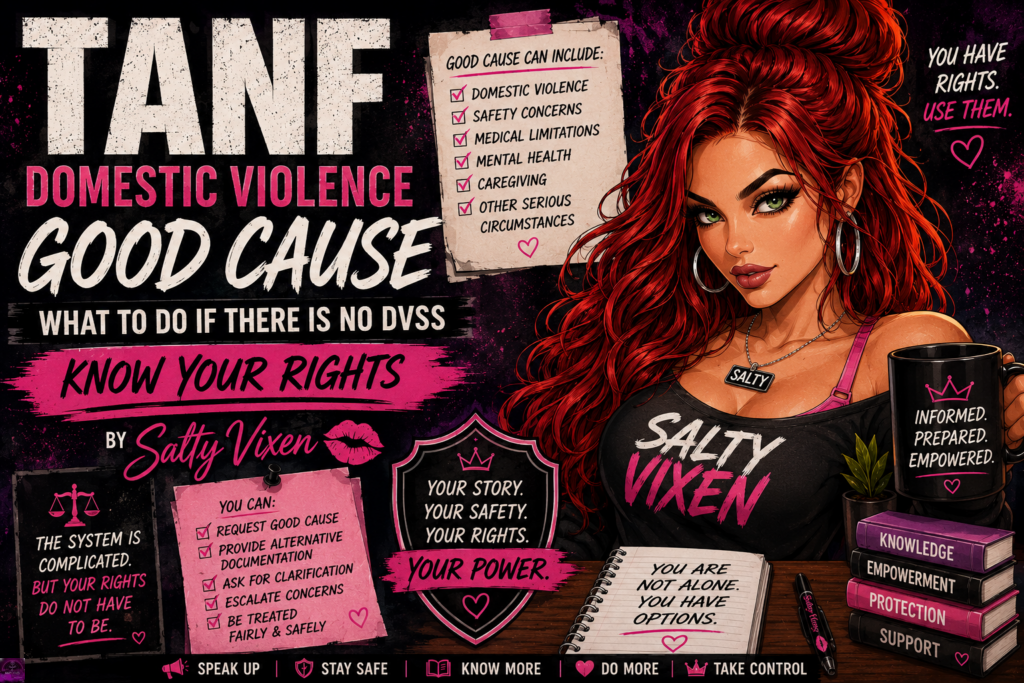
Most people on TANF don’t even know “good cause” exists—until they’re in a situation where they physically, emotionally, or safely can’t comply with the standard requirements.
And by the time they hear about it?
They’re already overwhelmed, confused, and stuck in a process that doesn’t match real life.
This article is here to fix that.
Because if you’re dealing with domestic violence (DV), safety concerns, or real limitations—and you’re being told to “just follow the program”—you need to understand one thing:
👉 You have rights under TANF policy.
👉 And “good cause” is one of the most important protections available.
@saltyvixenofficial I am on TANF: Know your rights for DV Good Cause #tanf #snap ♬ original sound – Salty Vixen
# What Is “Good Cause” in TANF?
“Good cause” is a provision within TANF that allows requirements—especially work participation requirements—to be adjusted, paused, or exempted when a person is facing circumstances that make compliance unreasonable or unsafe.
This includes, but is not limited to:
– Domestic violence (DV)
– Risk of harm from a partner or ex-partner
– Physical or medical limitations
– Mental health concerns
– Caregiving responsibilities (especially for minors)
In plain terms:
👉 Good cause exists so you are not forced to choose between compliance and your safety.
—
# Why Domestic Violence Qualifies
Domestic violence isn’t always physical—and it doesn’t end just because a relationship ends.
Many TANF participants are navigating:
– Ongoing intimidation or control
– Legal situations (custody, child support, etc.)
– Safety concerns involving children
– Emotional or psychological harm
– Fear of escalation if routines become predictable
Because of this, TANF policy recognizes DV as a valid reason to modify or exempt participation requirements.
—
# The Problem No One Explains: The DV Assessor Requirement
Here’s where things start to break down in real life.
In many TANF programs, DV-related good cause is supposed to be processed through:
👉 A Domestic Violence (DV) assessment
👉 Often completed by a trained DV specialist or assessor
That sounds reasonable—until you run into the reality:
👉 What happens when there is no DV assessor available?
—
# When the System Doesn’t Match Reality
In some counties and regions, DV assessors:
– Are not consistently available
– Rotate in and out
– Or no longer exist as an active role
This creates a serious gap. Because the system expects:
👉 Assessment → Approval → Case Adjustment
But if the assessment step can’t happen, the case can stall.
—
# What the Policy Actually Allows
Here’s the key point most people miss:
👉 TANF policy does NOT require cases to remain stuck if an assessor is unavailable.
Instead, alternative methods can be used.
These may include:
– Personal statements
– Police reports (if available)
– Documentation from shelters or advocates
– Written statements from:
– family
– friends
– neighbors
– Prior case notes or history
– Any credible supporting documentation
—
👉 In other words:
👉 The absence of a DV assessor does NOT eliminate your right to claim good cause.
—
# Why Cases Get Stuck Anyway
If the policy allows flexibility, why do so many cases stall?
Because there’s a difference between:
👉 Policy
👉 Practice
Caseworkers:
– Follow procedures they’ve been trained on
– May not have updated guidance
– Often rely on supervisors for exceptions
And when something falls outside the usual workflow?
👉 It gets escalated.
—
# The Escalation Phase (What It Really Means)
If your case goes to “review” or a “meeting,” it does NOT automatically mean:
– You’re in trouble
– You’re being accused of anything
– You did something wrong
It usually means:
👉 Your case doesn’t fit neatly into a checklist, so they need to decide how to process it correctly.
—
# How to Claim Good Cause for Domestic Violence (Step-by-Step)
If you’re in this situation, here’s how to approach it strategically:
—
## Step 1: Clearly State Your Situation
You don’t need a perfect explanation.
You need a clear and honest one:
👉 “I am requesting good cause due to domestic violence and safety concerns.”
—
## Step 2: Provide What You CAN (Not What You Don’t Have)
You do NOT need:
– perfect paperwork
– a signed assessment (if unavailable)
You CAN provide:
– written statements
– supporting context
– any documentation you already have
—
## Step 3: Ask for Clarification (Not Permission)
Instead of saying:
❌ “What should I do?”
Say:
👉 “If a DV assessor is not available, how should my documentation be processed under good cause?”
—
## Step 4: Stay Cooperative—but Clear
You can say:
👉 “I am willing to comply with program requirements within my physical and safety limitations.”
That shows:
– willingness ✔️
– reasonableness ✔️
– credibility ✔️
—
## Step 5: Escalate If Necessary
If your case is stuck:
👉 You are allowed to escalate.
This can include:
– requesting supervisor review
– contacting regional or state offices
– asking for clarification of policy application
—
# What About Work Requirements?
One of the biggest concerns is:
👉 “Do I still have to do the TANF work program?”
—
## The answer: It depends on your case status
With approved or pending good cause:
– Requirements may be reduced
– Requirements may be modified (ex: virtual participation)
– Requirements may be temporarily paused
—
👉 The key is this:
👉 You should not be forced into participation that creates risk or violates your limitations.
—
# Real-World Example (What This Looks Like)
Let’s simplify it.
You have:
– DV flagged in your case ✔️
– No DV assessor available ❌
– Physical limitations ✔️
– Care responsibilities ✔️
—
Instead of:
👉 forcing compliance
The system should:
👉 identify a reasonable path forward
That might include:
– accepting documentation
– adjusting participation
– allowing temporary flexibility
—
# Common Problems (And What They Actually Mean)
### “We need an assessment”
👉 They’re following standard procedure—not necessarily recognizing the gap
—
### “We’re reviewing your case”
👉 Your situation requires a decision beyond basic processing
—
### “We’ll discuss this in a meeting”
👉 Multiple people are determining the correct policy application
—
### “Submit updated documentation”
👉 They need something current—not necessarily something new
—
# Your Rights as a TANF Participant
You have the right to:
– Request good cause ✔️
– Provide alternative documentation ✔️
– Ask for clarification ✔️
– Escalate concerns ✔️
– Be treated with fairness and consistency ✔️
—
👉 And most importantly:
👉 You have the right to be safe while participating in any program.
—
# Why This Matters More Than People Think
Most people assume:
👉 “If the system says it, it must be right.”
But the reality is:
👉 Systems are only as effective as how they’re applied.
—
And when:
– policies change
– roles disappear (like DV assessors)
– guidance isn’t updated
—
👉 The burden often falls on the individual to ask questions.
—
# Media & Public Discussion on SNAP/TANF Challenges
Public discussions about SNAP and assistance programs have highlighted similar issues:
– access gaps
– administrative delays
– misunderstanding of eligibility and rights
You can view broader discussion here:
👉 CNN coverage on SNAP and economic challenges:
https://www.cnn.com
👉 Public policy discussions involving assistance programs:
https://www.congress.gov
—
These discussions reinforce one thing:
👉 The system is complex—and many people don’t fully understand their options within it.
—
# Final Thoughts
If you take one thing from this article, let it be this:
👉 The rules exist to protect you—but you may need to understand them to use them.
—
Good cause is not a loophole.
It’s not a shortcut.
It’s not “getting out of something.”
—
👉 It’s a safeguard.
—
And if your situation:
– involves safety
– involves limitations
– doesn’t fit a perfect checklist
—
👉 then the system is supposed to adjust—not force you into something that doesn’t work.
—
# Final Line
👉 “The policy allows flexibility—but knowing how to use it is where the real power is.”
—
*Disclaimer: This article is for informational purposes only and does not constitute legal advice. Policies may vary by state. Always confirm with your local agency for official
Article is also published on : https://medium.com/the-deep-thinkers-dossier/tanf-domestic-violence-good-cause-what-to-do-if-theres-no-dv-assessor-know-your-rights-c16e634db2e9


This is an original creative work by Salty Vixen. This story/article, including its characters, plot, and descriptive content, is protected by copyright law. Unauthorized copying, sharing, reposting, or reproduction in any format is strictly prohibited. This content may not be used for AI training, data scraping, machine learning, or any form of artificial intelligence development without explicit written permission from Salty Vixen Publishing LLC. Violators will be pursued to the fullest extent of the law.
