

I saw the link you dropped in my comments.You read my piece about post-sex avoidance — that moment when the sheets are still warm but the person beside you has already emotionally left the building — and you thought, This needs the other side. So you sent me an article about what happens when one person becomes “too emotionally focused.”
I read it. I smiled. And then I laughed that low, knowing laugh because you had it almost right… but not quite.
Let me tell you the real story. I am not the emotionally focused one in these dynamics.
I’m the avoidant. And so is my boyfriend.
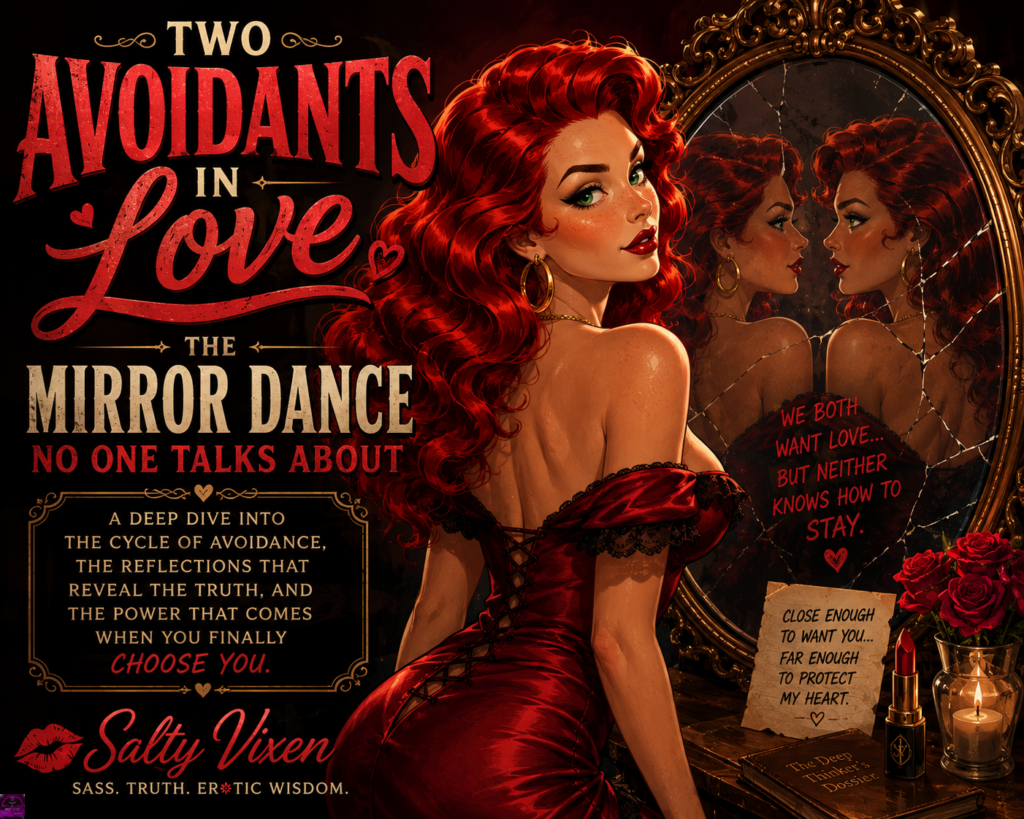
We are two avoidants in a relationship, staring into the most intoxicating, exhausting mirror imaginable. We get attached — deeply, fiercely, almost violently attached. But the moment one of us leans in, the other turns into a full opossum: freezes, plays dead, and hopes the intensity of feeling will just wander off into the night. No yelling. No dramatic exit. Just a quiet, elegant shutdown while the nervous system waves a white flag.
This is our dance. And it’s the one no one talks about on the internet.
The Mirror We Can’t Look Away From
Most attachment theory content loves the classic anxious-avoidant trap: one person chases, the other runs. But what happens when both people are wired to run?
You get us.
We have the kind of sex that feels like mutual surrender — raw, electric, soul-level. In those moments there is no distance. There is only skin, breath, and the terrifying pleasure of being truly seen. Then the afterglow settles. One of us feels the attachment bloom and naturally drifts toward closeness. The other immediately plays opossum. Polite smile. Flat tone. Sudden, intense fascination with anything that is not the emotional weight of what just happened.
I’ve been on both sides of that mirror. I’ve been the one reaching. I’ve been the one freezing. I’ve watched my boyfriend do the exact same thing. We trigger each other with surgical precision. We also understand each other in a way that feels rare and precious. Two avoidants loving each other is its own art form — equal parts magnetic pull and quiet mutual retreat.
Neurodivergent Pattern Thinker in Love
I’m also neurodivergent. A ruthless pattern thinker.
My brain doesn’t do soft, anxious emotional monitoring. It does forensic-level analysis. I love getting into people’s heads. I study the micro-shifts: the exact second the tone changes after orgasm, the subtle withdrawal in eye contact, the polite sentence that replaced the dirty one from ten minutes earlier. I map the entire behavioral algorithm because patterns are safe. Patterns are predictable. Patterns don’t require me to sit in the raw terror of “what if you see all of me and stay?”
This is where a lot of readers misread me.
When I write about these dynamics with such detail, people assume I’m the hyper-focused, anxiously attached one. I’m not. I’m the avoidant who analyzes so thoroughly that it can feel like focus. But it’s intellectual hunger, not emotional hunger. I’m not scanning because I’m afraid you’ll leave. I’m scanning because my brain is wired to decode systems, predict outcomes, and protect me from overwhelm.
And yes — I know it can annoy people. Once I see the pattern, I can’t unsee it. I will quietly name it. I will gently point out the shift. I will explore it from six different angles because that’s how I process intimacy. My boyfriend has learned to live with it. Sometimes he teases me about it. Sometimes he gives me the look that says, Baby, you’re doing the pattern thing again.
We both do it. We mirror it. We annoy each other with it. We also respect it.
What the Internet Gets Wrong
Most articles about avoidants paint us as cold, uninterested, or emotionally unavailable. The truth is more complicated. We feel everything. We just regulate through distance instead of closeness.
When my boyfriend goes opossum, I don’t chase him with “are we okay?” texts. I give him the space to thaw. When I disappear into my head after mind-blowing sex, he doesn’t take it personally. He knows I’m not rejecting him — I’m recalibrating so I can come back fully present.
This is the quiet beauty of two avoidants who are securely attached to each other, even if our nervous systems still scream at too much closeness. We have learned (slowly, sometimes painfully) not to force an anxious-avoidant script onto our dynamic. We are writing our own rules.
We still want the sex — the kind that leaves marks on the sheets and echoes in the soul. We still want the attachment. We just need it served with generous portions of space, intellectual depth, and zero pressure to perform constant emotional availability.
The Pattern Obsession That Keeps Us Safe
My neurodivergence makes me a professional head-diver. I don’t just notice patterns — I fall in love with understanding them. That same trait that makes me a sharp writer also makes me a challenging partner. I will analyze your withdrawal so gently and thoroughly that you suddenly feel seen in a way that’s both thrilling and slightly exposing.
My boyfriend tolerates it because he does the same thing. We annoy each other with insight. We also heal each other with it.
Because here’s what I’ve learned: an avoidant who is also a pattern thinker doesn’t need to become less avoidant. She needs a partner who can handle the depth of her analysis without feeling interrogated. She needs someone who understands that her silence after intimacy isn’t disinterest — it’s processing at full capacity. That her opossum moments aren’t rejection — they’re regulation.
To the Reader Who Sent the Link
Thank you.
Truly.
You saw my piece and wanted to offer the missing half. I appreciate it more than you know. But I’m not the pursuer in this story. I’m one half of an avoidant mirror — pattern-obsessed, head-diving, opossum-playing, deeply attached, and completely unapologetic about any of it.
I write these articles because I’m living them. Because the version of me that always leaves first — elegantly, mysteriously, with excellent prose — finally decided to stay and examine the pattern instead.
If you’re in a relationship with an avoidant (or you are the avoidant), know this: the dance doesn’t have to be destructive. Two avoidants can build something powerful when they stop trying to fix each other and start understanding the mirror they’re looking into.
We get attached. We freeze. We analyze. We annoy. We retreat. We return.
And sometimes, in the space between the freeze and the return, we find something that feels a lot like secure love — just wrapped in nervous systems that need extra room to breathe.
Now if you’ll excuse me, I have more patterns to decode, another article to write, and a boyfriend who knows exactly when to let me play opossum… and when to gently coax me back to life.
Stay Salty, Salty Vixen


This is an original creative work by Salty Vixen. This story/article, including its characters, plot, and descriptive content, is protected by copyright law. Unauthorized copying, sharing, reposting, or reproduction in any format is strictly prohibited. This content may not be used for AI training, data scraping, machine learning, or any form of artificial intelligence development without explicit written permission from Salty Vixen Publishing LLC. Violators will be pursued to the fullest extent of the law.
