
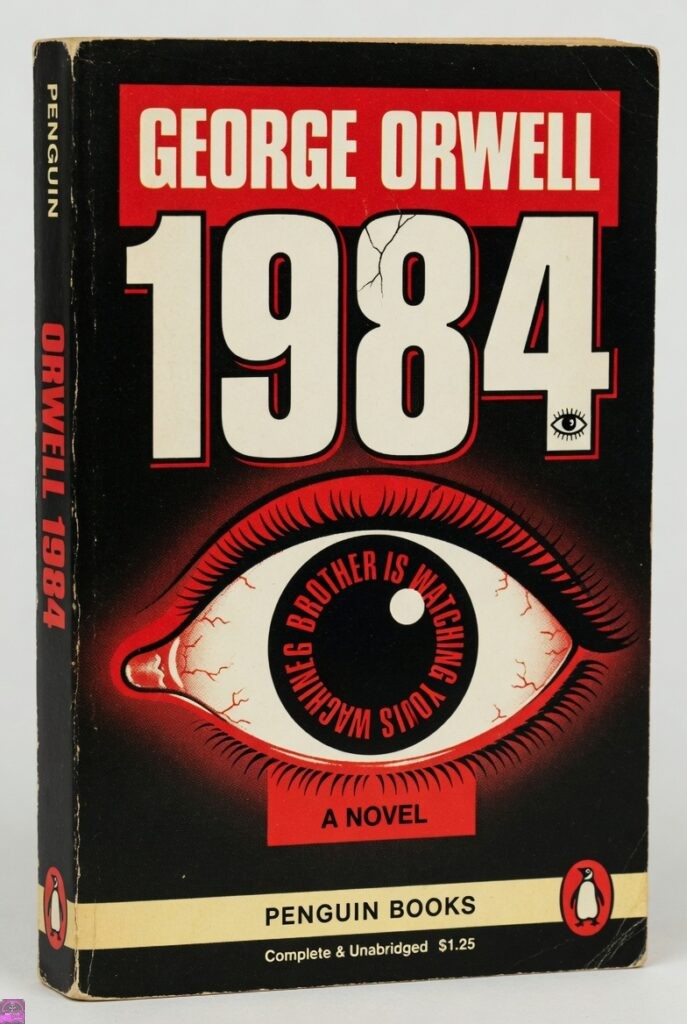
1984 Questions and Answers
Study Guide & Discussion Questions for George Orwell’s Dystopian Novel
Updated 2026 Edition
Click on each question below to reveal the answer ▼
What is important about the title of 1984?
The title “1984” is deliberately close to the year the book was written (1948). Orwell wanted readers to feel the future he described was not far away. By titling it 1984, he warned that totalitarianism could arrive in the near future if humanity was not careful.
What are the conflicts in 1984? What types of conflict are in this novel?
The main conflicts are Man vs. Society and Man vs. Himself. Winston struggles against the oppressive Party (external) and his own fear and doubt (internal). There is also moral conflict as he questions what is right in a world where truth is constantly rewritten.
How does George Orwell reveal character in 1984?
Orwell reveals character through Winston’s inner thoughts, his diary entries, his conversations with Julia and O’Brien, and his actions under extreme pressure. We see his development from quiet rebellion to total breakdown.
What are some themes in the story? How do they relate to the plot and characters?
Major themes include totalitarianism, surveillance, the destruction of truth, language as power (Newspeak), and the loss of individuality. These themes drive the plot and are embodied in Winston’s struggle against the Party.
What are some symbols in 1984? How do they relate to the plot and characters?
Key symbols include the glass paperweight (the past), Room 101 (ultimate fear), Big Brother’s face (surveillance), and the red sash Julia wears (suppressed sexuality and rebellion).
Is Winston consistent in his actions? Is he a fully developed character?
Winston is consistent in his hatred of the Party but inconsistent in his courage. He is a fully developed, complex character — flawed, fearful, intellectual, and ultimately broken — making him very human and relatable.
Do you find the characters likable? Would you want to meet them?
Winston and Julia are somewhat likable in their rebellion, but deeply flawed. O’Brien is fascinating but terrifying. Most readers would not want to meet any of them in the world of Oceania.
Does the story end the way you expected? How? Why?
The ending is deliberately bleak and shocking. Most readers do not expect Winston to be completely broken and to genuinely love Big Brother. This ending powerfully reinforces the novel’s warning.
What is the central purpose of the story?
The central purpose is to warn against the dangers of totalitarianism, government surveillance, and the loss of truth and individual freedom.
How does this novel relate to dystopian literature? Is Winston a strong character?
1984 is one of the most important dystopian novels, alongside Brave New World and The Handmaid’s Tale. Winston is not a traditional “strong” hero — his strength lies in his mind and his brief resistance before he is broken.
How essential is the setting to the story?
The setting (Oceania, Airstrip One, 1984) is absolutely essential. The oppressive, gray, war-torn environment reinforces the themes of control and despair.
What is the role of women in the text? Is love relevant?
Women are portrayed through Julia as sources of both rebellion and pleasure. Love is relevant but dangerous — it becomes an act of political defiance against the Party.
Why is 1984 controversial? Why has it been banned?
It has been banned for its political content, sexual references, and criticism of authoritarianism. Many governments and schools have found its critique of power too threatening.
How does 1984 relate to current politics and society?
In 2026, many see parallels in mass surveillance, “fake news,” cancel culture, language policing, and political rewriting of history — making the novel more relevant than ever.
Would you recommend this novel to a friend?
Yes — especially to anyone interested in politics, freedom, or technology. It is a difficult but extremely important read that will change how you view the world.
These questions and answers are excellent for students, book clubs, and teachers studying George Orwell’s 1984.

This is an original creative work by Salty Vixen. This story/article, including its characters, plot, and descriptive content, is protected by copyright law. Unauthorized copying, sharing, reposting, or reproduction in any format is strictly prohibited. This content may not be used for AI training, data scraping, machine learning, or any form of artificial intelligence development without explicit written permission from Salty Vixen Publishing LLC. Violators will be pursued to the fullest extent of the law.
