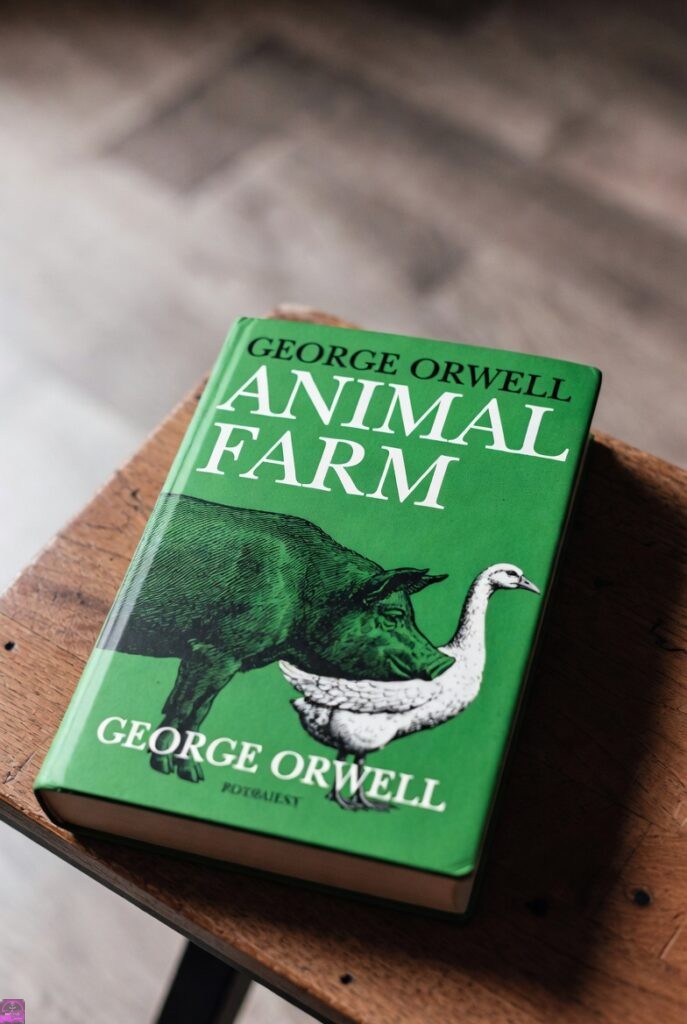
‘Animal Farm’ Questions for Study and Discussion George Orwell’s Famous Novel
📖0 mins read
<
Animal Farm is a famous novel by George Orwell. With this fable, Orwell was making a statement about communism and totalitarianism. Here are questions and answers for study and discussion.
YOUR ORIGINAL SAVED STORIES
Your reading list is empty. Click the button above to save this story!
► What is important about the title?
The title strips away the romanticized idea of a human “Manor Farm” and replaces it with the blunt reality of animal ownership. It signals the utopian shift where animals take control of their own destiny, while ironically foreshadowing how the farm ultimately reverts to its oppressive origins, proving the name change was a temporary illusion.
► What are the conflicts in Animal Farm? What types of conflict do you see?
The story features several layers of conflict:
• Physical: The violent Rebellion against Mr. Jones and the subsequent Battle of the Cowshed.
• Moral/Intellectual: The working animals’ struggle to remember the original tenets of Animalism versus the pigs’ gradual rewriting of the rules (intellectual exploitation).
• Emotional: The heartbreak and betrayal felt by loyal animals like Boxer as the regime turns tyrannical.
► How does George Orwell reveal character in Animal Farm?
Orwell primarily uses indirect characterization through actions, speech, and allegorical representation. Napoleon rarely speaks but acts ruthlessly; Snowball is passionate and full of ideas; Squealer is manipulative and physically nimble. By modeling them after real historical figures (Stalin, Trotsky, Molotov), their traits are reinforced by their political actions.
► What are some themes in the story? How do they relate to the plot and characters?
Key themes include the corruption of socialist ideals, the danger of a naive working class, and the abuse of language/power. These drive the plot as Napoleon slowly alters the Seven Commandments to justify his luxury, while characters like Boxer work themselves to death out of blind, uncritical loyalty.
► What are some symbols in Animal Farm? How do they relate to the plot and characters?
• The Windmill: Symbolizes modern industrialization and the manipulation of the working class (the pigs use it to keep the animals busy and distracted).
• The Seven Commandments: Symbolize the mutability of truth and history when controlled by a totalitarian regime.
• The Barn: Represents the collective memory and shifting conscience of the farm.
► From which character’s perspective is the story told?
The story is told from a third-person omniscient perspective, but it largely filters its point of view through the collective consciousness of the common animals. This allows the reader to feel the confusion, hope, and eventual despair of the working class as they witness their revolution being hijacked.
► Can you discern an authorial voice in the book?
While Orwell doesn’t have a direct human mouthpiece, Benjamin the donkey most closely mirrors Orwell’s cynical, detached skepticism. Benjamin realizes early on that things will never get better and that power inherently corrupts, echoing Orwell’s warning about the tragic, cyclical nature of political revolutions.
► Do you find the characters likable? Would you want to meet them?
Characters like Boxer and Clover are deeply sympathetic and likable due to their loyalty and kindness, though their tragic lack of critical thinking is frustrating. Meeting the pigs like Napoleon or Squealer would be deeply unnerving, as they represent the chilling, manipulative nature of real-world dictators.
► Does the story end the way you expected? How? Why?
The ending is deliberately jarring but logically inevitable. Instead of a triumphant animal utopia, the final image of the pigs playing cards with humans—indistinguishable from one another—brilliantly seals the novel’s cynical message: the new rulers have become identical to the old oppressors.
► What is the central purpose of the story? Is it important or meaningful?
The central purpose is to satirize the 1917 Russian Revolution and warn against the insidious nature of totalitarianism. It remains highly meaningful today because it serves as a universal blueprint for how democracies can slide into autocracy through propaganda, apathy, and the slow erosion of truth.
► How effective is the novel as a fable?
It is exceptionally effective. By using a simple, accessible animal fable structure, Orwell strips away complex political jargon. This allows readers of all ages and backgrounds to easily digest and understand the psychological and structural mechanics of political oppression.
► How essential is the setting to the story? Could it take place anywhere else?
The micro-setting of an isolated farm is essential because it mirrors a closed, totalitarian state where information can be easily monitored, manipulated, and withheld. While the allegorical concept could apply to a factory or a small country, the farmyard hierarchy perfectly maps onto human social classes.
► How does George Orwell explore rhetoric in this book?
Orwell explores rhetoric primarily through Squealer, who uses gaslighting, statistical manipulation, fear-mongering (“Surely you don’t want Jones back?”), and shifting vocabulary (calling a food reduction a “readjustment”) to control the narrative and keep the animals submissive.
► Would you recommend this story to a friend?
Absolutely. It is a masterclass in brevity, allegorical storytelling, and political philosophy. It serves not only as an important historical artifact but as a vital tool for media literacy and civic awareness in the modern digital age.
♥
Want more stories like this? Tip Salty Vixen!US & UK Readers:Cash AppCanada, Mexico & International:PayPal
This is an original creative work by Salty Vixen. This story/article, including its characters, plot, and descriptive content, is protected by copyright law. Unauthorized copying, sharing, reposting, or reproduction in any format is strictly prohibited. This content may not be used for AI training, data scraping, machine learning, or any form of artificial intelligence development without explicit written permission from Salty Vixen Publishing LLC. Violators will be pursued to the fullest extent of the law.
To provide the best experiences, we use technologies like cookies to store and/or access device information. Consenting to these technologies will allow us to process data such as browsing behavior or unique IDs on this site. Not consenting or withdrawing consent, may adversely affect certain features and functions.
Functional
Always active
The technical storage or access is strictly necessary for the legitimate purpose of enabling the use of a specific service explicitly requested by the subscriber or user, or for the sole purpose of carrying out the transmission of a communication over an electronic communications network.
Preferences
The technical storage or access is necessary for the legitimate purpose of storing preferences that are not requested by the subscriber or user.
Statistics
The technical storage or access that is used exclusively for statistical purposes.The technical storage or access that is used exclusively for anonymous statistical purposes. Without a subpoena, voluntary compliance on the part of your Internet Service Provider, or additional records from a third party, information stored or retrieved for this purpose alone cannot usually be used to identify you.
Marketing
The technical storage or access is required to create user profiles to send advertising, or to track the user on a website or across several websites for similar marketing purposes.