

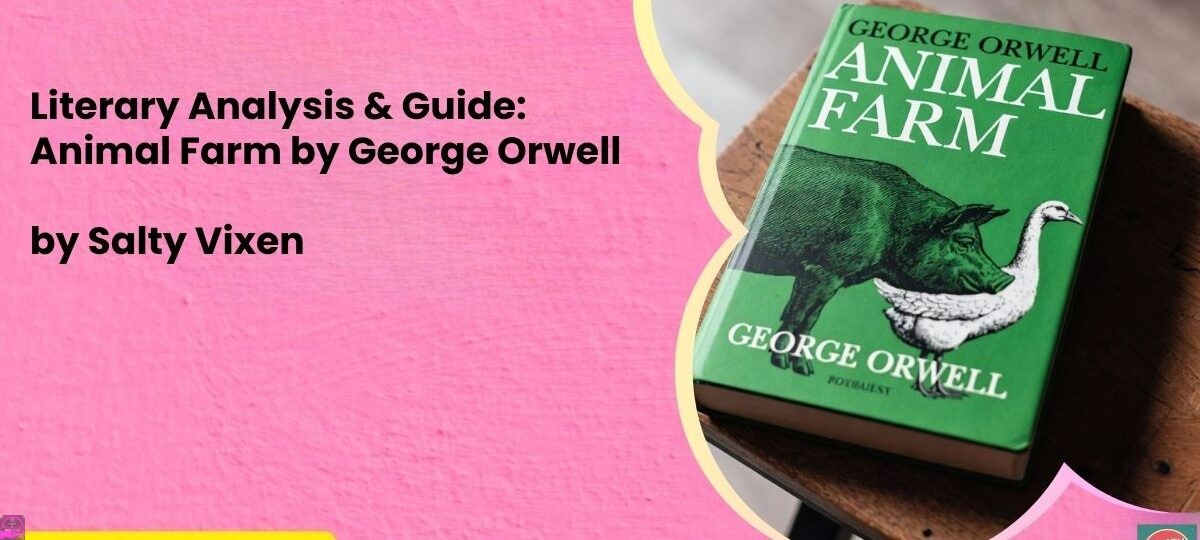
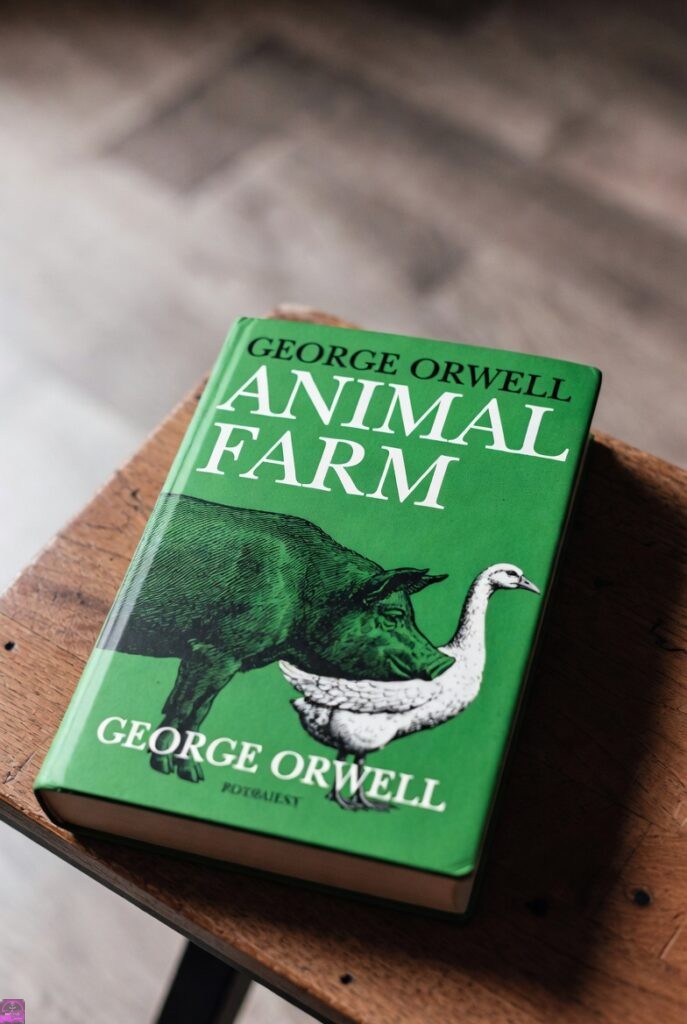
Animal Farm serves as George Orwell’s biting critique of the corruption of socialist ideals, specifically tracking how the noble rhetoric of a popular revolution can be systematically subverted into totalitarian tyranny.
Technical Specifications & Background
-
Title: Animal Farm
-
Author: George Orwell (the widely recognized pseudonym of Eric Arthur Blair).
-
Composition: Written between November 1943 and February 1944 in London, during the height of World War II.
-
Setting: A non-specific, timeless era on a fictional farm in the English countryside, designed to mirror the trajectory of Soviet history from 1917 to 1943.
-
Narrator: An anonymous, third-person omniscient narrator. The narrative voice is deliberately detached, objective, and matter-of-fact, mimicking the tone of a traditional children’s fable.
-
Genre / Type of Work: A dystopian allegorical novella, political satire, and beast fable.
Critical Evaluation
The Pros
-
Exceptional Accessibility: Orwell crafts the narrative in a clear, straightforward, and deceptively simple prose style. By using an uncomplicated vocabulary and a brisk pace, the complex machinery of political manipulation is made accessible to readers of all ages and backgrounds.
-
Prestige and Acclaim: The novella is universally recognized as a masterpiece of 20th-century literature. It was selected by Time magazine as one of the 100 best English-language novels and features prominently on the Modern Library’s list of top novels of the century.
-
Theoretical Versatility: Because of its rich layering, the text easily lends itself to multiple academic and critical frameworks:
-
Marxist Theory: Analyzing class struggle, the exploitation of the working class (the horses), and the rise of a new ruling elite (the pigs).
-
Political Theory: Examining the mechanics of propaganda, the erosion of civil liberties, and the transition from democracy to autocracy.
-
Psychological Criticism: Studying the herd mentality of the sheep, the psychological warfare waged by Squealer, and the corrupting nature of absolute power.
-
Feminist Theory: Evaluating the specific roles and systemic erasure of the female animals (like Clover and the hens) within the farm’s patriarchal power structure.
-
The Cons
-
Weaponization as Propaganda: During his lifetime, George Orwell was deeply frustrated and upset by how the novella was co-opted. Intended as a warning about how revolutions go wrong, it was frequently weaponized by Western capitalist factions as blanket anti-socialist propaganda, flattening Orwell’s nuanced democratic-socialist views.
-
Determinism and Pessimism: Some critics argue that the narrative’s bleak trajectory implies that all revolutions are inherently doomed to fail, potentially breeding political cynicism or apathy in the reader.
Guide Review & Summary Analysis
“All animals are equal, but some animals are more equal than others.”
Animal Farm is much more than a simple beast fable; it is a masterclass in literary economy. By cleverly crafting a self-contained setting, a tightly wound plot, and a rigid allegorical structure, Orwell achieves a brilliant narrative duality.
Through the use of extended metaphors and historical allusions, he is able to say a great deal more about human nature, state control, and geopolitical betrayal than he ever could have through a dense, literal political essay. Every character on Manor Farm corresponds to a historical figure or collective archetype from the Russian Revolution:
-
Old Major: Karl Marx / Vladimir Lenin
-
Napoleon: Joseph Stalin
-
Snowball: Leon Trotsky
-
Boxer: The exploited Soviet working class (the Stakhanovite movement)
By filtering the horrors of totalitarianism through the lens of a farmyard rebellion, Orwell strips away historical biases, forcing readers to confront the universal mechanisms of political corruption, language manipulation, and authoritarian greed.

This is an original creative work by Salty Vixen. This story/article, including its characters, plot, and descriptive content, is protected by copyright law. Unauthorized copying, sharing, reposting, or reproduction in any format is strictly prohibited. This content may not be used for AI training, data scraping, machine learning, or any form of artificial intelligence development without explicit written permission from Salty Vixen Publishing LLC. Violators will be pursued to the fullest extent of the law.
