

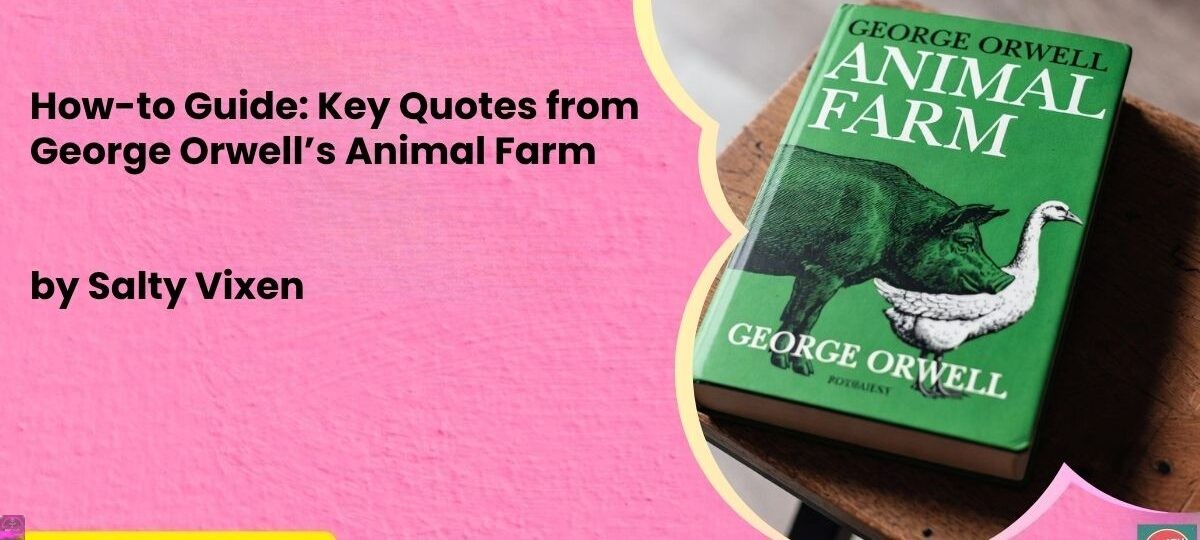
George Orwell’s Animal Farm remains one of the most chillingly accurate blueprints of political betrayal ever written. What begins as a hopeful, unified rebellion against human tyranny quickly devolves into a terrifying masterclass in psychological warfare, linguistic manipulation, and absolute corruption. By tracking the evolution of the farm’s slogans and rules, we can see exactly how the ruling elite systematically strip away the rights of ordinary citizens under the guise of the “greater good.”
The following categorized guide breaks down the book’s most significant quotes, mapping the tragic trajectory from revolutionary idealism to totalitarian nightmare.
The Beginning of the Rebellion: Universal Idealism
Before the rebellion, the philosophy of Animalism is rooted in a clear rejection of human exploitation and a fierce desire for self-determination. These early quotes capture the initial purity of the movement.
“Man is the only creature that consumes without producing. He does not give milk, he does not lay eggs, he is too weak to pull the plough, he cannot run fast enough to catch rabbits. Yet he is lord of all the animals. He sets them to work, he gives back to them the bare minimum that will prevent them from starving, and the rest he keeps for himself.” — Chapter 1
“All men are enemies. All animals are comrades.” — Chapter 1
“THE SEVEN COMMANDMENTS
Whatever goes upon two legs is an enemy.
Whatever goes upon four legs, or has wings, is a friend.
No animal shall wear clothes.
No animal shall sleep in a bed.
No animal shall drink alcohol.
No animal shall kill any other animal.
All animals are equal.” — Chapter 2
The Honeymoon Phase: Autonomy and Bliss
Immediately following the expulsion of Mr. Jones, the animals experience a brief period of genuine pride and fulfillment. For the first time, their labor belongs entirely to them.
“The animals were happy as they had never conceived it possible to be. Every mouthful of food was an acute positive pleasure, now that it was truly their own food, produced by themselves and for themselves, not doled out to them by a grudging master.” — Chapter 3
The Tools of Manipulation: Language and Slogans
As the elite pigs begin consolidating power, they realize the working class cannot grasp complex political theory. They simplify the core tenets into mind-numbing slogans, which eventually become tools to shut down critical thinking.
“FOUR LEGS GOOD, TWO LEGS BAD” — Chapter 3, pg. 29
“I will work harder!” — Chapter 3 (Boxer’s lifelong mantra)
“Napoleon is always right.” — Chapter 5
External Threats and the Scapegoat Strategy
To keep the populace compliant, the totalitarian regime uses two powerful psychological weapons: the threat of external enemies and the creation of an internal scapegoat to blame for every institutional failure.
“It was given out that the animals there practiced cannibalism, tortured one another with red-hot horseshoes, and had their females in common. This was what came of rebelling against the laws of Nature, Frederick and Pilkington said.” — Chapter 4
“The human beings did not hate Animal Farm any less now that it was prospering; indeed, they hated it more than ever.” — Chapter 6
“If a window was broken or a drain was blocked up, someone was certain to say that Snowball had come in the night and done it, and when the key of the store-shed was lost, the whole farm was convinced that Snowball had thrown it down the well. Curiously enough, they went on believing this even after the mislaid key was found under a sack of meal.” — Chapter 7
The Erosion of Truth and Civil Liberties
As absolute power corrupts the leadership, propaganda replaces reality. The pigs alter history, rewrite original laws in the dead of night, and utilize violent intimidation to crush dissent.
“No one believes more firmly than Comrade Napoleon that all animals are equal. He would be only too happy to let you make your decisions for yourselves. But sometimes you might make the wrong decisions, comrades, and then where should we be?” — Chapter 5
“They were always cold, and usually hungry as well.” — Chapter 7
“some of the animals remembered–or thought they remembered–that the Sixth Commandment decreed ‘No animal shall kill any other animal.’ And though no one cared to mention it in the hearing of the pigs or the dogs, it was felt that the killings which had taken place did not square with this.” — Chapter 8
The Gaslighting of the Working Class
Through doctored statistics and forced optimism, the propaganda machine under Squealer successfully convinces the exhausted, starving animals that their misery is actually a triumph.
“Reading out the figures in a shrill, rapid voice, he proved to them in detail that they had more oats, more hay, more turnips than they had had in Jones’s day, that they worked shorter hours, that their drinking water was of better quality, that they lived longer, that a larger proportion of their young ones survived infancy, and that they had more straw in their stalls and suffered less from fleas.” — Chapter 9
“Besides, in those days they had been slaves and now they were free, and that made all the difference, as Squealer did not fail to point out.” — Chapter 9
“It had become usual to give Napoleon the credit for every successful achievement and every stroke of good fortune. You would often hear one hen remark to another, ‘Under the guidance of our Leader, Comrade Napoleon, I have laid five eggs in six days’; or two cows, enjoying a drink at the pool, would exclaim, ‘Thanks to the leadership of Comrade Napoleon, how excellent this water tastes!'” — Chapter 8
Heartbreak and Cynicism: The Lost Revolution
The deep tragedy of the novel lies in the silent realization among the citizens that their utopian dream has turned into a police state, leaving only the cynical perspective that suffering is the default human condition.
“‘I have no wish to take life, not even human life,’ repeated Boxer, and his eyes were full of tears.” — Chapter 4
“If she herself had had any picture of the future, it had been of a society of animals set free from hunger and the whip, all equal, each working according to his capacity, the strong protecting the weak.” — Chapter 7
“they had come to a time when no one dared speak his mind, when fierce, growling dogs roamed everywhere, and when you had to watch your comrades torn to pieces after confessing to shocking crimes.” — Chapter 7
“Only old Benjamin professed to remember every detail of his long life and to know that things never had been, nor ever could be much better or much worse – hunger, hardship and disappointment being, so he said, the unalterable law of life.” — Chapter 10, pg. 109
The Ultimate Betrayal: Full Circle Totalitarianism
In the final chapter, the original rebellion is completely erased. The pigs adopt every single vice of their former human masters, rewriting the constitution into a singular, terrifying contradiction before merging entirely with the enemy.
“All that year the animals worked like slaves. But they were happy in their work; they grudged no effort or sacrifice, well aware that everything they did was for the benefit of themselves and those of their kind who would come after them, and not for a pack of idle, thieving human beings.” — Chapter 6
“Napoleon had denounced such ideas as contrary to the spirit of Animalism. The truest happiness, he said, lay in working hard and living frugally.” — Chapter 10
“ALL ANIMALS ARE EQUAL, BUT SOME ARE MORE EQUAL THAN OTHERS” — Chapter 10
“No question now, what had happened to the faces of the pigs. The creatures outside looked from pig to man, and from man to pig, and from pig to man again; but already it was impossible to say which was which.” — Chapter 10


This is an original creative work by Salty Vixen. This story/article, including its characters, plot, and descriptive content, is protected by copyright law. Unauthorized copying, sharing, reposting, or reproduction in any format is strictly prohibited. This content may not be used for AI training, data scraping, machine learning, or any form of artificial intelligence development without explicit written permission from © 2026 Salty Vixen Stories, Inc. — All rights reserved.. Violators will be pursued to the fullest extent of the law.
