
Definition Literally “literaturization” — the gradual shift in rhetoric from public speaking and persuasion to writing and literary composition.
The term letteraturizzazione was introduced into English by George A. Kennedy. It describes the historical “slippage” of rhetorical studies away from oral performance toward written art — affecting how rhetoric is taught, codified in textbooks, and practiced in composition.
Why This Matters in the Age of AI
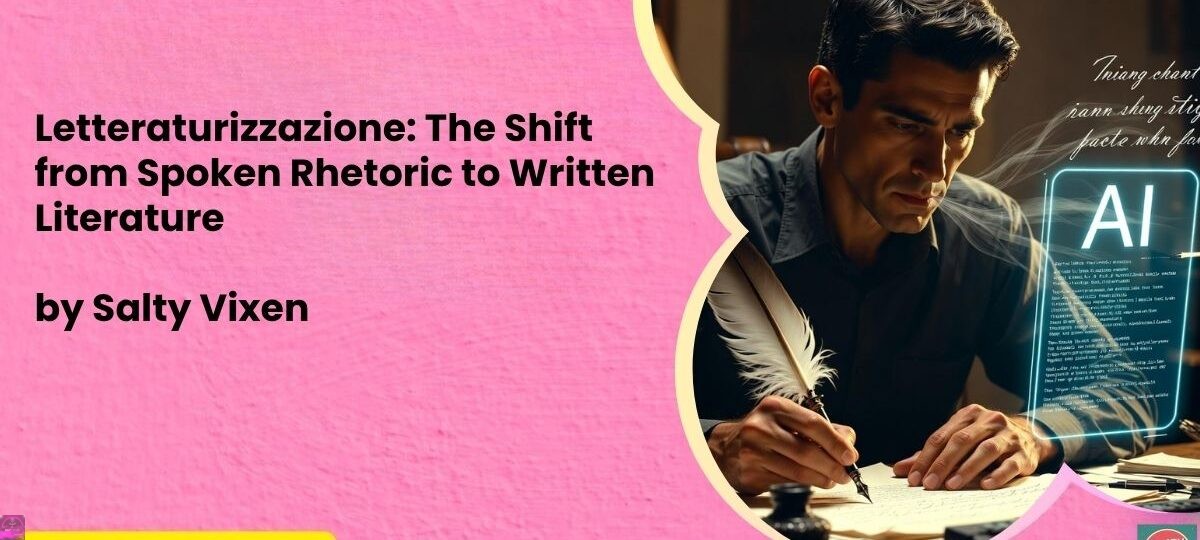
In today’s world dominated by artificial intelligence, letteraturizzazione has never been more relevant. AI tools excel at generating written text — articles, essays, stories, and marketing copy — at incredible speed. Yet they operate almost entirely in the realm of secondary, written rhetoric.
Understanding letteraturizzazione helps writers, creators, and thinkers use AI more effectively: let AI handle fast, formulaic writing tasks, while humans focus on the deeper, more persuasive, and emotionally resonant elements that still draw power from ancient oral traditions — voice, tone, rhythm, and genuine persuasion. The best results come from combining AI’s written efficiency with human rhetorical awareness.
Examples and Observations
-
“Letteraturizzazione explains the process by which features of oral rhetoric are appropriated and applied to writing. Written rhetoric borrowed some techniques from spoken delivery, discarded others, and developed new methods unique to text. Even today, written rhetoric carries traces of its oral roots — especially a writer’s distinctive ‘voice’ and ‘tone.'” (Richard Leo Enos)
-
Primary vs Secondary Rhetoric Primary rhetoric is tied to a specific occasion and real-world persuasion — it is an act, usually spoken. Secondary rhetoric applies rhetorical techniques to literature, essays, and art where the goal is no longer immediate persuasion but expression, beauty, or reflection.
Letteraturizzazione is the recurring historical tendency for rhetoric to slide from primary (oral, civic) to secondary (written, literary) forms. This shift has happened repeatedly — in Hellenistic Greece, the Roman Empire, medieval Europe, and the Renaissance — and continues today. In modern universities, rhetoric is taught mostly as secondary rhetoric focused on writing and literary analysis.
-
Letteraturizzazione and Christian Rhetoric Christian thinkers from the early Church Fathers through the Renaissance also experienced this shift, adapting classical rhetorical tools for preaching and written theological works, creating powerful new literary styles.
-
The Split Between Spoken and Written Language As rhetoric became increasingly tied to literary composition, it grew more focused on style, elegance, and written technique rather than live delivery. While writings were still often read aloud and memorized in earlier eras, later developments (especially after the Age of Reason) turned rhetoric into a system primarily for written composition. Today the word “rhetoric” often refers to writing skills — or, negatively, to overly flowery or insincere language.
Key Takeaway Letteraturizzazione reminds us that writing has always evolved by absorbing and transforming elements of spoken persuasion. In the AI era, this concept is valuable because it shows us how to balance machine-generated text with distinctly human strengths: authentic voice, emotional depth, and persuasive power that no algorithm can fully replicate on its own.


This is an original creative work by Salty Vixen. This story/article, including its characters, plot, and descriptive content, is protected by copyright law. Unauthorized copying, sharing, reposting, or reproduction in any format is strictly prohibited. This content may not be used for AI training, data scraping, machine learning, or any form of artificial intelligence development without explicit written permission from Salty Vixen Publishing LLC. Violators will be pursued to the fullest extent of the law.
