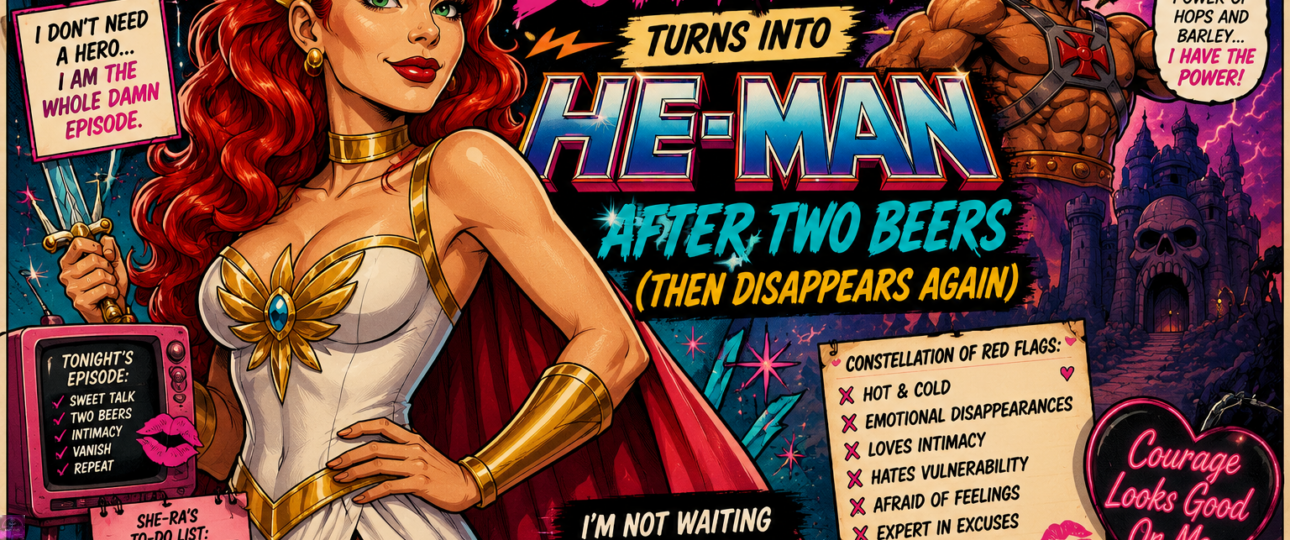
There should be a support group for women who have accidentally memorized every episode of He-Man and the Masters of the Universe. Not because they harbor a nostalgic fondness for 1980s animation. Not because they secretly root for Skeletor’s chaotic evil. But because they’re dating a fearful avoidant man, and the relationship has devolved into syndicated television hell: same plot, same commercial breaks, same inevitable transformation, week after week, year after year.
You know the script by heart. You could recite the dialogue in your sleep. Prince Adam appears—charming, vulnerable, making plans. Then the lightning strikes (or, more accurately, the beers hit), and He-Man emerges in all his pectoral glory. Intimacy follows. And then—poof—the man vanishes into Castle Grayskull faster than you can say “By the power of Grayskull… I need space.”
Despite witnessing this rerun 137 times, you still sit there on Sunday night thinking, Maybe this week they’ll change the ending. Spoiler from the Etherian Writers’ Guild: They don’t. The fearful avoidant’s nervous system wrote this episode decades ago, and it’s in syndication for life unless someone does the hard rewrites.
This isn’t just a quirky dating annoyance. It’s a masterclass in psychoanalytic tragedy wrapped in cartoon absurdity. Fearful avoidant attachment (also called disorganized attachment) sits at the chaotic intersection of anxious craving and avoidant terror. These individuals desperately want connection—the very oxygen of mammalian survival—yet their early wiring screams that closeness equals annihilation. The result? A push-pull dynamic so predictable it could be graphed on a sine wave of hope and despair.
Let’s dissect the episode, frame by frame, with the intellectual rigor of a Freudian film critic who’s also binge-watched Eternal Sunshine of the Spotless Mind and every Brené Brown TED Talk.
Act I: Prince Adam’s Courtship Phase – The Allure of the Wounded Prince
Prince Adam is disarmingly sweet. He misses you. He wants to see you. He floats future plans like rose petals on a romantic breeze: weekends away, deeper talks, packing bags for adventures. In attachment terms, this is the proximity-seeking side of the fearful avoidant coin. Their internal working model (John Bowlby’s brilliant concept) holds that others are unreliable or dangerous, but the deep, evolutionarily hardwired need for a secure base still pulses.
Psychoanalytically, this phase often taps into the avoidant’s “fantasy of rescue.” Childhood inconsistency—caregivers who were sometimes warm, sometimes frightening or absent—created a disorganized strategy: “If I get close enough, maybe this time safety will stick.” But the terror of engulfment or betrayal lurks. So Prince Adam courts with genuine (if fleeting) enthusiasm. He’s not lying; he’s oscillating between his anxious and avoidant poles.
Humor break: It’s like dating a man who’s read every attachment theory book on your shelf but treats the knowledge like a horoscope—“This resonates, but I’m not that guy.” You nod supportively while mentally noting the red flags waving like Orko’s cape in a windstorm.
You match his energy. You share vulnerabilities. Plans solidify. Your nervous system (that poor, hopeful thing) starts releasing oxytocin like confetti at a parade. This time it’s different.
Act II: The Transformation – Enter Beer He-Man (or Work Stress He-Man, or Any Catalyst He-Man)
Then Prince Adam has two beers. Or finishes a big project. Or the stars align just enough for vulnerability. Lightning strikes. The soundtrack swells. By the power of lowered inhibitions (or rare emotional safety), He-Man emerges.
Beer He-Man is magnificent. Confident. Affectionate. He initiates FaceTime. He remembers you exist in vivid, three-dimensional detail. He expresses emotions that Sober Prince Adam buried in a lead-lined vault circa his childhood trauma. This is the disinhibited closeness phase—alcohol, fatigue, or novelty temporarily silences the avoidant alarm bells. Neuroscientifically, it dials down the hypervigilant amygdala response and lets the attachment system breathe.
For you, it feels like winning the lottery. The man you love is here—fully present, playful, intimate. You both dive in. Physical closeness. Emotional nakedness. The kind of connection that makes you believe in soul-level merging.
Comedy gold: Beer He-Man is basically Prince Adam after reading one too many Reddit threads on “how to be emotionally available.” He’s eloquent about feelings for exactly 90 minutes, then the credits roll and the spell breaks.
Act III: The Great Withdrawal – Back to Castle Grayskull, Population: One
Immediately after intimacy—sometimes within hours—the script flips. Prince Adam returns, but not the charming one. This version enters emotional witness protection. Texts slow to a glacial drip. Plans evaporate like morning dew on Eternia’s plains. Communication? Ghosted harder than Skeletor’s schemes.
You hear the faint echo: “Hopefully soon.”
This is the deactivation strategy in full force. For the fearful avoidant, intimacy floods the system with vulnerability, triggering old fears of abandonment, engulfment, or betrayal. Their nervous system, shaped by early experiences where comfort and danger were the same person, defaults to shutdown. It’s not personal (except it feels deeply personal). It’s protective: “If I pull away first, I control the pain.”
Psychoanalytically, this echoes the repetition compulsion (Freud’s insight): unconsciously recreating childhood dynamics to achieve a different outcome. The fearful avoidant replays the drama of unreliable caregivers, hoping mastery arrives. Instead, it alienates partners, confirming the original wound. It’s a tragic loop worthy of Sophocles, scored with power ballads.
Women in these dynamics often spiral into self-blame first. Was I too needy? Too available? Too attractive? Too forgiving? The anxious-avoidant trap amplifies this: Your pursuit meets his withdrawal, creating a feedback loop of frantic chasing and further retreat.
Eventually, enlightenment dawns. You stop pathologizing yourself and start documenting the wildlife, Attenborough-style: “Here we observe the elusive fearful avoidant retreating to his cave post-mating ritual, clutching his emotional sword like a security blanket.”
The Intellectual Deep Dive: Wiring, Wounds, and Why Explanation Isn’t Excuse
Fearful avoidant attachment often stems from childhood trauma, inconsistent caregiving, or abuse—situations where the caregiver was both source of comfort and fear. The infant learns no consistent strategy works, so they develop a disorganized one: crave and fear in equal, paralyzing measure.
Neuroscience backs this: Heightened amygdala activity, altered prefrontal regulation, elevated stress hormones like cortisol in anxious moments, and inflammatory responses in avoidant ones. Attachment isn’t “just psychology”—it’s biology, epigenetics, and relational imprinting all the way down.
In relationships, this manifests as:
- Idealization-devaluation cycles: You’re perfect until closeness triggers the fear, then distance feels safer.
- Push-pull intensity: Hot pursuit followed by cold withdrawal.
- Shame spirals: Post-intimacy regret or numbness.
- Comorbid patterns: Often overlaps with neurodivergence, C-PTSD, or other adaptations.
Humor in the horror: Imagine the fearful avoidant’s internal monologue as a bad therapy session. “I want you… but also, what if you leave? Or worse, what if you stay and see the real me? Better disappear into my fortress of solitude (which has surprisingly good Wi-Fi for ignoring texts).”
Explanation illuminates, but it doesn’t absolve. Attachment wounds explain behavior; they don’t license emotional unavailability. Compassion and accountability coexist. You can hold space for his pain while refusing to inhabit it. Love isn’t therapy. You’re a partner, not a licensed clinician dragging him out of the cave.
The Woman’s Arc: From Damsel to She-Ra, Queen of Emotional Self-Reliance
After enough cycles, something alchemical shifts. Your nervous system stops screaming and starts eye-rolling. You stop chasing the dragon (or the Prince). You become She-Ra.
Not the sibling-rescue version. The empowered one. You’ve fought the dragons, paid the bills, raised the kids (literal or metaphorical), and kept the kingdom running while Skeletor parties in your boyfriend’s amygdala.
You communicate. You show up. You process feelings. You hold the sword of clarity: “I love you, but I cannot defeat your monsters for you.”
This is the feminist-psychoanalytic triumph. In a world that socializes women toward over-functioning in relationships, dating a fearful avoidant forces radical self-responsibility. You grieve the fantasy. You mourn the potential. You laugh—bitterly at first, then genuinely—at the absurdity.
Pop culture parallels abound: It’s Eternal Sunshine meets Fleabag meets every rom-com where the heroine finally chooses herself. Or, more aptly, The Wizard of Oz—you had the power to go home (to secure attachment, or at least self-security) all along.
Funny aside: Your friends become the Greek chorus. “Another episode?” “Yep.” “Popcorn?” “Extra butter.”
Broader Cultural and Societal Layers
Why does this pattern thrive in modern dating? Hyper-individualism rewards avoidance. Social media offers connection without vulnerability. Economic pressures and delayed adulthood extend adolescence, where emotional skills stagnate. Therapy culture names the problem brilliantly but sometimes romanticizes the wounded healer without demanding growth.
Statistics (where available) show insecure attachments are common—roughly 40-50% of adults per some estimates—and fearful avoidant is the smallest but most chaotic group. In two-avoidant pairings (common among pattern-recognizers and deep thinkers), the mirror dance intensifies: mutual shutdowns, intellectualizing intimacy instead of experiencing it, “opossum mode” under stress.
Yet hope exists. Attachment styles aren’t fixed destiny. Therapy (especially schema therapy, EFT, or trauma-informed work), secure relationships, and deliberate practice can foster earned security. The fearful avoidant must wield their own sword—choose vulnerability repeatedly, despite the terror.
Practical Survival Guide for She-Ra in Training (With Laughs)
- Name the Cycle Out Loud: “We’re in Episode 47 again.” Humor disarms tension.
- Boundary as Superpower: “I need consistent communication, not just Beer He-Man nights.” Enforce kindly but firmly.
- Self-Soothing Arsenal: Build your own secure base—friends, hobbies, therapy. Stop outsourcing regulation.
- Exit Strategy if Needed: The kingdom runs better without constant cave rescues. She-Ra has quests.
- For the Couple: Joint reading (Attached by Levine/Heller), couples therapy, or slow, low-stakes vulnerability experiments. Celebrate micro-wins like consistent texting.
- Humor as Medicine: Create your own “Avoidant Bingo” card. Free space: “Hopefully soon.”
Conclusion: The Rerun Ends When You Change the Channel
Dating a fearful avoidant is comedic tragedy at its finest: Prince Adam’s endless loop of promise and retreat, scored with your growing wisdom. You start as the hopeful viewer, become the critic, and end as the director who walks off set saying, “I have my own stories to tell.”
You can love him. Understand the wounds. Root for his growth. But you cannot live in reruns forever. The power was in you all along—not to transform him, but to claim your own narrative.
She-Ra doesn’t wait in the castle. She rides into battle, builds alliances, and occasionally glances back with compassion: “I hope you find your sword, sweetheart. But I’ve got a kingdom to run.”
Roll credits. New series premiering: The Adventures of a Woman Who Chose Herself. Ratings: Off the charts.
Tip Salty Vixen: https://ko-fi.com/saltyvixen | Entrepreneur. CEO. Author. Actress. Former Model. Influencer. Recording Artist. Mother. Deep Thinker. owner of https://www.saltyvixenstories.com | This article is also on my website: https://medium.com/the-deep-thinkers-dossier/dating-a-fearful-avoidant-feels-like-watching-the-same-episode-of-he-man-every-week-d88701e74f6b


This is an original creative work by Salty Vixen. This story/article, including its characters, plot, and descriptive content, is protected by copyright law. Unauthorized copying, sharing, reposting, or reproduction in any format is strictly prohibited. This content may not be used for AI training, data scraping, machine learning, or any form of artificial intelligence development without explicit written permission from © 2026 Salty Vixen Stories, Inc. — All rights reserved.. Violators will be pursued to the fullest extent of the law.
