Hey loves, It’s me, Salty Vixen—your favorite late-night storyteller, coming to you from the quiet, blurry hours of the morning when the rest of the world is asleep, but the characters in my head are loud, demanding, and utterly alive.
Lately, I’ve been on a self-imposed mission that is part exhilarating dream, part absolute madness: I am writing and publishing a brand-new, completely original short story every single day for LGBTQ+ Month. Thirty days. Thirty distinct narratives. And each one centers entirely on a different gender identity across the vast, beautiful, and often misunderstood spectrum of human existence.
To say it is a massive undertaking would be an understatement. It is a creative crucible. Every morning, I wake up to a blank page and a new identity to explore, honor, and breathe life into. One day it’s a non-binary space mechanic navigating the silent, heavy voids of a distant galaxy; the next, it’s a transfeminine artist in Paris finding her voice through the texture of oil paints; the day after that, an agender archivist uncovering forbidden histories in a crumbling utopian library.
And honestly? It’s been one of the most exciting, terrifying, and profoundly transformative creative challenges I’ve ever given myself.
When I first came up with this idea, a few well-meaning author friends told me I was insane. “The algorithms won’t love a daily drop,” they warned. “You’re going to burn out by day ten,” they said. But the moment someone tells me a creative feat is impossible, or that it doesn’t align with standard industry marketing strategies, a little spark catches fire in my chest.
This challenge wasn’t conceived in a marketing meeting. It wasn’t born from an analysis of search engine optimization or trending keywords on digital storefronts. It was born from a deep, aching desire to see the full, unadulterated kaleidoscope of our community represented with nuance, dignity, and a healthy dose of passion.
Writing daily forces an author to bypass their inner critic. There is simply no time for the agonizing self-doubt that usually slows down the creative process. I cannot spend three days debating the placement of a comma or wondering if a character’s internal monologue is perfectly polished. I have to trust my instincts. I have to dive headfirst into the emotional core of the character, map out their world, capture their unique heartbeat, and lay it bare on the screen before the clock strikes midnight. It’s an exercise in raw vulnerability, not just for the characters, but for me as the creator holding the pen.
To understand why I would willingly subject myself to the frantic pace of a daily publishing schedule, you have to understand a little bit about how my mind operates. As an openly neurodivergent writer, my brain doesn’t function in a straight, predictable line. It doesn’t walk down a well-paved, orderly path; it leaps across chasms, maps out intricate webs of interconnected thoughts, and thrives on an intense, almost manic exploration of new ideas, new perspectives, and new ways of being.
Where a neurotypical brain might find comfort in consistency, routine, and sticking to a single, hyper-focused lane, my brain experiences that kind of rigidity as a creative death sentence. I get bored easily if I am forced to repeat the same formulas over and over again. But give me a complex puzzle—like how to authentically portray the distinct internal experience of a genderfluid protagonist shifting between social roles in a high-fantasy royal court—and my mind lights up like a pinball machine in the dark.
Gender identity stories, in particular, provide the ultimate playground for a pattern-loving, intensely curious mind. Gender is not a static biological box; it is a profound, deeply personal tapestry of language, presentation, internal knowing, social performance, and historical context. When I write about different gender identities, I am playing with the very fabric of how human beings experience themselves from the inside out. I get to dissect and reimagine how people love, how they navigate intimacy, how they perceive their own physical forms, and how they fight to be seen in a world that desperately wants to categorize them into neat, binary columns.
My neurodivergence means I possess an innate love for systems, structures, and patterns, but also a deep-seated urge to disrupt them. When I look at the spectrum of gender, I don’t see confusion; I see an exquisite system of human diversity. Writing these stories allows me to hyper-focus on the micro-nuances of human behavior. How does a person who has never felt a connection to the concept of gender describe the sensation of falling in love? What words do they use to express desire when the standard romantic lexicon fails them?
These are the creative riddles that keep me awake at 3:00 AM, typing furiously until my wrists ache. I am not chasing trends. I am not trying to fulfill a diversity checklist or pander to an audience for the sake of clicks. This is pure, unadulterated creative fuel. I write these stories because they genuinely excite me, because they challenge my intellect, and because my brain demands the novelty and depth that only a project of this scale can provide. It is an act of love, an act of self-discovery, and an act of artistic rebellion.
While I’ve been deep in the trenches of this 30-day journey, swimming through oceans of identity, romance, and human connection, I’ve found myself thinking a lot about another artistic domain that is incredibly close to my heart, yet fiercely contested: erotica.
Let’s be completely real with each other for a moment—erotica still gets a horribly bad rap in the mainstream literary world. You can write about visceral, bloody violence; you can pen detailed descriptions of psychological torture, corporate greed, war, and betrayal, and the high-brow literary critics will hail it as a masterpiece of the human condition. But the moment an author turns their focus to the intimate, sweaty, vulnerable mechanics of sexual desire, the room goes cold. A lot of people hear the word “erotica” and immediately roll their eyes, smirk, or dismiss it entirely, assuming it’s nothing more than mindless, poorly written smut designed solely for cheap thrill, devoid of any genuine literary merit.
But here’s the undeniable truth I’ve learned after years of operating in this space, studying the genre, and writing it myself: A massive chunk of what gets labeled as “erotica” in modern digital bookstores and online writing platforms really shouldn’t be carrying that label at all.
We need to establish a clear, honest distinction here. What a large portion of the market consumes today isn’t erotica; it is what I call “word porn.”
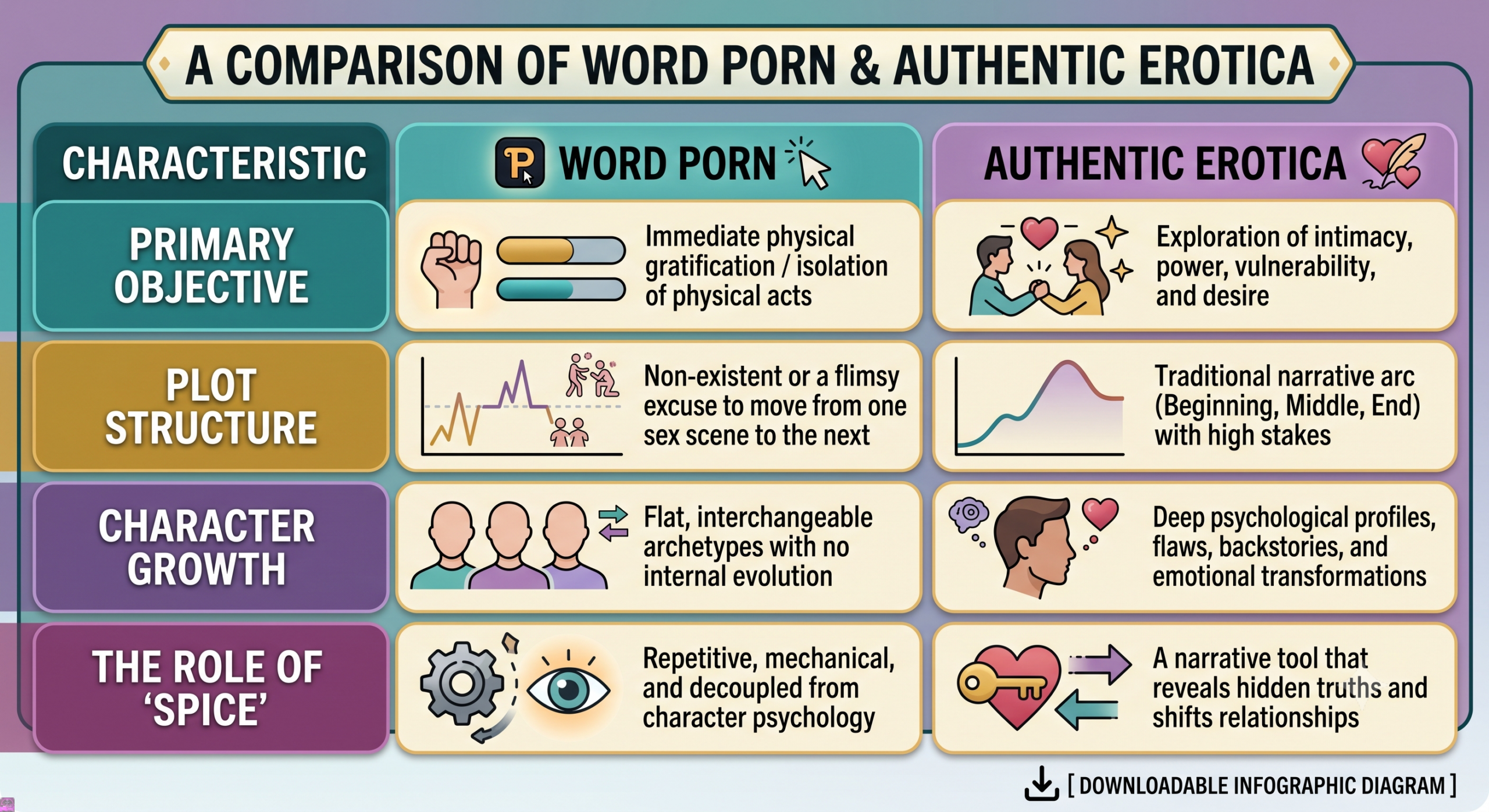
Word porn serves a specific purpose. It is transactional text. It is designed to be a quick, repetitive hit of dopamine, featuring flat characters who exist merely as anatomical chess pieces moved around a board to achieve maximum physical stimulation for the reader. There is zero plot, zero character growth, and zero emotional depth. The language is often copy-and-pasted from a shared cultural lexicon of cliché dirty words, offering no unique voice or artistic vision. And look—let me be clear: word porn serves a purpose. It satisfies a basic, immediate human need, and there is absolutely nothing wrong with its existence. It has a right to be read, and people have a right to enjoy it without shame.
But it is profoundly unfair, lazy, and incorrect to collapse the entire genre of real erotica into that single, mechanical category.
Real erotica is an entirely different beast. Real erotica is literature. It honors the classic tenets of storytelling: it possesses a compelling beginning, a tension-filled middle, and a satisfying end. It demands characters who aren’t just bodies, but human beings with complex desires, deeply ingrained fears, painful backstories, internal conflicts, and room for genuine psychological growth.
In authentic erotica, the heat—the delicious, spicy, breath-catching parts—does not interrupt the story; the heat is the story. The physical intimacy is a language used by the characters when spoken words are no longer sufficient to carry the weight of their emotions. A sex scene in a true piece of erotica is a narrative turning point. It can reveal a character’s deepest insecurities, it can expose their need for control, it can highlight their fear of abandonment, or it can mark the exact moment two souls finally drop their armor and surrender to each other.
Good erotica can be intensely emotional, psychologically complex, and beautifully written. It can mirror the messy, chaotic, beautiful reality of human relationships in a way that standard, sanitized fiction simply cannot. It explores the dark corners of our minds, our hidden fantasies, and our fundamental need to be known by another person, both clothed and unclothed.
Because of the cultural stigma surrounding the genre, many authors who dare to write about sex do so from a place of quiet apology. They use pen names not out of a desire for creative anonymity, but out of fear of social ruin. They hide their work from their families, speak about their writing in hushed whispers at cocktail parties, and constantly feel the need to justify their career choices by adding caveats like, “Well, it’s actually a psychological thriller that just happens to have sex in it.”
I am here to tell you that I am completely, irrevocably done with the apologies. I refuse to apologize for writing erotica.
Why should we apologize for exploring the one human experience that is capable of bringing the highest highs of joy, the deepest levels of vulnerability, and the most profound senses of connection? Sex is not a footnote in the human experience; it is an driving force of history, art, psychology, and personal identity. To treat it as something inherently dirty, unacademic, or shameful to write about is an insult to the complexity of human nature.
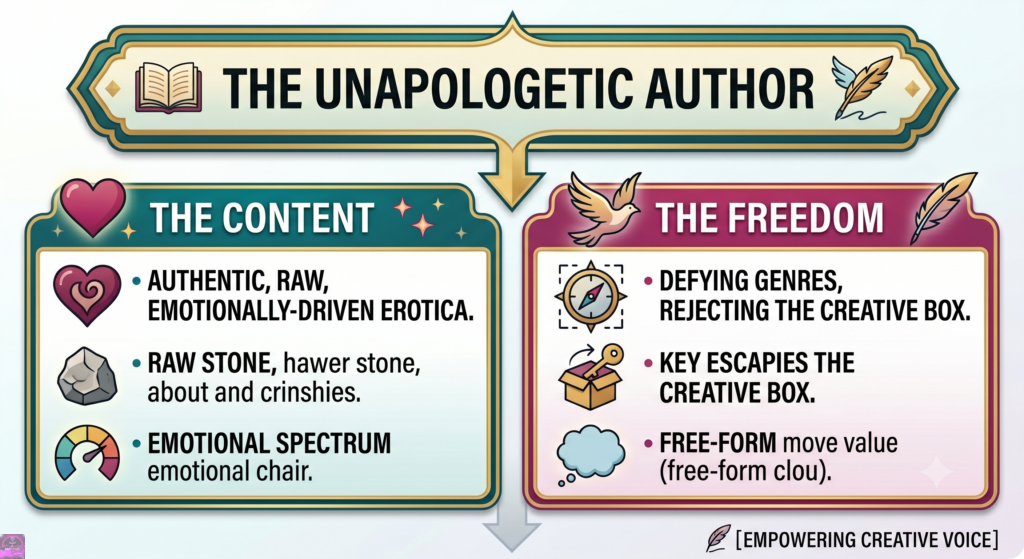
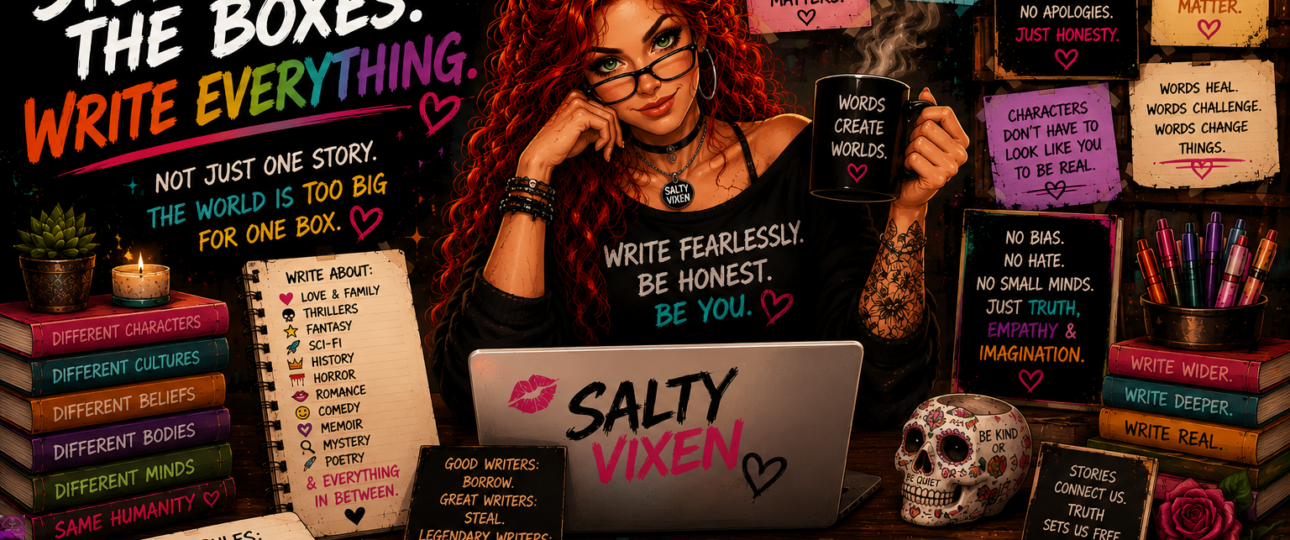
Furthermore, I also refuse to stay in one designated box as a creator. The publishing industry loves boxes. It wants to take an artist, slap a single label on their forehead—Romance Writer, Sci-Fi Writer, Literary Novelist—and keep them in that specific aisle of the bookstore forever because it makes marketing budgets easier to calculate. They want you to find a single formula that works, build a neat little cage around yourself, and never attempt to scale the walls.
But my brain, as I mentioned earlier, rejects cages. I write sweet, slow-burn contemporary romance where the simpler acts of hand-holding and shared glances carry the weight of the world. I write dark, sweeping high-fantasy epics filled with political intrigue, magic systems, and bloody battles. I write high-concept sci-fi thrillers that explore artificial intelligence, existential dread, and distant planets. And yes, I write intensely spicy, uninhibited erotica.
I do all of this because my creative spirit refuses to be limited, compartmentalized, or domesticated. I believe that an author can care deeply about world-building, prose, and philosophical themes while simultaneously caring about the erotic tension between their characters. The presence of spice does not diminish the intelligence of the plot, nor does a complex plot diminish the passion of the intimate scenes. They can coexist. They should coexist. And my goal as a writer is to prove that you never have to sacrifice one for the sake of the other.
This rejection of the box isn’t just about my own liberation as a writer; it is about your liberation as a reader. Just as the industry tries to force writers into narrow lanes, it tries to convince readers that they must choose a side. It tells you that if you are a “serious” reader who enjoys high-concept fiction, intellectual prose, and deep character studies, you should look down your nose at romance and erotica. Conversely, it suggests that if you love stories that make your heart race and your skin flush, you shouldn’t care about plot mechanics, philosophy, or world-building.
What absolute, total nonsense.
We are complex, multi-faceted human beings. We contain multitudes. Why should your bookshelf be any less diverse than your internal emotional landscape?
-
The Soft Romantics: There are days when your soul is weary from the harshness of the real world, and you need a story that feels like a warm blanket—a sweet, gentle, comforting romance where safety, kindness, and emotional healing are the core focus.
-
The World-Builders: There are nights when your intellect craves escape, and you want to lose yourself in an intense fantasy kingdom or a gritty cyberpunk cityscape, tracking complex political betrayals and questioning the nature of morality.
-
The Bold Explorers: And then there are times when you want a story that makes you blush, that stirs a dormant fire in your belly, challenges your taboos, and makes you think deeply about your own hidden desires all at the same time.
There is space in this literary universe for every single one of those experiences. You do not have to choose. You do not have to divide your personality into acceptable and unacceptable parts when you open a book. We can have depth and desire. We can have an intricate, brilliant story and mind-melting spice.
Imagine a world where a science fiction novel doesn’t skip over the intimate moments between its characters with a lazy fade-to-black, but instead uses those moments to explore how alien biology or technological integration alters the very nature of physical love. Imagine a historical romance that doesn’t just focus on societal constraints, but realistically portrays the raw, liberating sexual agency of a protagonist who refuses to be tamed by their era. That is the kind of fiction I want to read, and that is exactly the kind of fiction I am dedicated to creating.
So, my beautiful loves, here is my explicit challenge to you today: Stop worrying about fitting into one perfect, clean, socially acceptable category. Whether you are standing at a keyboard trying to figure out what kind of story to tell, or sitting on your couch trying to decide what kind of book to read, throw away the invisible rulebook that society has handed you. The world is filled with loud, judgmental voices that want to keep you small, predictable, and easily controlled. They want to shame you for your interests, dictate what is appropriate, and make you feel guilty for seeking out pleasure, novelty, and passion in your art.
Do not let them.
-
If you are a writer: Write the story that scares you. Write the scene that makes your hands shake a little bit as you type it. If you want to mix spaceships with ancient mythology and explicit, queer BDSM intimacy, do it. Do it with pride, do it with craftsmanship, and do it with every ounce of your creative soul. Do not tone down your passion to make it palatable for the masses, and do not strip away your intellect to make it fit a fast-food publishing model.
-
If you are a reader: Pick up the book that calls to you, regardless of what the cover looks like or what section of the store it came from. Read the dark fantasy that pushes your boundaries. Read the sweet, queer romance that makes you cry. Read the explicit erotica proudly on the subway or on your digital e-reader without feeling the need to hide the screen from passing strangers.
Explore different identities. Learn about experiences outside of your own lived reality. Dive into kinks that pique your curiosity, worlds that defy imagination, and emotions that shake you to your core—and do it entirely without shame. Shame is the absolute death of creativity, and it is the enemy of genuine human connection.
The best stories—the ones that permanently anchor themselves in our souls, the ones that we think about years after we turn the final page—are never the ones that were written to safely please everyone. They are the stories that were penned with absolute, uncompromising honesty and fierce, terrifying courage. They are the stories where the author looked into the mirror, found their rawest truth, and had the audacity to share it with the world.
As I wrap up this long late-night transmission and prepare to dive back into the next story for my LGBTQ+ Month challenge, I want to open up the floor and turn the spotlight completely onto you. This journey isn’t a monologue; it’s a living, breathing conversation between my mind and yours, and I want to hear the music of your voices.
What about you, my loves?
Have you ever stepped outside your usual, comfortable box as a writer or a reader? Have you ever taken a wild leap into a genre, an identity, or a subject matter that you never thought you’d touch, only to discover a brand-new piece of yourself waiting there in the dark?
Have you ever felt the cold sting of judgment—either from friends, family, or society at large—for admitting that you love “spicy” stories that happen to have a real, beating heart and true emotional depth? Have you ever had to defend your reading list or your writing choices to someone who couldn’t see past their own narrow prejudices?
Drop your thoughts, your stories, your confessions, and your triumphs in the comments below. I want this comment section to become a sanctuary—a vibrant, chaotic, completely judgment-free zone where we can lay down our armor, speak our truths, and celebrate our shared love for untamed, beautiful literature.
I promise you that I read every single comment that gets left on my posts. Your words are the fuel that keeps this neurodivergent brain firing when the exhaustion sets in and the blank page looks daunting.
Thank you for being on this wild journey with me. Thank you for reading, for daring to care, and for refusing to stay in the box.
With love & a little mischief,
Salty Vixen 💋
This is an original creative work by Salty Vixen. This story/article, including its characters, plot, and descriptive content, is protected by copyright law. Unauthorized copying, sharing, reposting, or reproduction in any format is strictly prohibited. This content may not be used for AI training, data scraping, machine learning, or any form of artificial intelligence development without explicit written permission from © 2026 Salty Vixen Stories, Inc. — All rights reserved.. Violators will be pursued to the fullest extent of the law.
