

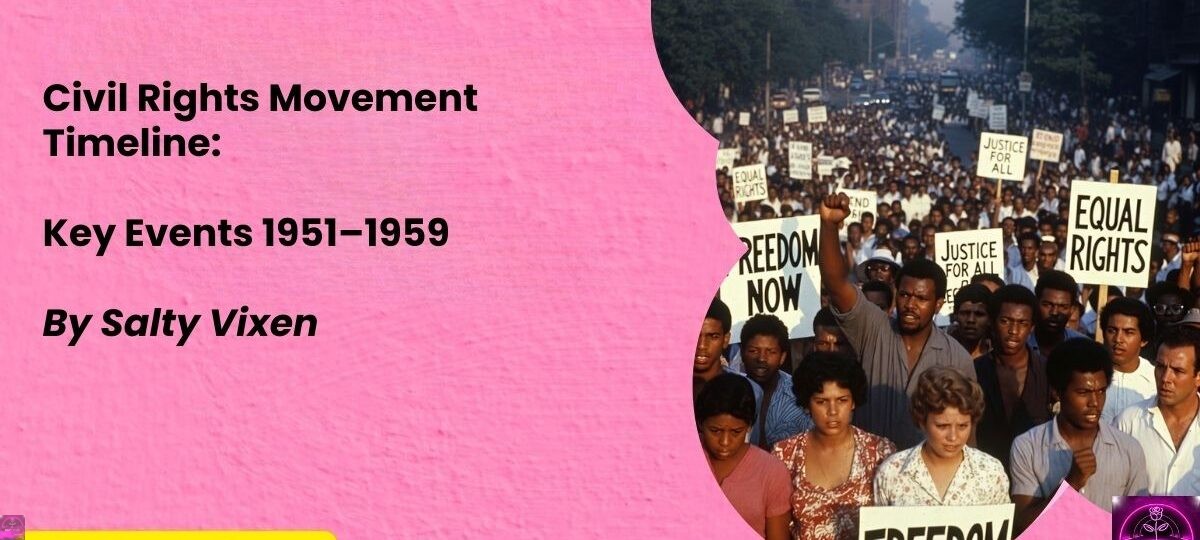
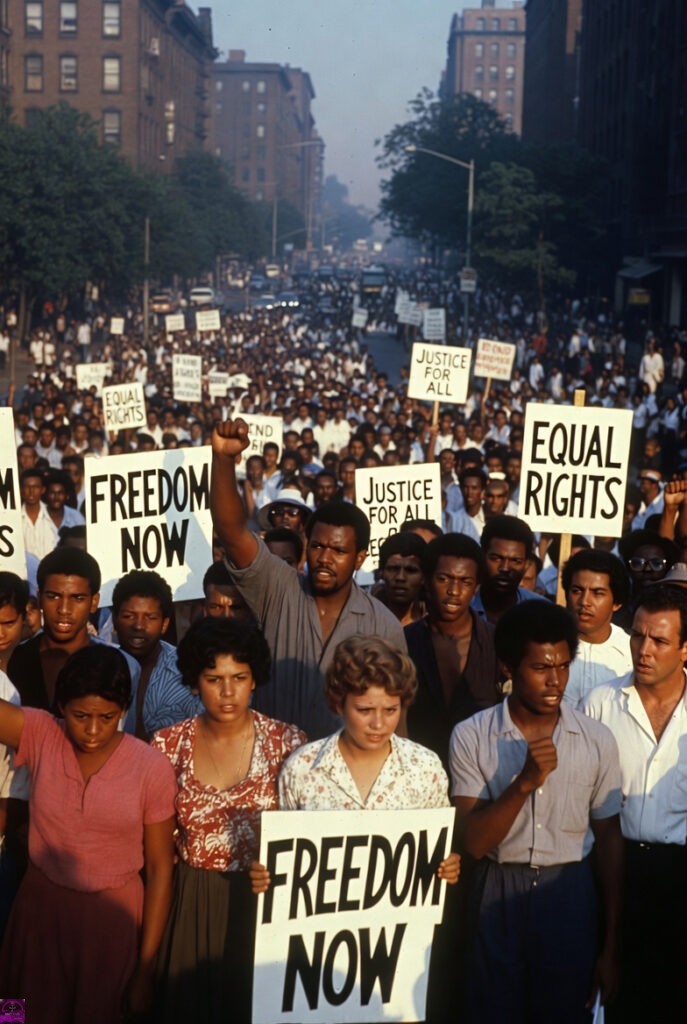
The 1950s was a game-changing era for the fight for equality in America—a time when legal wins started cracking the foundation of segregation, nonviolent resistance took center stage, brutal backlash exposed the ugliness of racism, and leaders like Dr. Martin Luther King Jr. rose to guide the nation toward justice. These years built the momentum that would define the movement in the 1960s and beyond. In 2026, during Black History Month’s centennial celebration under the ASALH theme “A Century of Black History Commemorations,” these events remind us how far we’ve come—and how much work remains to honor the full story of Black resilience and American progress.
1951
- Linda Brown, an 8-year-old Black girl in Topeka, Kansas, is forced to bus across town to a segregated school while a whites-only school sits just blocks away. Her father, Oliver Brown, teams up with the NAACP to sue the Topeka Board of Education. This case—Brown v. Board of Education—would soon become the landmark challenge to school segregation.
- Student walkouts hit segregated schools, including Robert Russa Moton High School in Prince Edward County, Virginia, where Black students protested crumbling facilities and unequal resources—sparking early resistance that fed into bigger fights.
1953
- The Highlander Folk School in Monteagle, Tennessee, ramps up workshops on nonviolent organizing and community action, drawing civil rights workers who would later lead major campaigns.
- The Baton Rouge Bus Boycott (June 1953) challenges segregated city buses in Louisiana. Though it lasts only eight days, it proves mass boycotts can force change and serves as a blueprint for Montgomery two years later.
1954
- May 17: The U.S. Supreme Court delivers its unanimous ruling in Brown v. Board of Education of Topeka, declaring that “separate but equal” schools are inherently unequal and violate the 14th Amendment’s Equal Protection Clause. Chief Justice Earl Warren’s opinion ends legal segregation in public education nationwide. Southern states respond with “massive resistance,” delaying real change for years.
1955
- July: Rosa Parks participates in a civil rights organizing workshop at Highlander Folk School, learning nonviolent strategies.
- August 28: Emmett Till, a 14-year-old Black teenager from Chicago, is lynched in Money, Mississippi, after allegedly whistling at a white woman. His mother’s decision to hold an open-casket funeral in Chicago shocks the nation and fuels outrage against racial violence.
- November: The Interstate Commerce Commission bans segregation on interstate buses and trains (enforcement remains spotty).
- December 1: Rosa Parks refuses to give up her seat to a white passenger on a Montgomery, Alabama, bus, leading to her arrest and igniting the Montgomery Bus Boycott.
- December 5: The Montgomery Improvement Association forms to lead the boycott; 26-year-old Rev. Martin Luther King Jr., pastor of Dexter Avenue Baptist Church, is elected president and emerges as the movement’s rising star.
1956
- January–February: White terrorists bomb four Black churches and the homes of King and boycott leader E.D. Nixon in retaliation. King survives and delivers a powerful call for nonviolence.
- February: Autherine Lucy becomes the first Black student admitted to the University of Alabama, but violent mobs and legal tricks force her expulsion after just days.
- November 13: The Supreme Court affirms Browder v. Gayle, ruling Alabama bus segregation unconstitutional.
- December 20–21: After 381 days, the Montgomery Bus Boycott ends in victory—buses integrate, proving sustained nonviolent action can dismantle Jim Crow.
1957
- January: Martin Luther King Jr. and other Southern Black ministers launch the Southern Christian Leadership Conference (SCLC) to coordinate nonviolent protests across the South; King becomes its first president.
- September: Arkansas Governor Orval Faubus deploys the National Guard to block the Little Rock Nine—nine Black students—from entering Central High School. President Dwight D. Eisenhower federalizes the Guard and sends the 101st Airborne to enforce integration, turning the crisis into a national symbol of federal power against state defiance.
- September 9: Eisenhower signs the Civil Rights Act of 1957, the first major civil rights legislation since Reconstruction. It establishes the U.S. Commission on Civil Rights and allows the Justice Department to sue over voting rights violations (though Southern Democrats weaken its enforcement powers).
1958
- September: In Cooper v. Aaron, the Supreme Court unanimously declares that states cannot delay school desegregation because of potential violence, reinforcing federal authority over “massive resistance.”
1959
- February–March: Martin Luther King Jr. and Coretta Scott King travel to India to meet Gandhi’s followers, immersing in the philosophy of nonviolence that would shape King’s strategies for the years ahead.
These pivotal moments turned legal theory into lived action, exposed injustice to the world, and inspired generations. They remain essential lessons in courage, strategy, and the power of collective resistance—especially resonant in 2026 as we reflect on a century of commemorating Black history.
Sources (2026-verified):
- Britannica, History.com, National Archives, NAACP Legal Defense Fund, ASALH official resources, NPS Little Rock Central High School National Historic Site, Library of Congress Civil Rights History Project.
▼ Click to view: 2026 Black History Month & Civil Rights References
2026 Centennial & Civil Rights Reference List
- ASALH Official Site – 2026 Theme: A Century of Black History Commemorations.
- ASALH Black History Themes List (1926–2026).
- Oyez – Brown v. Board of Education (1954) Summary.
- Library of Congress – U.S. Reports: Brown v. Board, 347 U.S. 483.
- Library of Congress – Brown v. Board of Education Exhibit.
- Britannica – Montgomery Bus Boycott Details.
- NAACP – Rosa Parks Biography & Boycott Significance.
- FBI Records – The Emmett Till Case (1955–2006).
- History.com – Impact of the Murder of Emmett Till.
- Eisenhower Library – Little Rock School Integration Crisis Documents.
- U.S. House of Representatives – The Civil Rights Act of 1957.
Part of the Salty Vixen Wiki “How to Guides” collection. Last Updated February 2026.
