
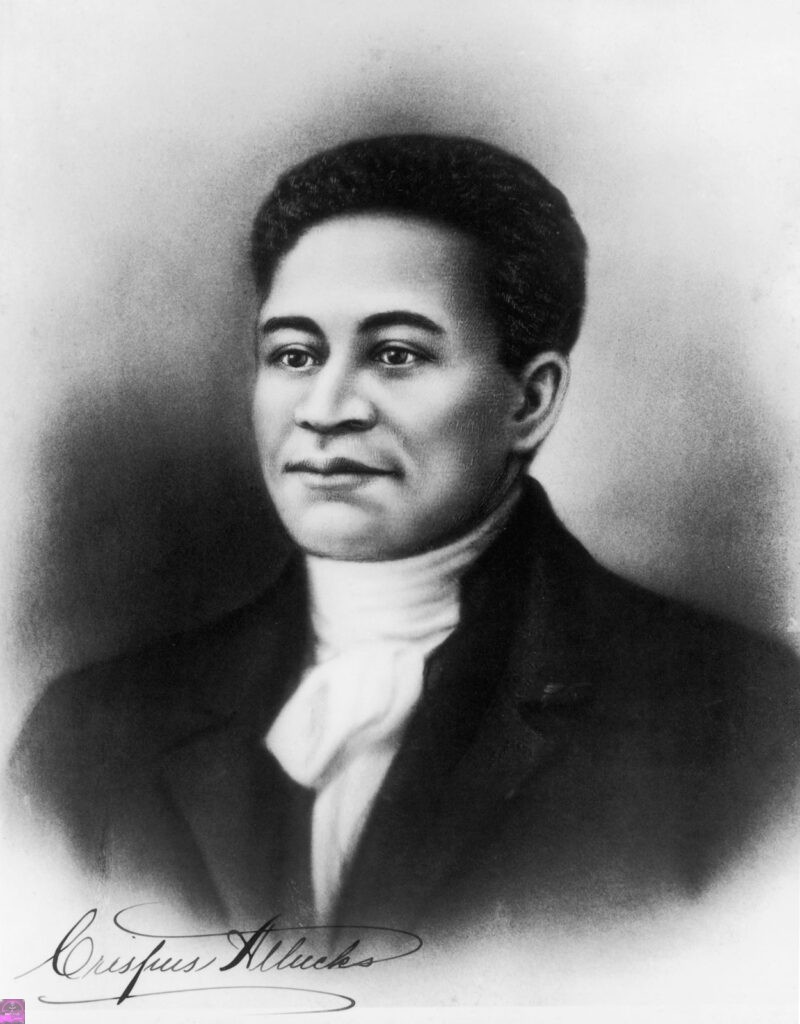
Crispus Attucks (c. 1723 – March 5, 1770) is widely regarded as the first person killed in the Boston Massacre and, as a result, the first American casualty of the American Revolution. A man of African and Native American (likely Wampanoag) descent, Attucks was a sailor, whaler, and stevedore who lived much of his life at sea. His death on March 5, 1770, amid escalating tensions between Boston colonists and British troops, transformed him from an ordinary dockworker into a powerful symbol of resistance, sacrifice, and the fight for liberty—especially in African American history and during Black History Month observances.
In 2026, as we commemorate the centennial of Black History Month under the ASALH theme “A Century of Black History Commemorations,” Attucks’ story remains a cornerstone, highlighting early Black contributions to American independence and the ongoing pursuit of inclusive historical narratives.
Early Life and Background
Born around 1723 in Framingham, Massachusetts, Attucks was likely born into slavery. Historical records suggest his father was an enslaved African man (possibly named Prince Yonger), and his mother was a Natick or Wampanoag Native American woman (possibly Nancy Attucks). The name “Attucks” derives from the Narragansett word for “deer,” linking him to Indigenous heritage.
In 1750, Deacon William Brown of Framingham advertised in the Boston Gazette for the return of a runaway slave named “Crispas,” described as a “Molatto Fellow, about 27 Years of Age, 6 feet two Inches high, short curl’d Hair,” offering a 10-pound reward. Historians debate whether Attucks was still enslaved or had secured his freedom by the time of his death, but he lived as a free man afterward, using the alias “Michael Johnson” at times to evade recapture.
Attucks worked in maritime trades—whaling, sailing, and stevedoring—spending years on ships and Atlantic docks. He was in Boston in early 1770 after a voyage to the Bahamas, planning to head to North Carolina.
His mixed ancestry (African and Native) was typical in colonial New England, where intermarriages occurred amid enslavement and displacement. Contemporary accounts often described him as “mulatto” (referring to skin tone) or tied to Indigenous roots, though modern narratives emphasize his African American identity.
The Boston Massacre
Tensions in Boston had risen since 1768, when British troops arrived to enforce taxes like the Townshend Acts. On March 5, 1770, a confrontation escalated: a wigmaker’s apprentice accused a British officer of non-payment, leading to harassment of a sentry. A crowd gathered, throwing snowballs, sticks, and insults at soldiers from the 29th Regiment.
Attucks joined the mob, reportedly at the front with a club or cordwood stick. Witnesses gave conflicting accounts—some claimed he struck a soldier or led the charge; others said he was leaning on his stick. When the soldiers fired, Attucks was hit by two musket balls in the chest (one ricocheting), killing him instantly. He was about 47 years old.
Five colonists died that night (Attucks first), with six wounded. His body lay in state at Faneuil Hall before a joint funeral and burial in the Granary Burying Ground (now a shared grave with other victims).
Aftermath and Trial
John Adams defended the soldiers, calling the crowd a “motley rabble” and portraying Attucks as an instigator with “mad behavior.” Two soldiers were convicted of manslaughter (branded on the thumb) but avoided harsher punishment. Samuel Adams popularized “Boston Massacre” in propaganda, with Paul Revere’s engraving (based on Henry Pelham’s image) depicting the event—often showing Attucks prominently.
Legacy and Commemoration
Abolitionists in the 19th century, like William Cooper Nell, elevated Attucks as a martyr and symbol of Black patriotism. His death helped fuel anti-slavery arguments and claims to citizenship. By the mid-1800s, Boston abolitionists celebrated “Crispus Attucks Day.”
Key memorials include:
- The Boston Massacre Monument (1888) on Boston Common, with Attucks in the foreground bas-relief.
- Crispus Attucks High School (Indianapolis, first Black high school to win national basketball championships in 1955–1956).
- Schools, theaters, parks, and centers named after him nationwide.
- 1998 U.S. Treasury silver dollar featuring him (supporting a proposed Black Revolutionary War Patriots Memorial).
In popular culture: referenced by Martin Luther King Jr., Stevie Wonder (“Black Man”), Nas, and in media like Luke Cage and Da 5 Bloods. Debates persist on his exact role (hero vs. instigator), freedom status, and whether Christopher Seider (killed February 22, 1770) was the true first casualty—but Attucks remains the most remembered.
During Black History Month 2026, sites like the Museum of the American Revolution and Boston Parks highlight Attucks as a figure of resilience, tying his sacrifice to broader themes of freedom and equality.
▼ Click to view: Crispus Attucks & Historical References
Historical Reference List
- Africans in America – Part 2 – Crispus Attucks. PBS. Retrieved 1 November 2011.
- Africans in America: Crispus Attucks. PBS. Retrieved 18 May 2022.
- Crispus Attucks. Biography.com. 26 March 2021.
- Dixon, Chris (2018). African Americans and the Pacific War, 1941–1945. Cambridge University Press.
- Christopher Seider: The First Casualty. New England Historical Society.
- Kachun, Mitchell (2017). First Martyr of Liberty: Crispus Attucks in American Memory. Oxford University Press.
- Crispus Attucks Family. The Crispus Attucks Museum.
- Reflecting Attucks: Putting Pieces Together. Revolutionary Spaces.
- Appearance of Crispus Attucks. RootsWeb.
- The Hidden Life of Crispus Attucks. Journal of the American Revolution.
- 16 Mar 1860, Page 2 – The Liberator. Newspapers.com.
- The Murder of Crispus Attucks. Library of Congress.
- Books Bound in Human Skin. The New York Times.
- Crispus Attucks ‘Today Was a Good Day’ – Wayne Brady. YouTube.
Part of the Salty Vixen Wiki “How to Guides” collection.
