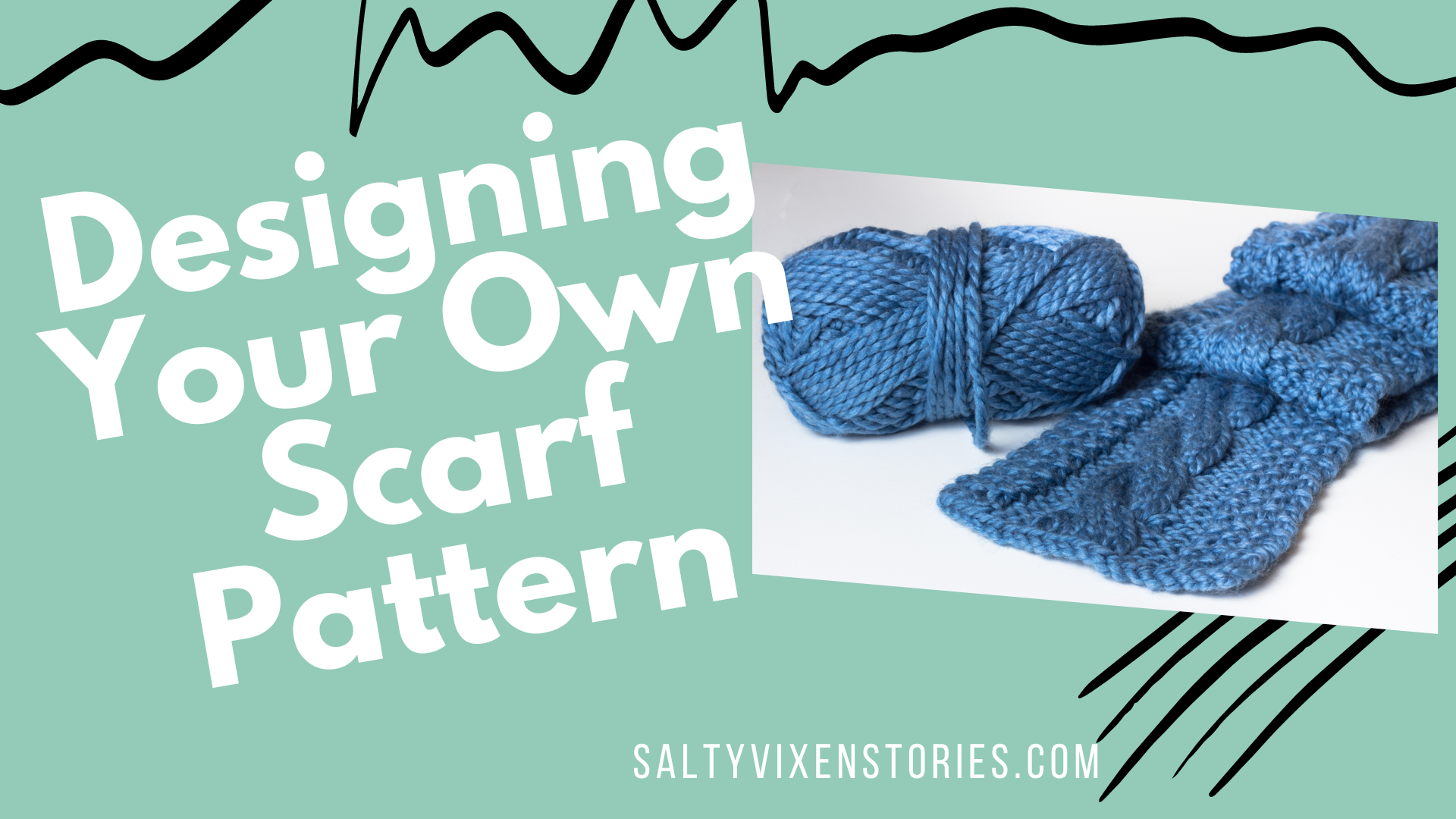
If you can knit, you can design your own scarf pattern. If you can purl as well, that’s a bonus. Unless it’s something unusual, such as my Zig Zag Scarf, there’s no need for a pattern at all. You just need to understand a few basics and you’re off and knitting!:
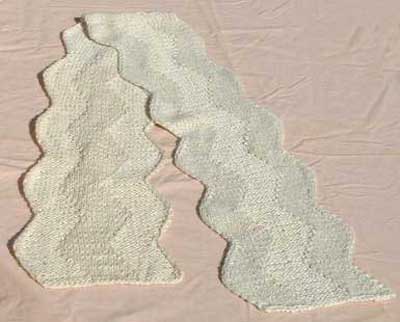 Instructions for Zig-Zag:
CO 29 st.
Row 1: k10, p9, k10
Row 2: sl1, p9, k9, p9, sl1
Row 3: k1, k into front and back of next st, k7, p9, k8, k2tog, k1
Row 4: sl1, p9, k9, p9, sl1
Rows 5 through 14: Rep rows 3 and 4
Row 15: k1, ssk, k8, p9, k7, k into front and back of next st, k1
Row 16: sl1, p9, k9, p9, sl1
Rows 17 through 26: Rep rows 15 and 16
Repeat rows 3-26 until scarf is desired length and BO in pattern.
Stockinette Rolls
The first thing you need to know is stockinette rolls. If you knit one row and purl the next for 8 feet, yes you’ll have a scarf. But it will roll inward and what you will end up with is something that resembles a tube.
Stockinette makes a lovely, although plain, fabric. If you want to do a stockinette scarf, add three to four stitches of seed stitch :
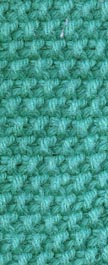 Instructions for Seed Stitch:
Even number of stitches
Row 1: *k1, p1; rep from *
Row 2: *p1, k1; rep from *
or garter stitch as borders on each side and four rows at the top and bottom. This will keep the fabric stable and it won’t roll.
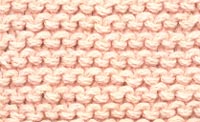 Instructions for Garter Stitch:
On straight needles:
Knit every row
On circular needles:
Knit the first round
Purl the second round
Or get around the problem entirely by working the entire scarf in seed stitch or garter stitch. There are literally thousands of very lovely stitch patterns that will also lie flat; consider working one of those. Most of these are put to better use when worked with a smooth yarn that will show them off as they are lost in textured novelty yarns.
But How Many Stitches Do I Start With?
This depends on two things: the gauge and the desired width.
A good width for a scarf is 6″ to 7.5″. This isn’t a hard and fast rule but it’s a general guideline. You might want a slinky scarf knit in a baby weight alpaca to be only 4″ wide. The choice is yours.
To determine how many stitches to cast on, work a swatch and measure your gauge. Determine how many stitches equal one inch. You might consider using much larger needles than you ordinarily would with the yarn (look at the label for the suggested needle size) for a more open look. Remember, this is a scarf, not a sweater.
Desired width x stitches per inch = the number of stitches to cast on.
For example, let’s say you wanted to make a scarf 6″ wide and your gauge was 4 stitches to the inch. You would cast on 24 stitches to begin (6 x 4= 24).
If you’re using a pattern stitch that requires a stitch multiple, then you’ll need to begin by casting on a number of stitches that will work with that multiple. A multiple of 4 means any number divisible by 4. A multiple of 4 + 1 means any number divisible by 4 plus 1.
How Long And How Much Yarn?
There’s no rule here either. You might want a scarf 2 feet long that can be tucked around your neck and inside your coat. Or you might want one 8 feet long.
The amount of yarn you need is dependent upon how long you want the scarf to be and how many yards there are in a skein, as well as your gauge. There’s no easy way to figure this out (that’s one advantage of using a pattern) with any accuracy. So if you want a fairly long scarf, buy three or four skeins and add them to your stash if you don’t use them all.
Combine Yarns
Combining two different yarns and knitting with them as if they were one is a fun way to create a unique scarf and a totally different yarn at the same time!
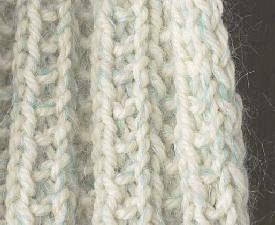
This is a good example of combining two totally different yarns to create a look that neither alone would produce. A very thin aqua mohair is carried along with a neutral, soft wool. It also illustrates how you can use a stitch pattern to create a beautiful and classic scarf.
Novelty Yarns Are Fun And Easy
Novelty yarns are all the rage and you’ll find a staggering number of different types, all of which make great scarves. Use them alone or combine them together, or with another smooth yarn. The possibilities are literally endless. Remember that fancy stitch patterns will get lost with all the texture, yet you want it to be flat. So just use garter stitch or seed stitch and you can create any look you like.
