
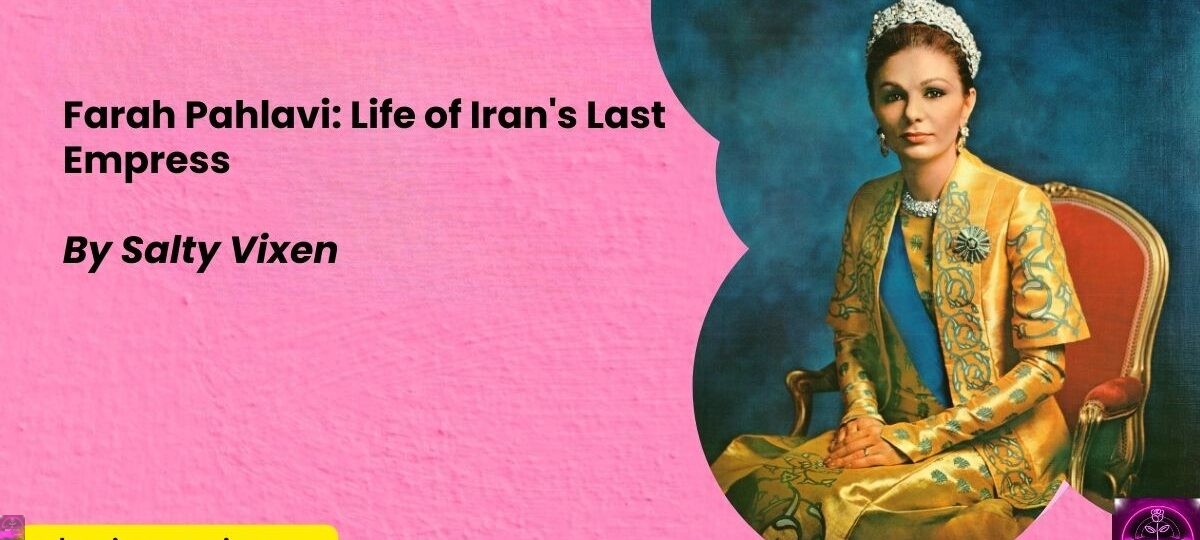
Farah Pahlavi, born Farah Diba on October 14, 1938, in Tehran, Iran, embodies one of the most dramatic personal and national stories of the 20th and 21st centuries. As the last Shahbanou (Empress) of Iran, consort to Mohammad Reza Pahlavi, she became a global symbol of modernization, cultural patronage, and women’s advancement during the Pahlavi dynasty’s final two decades. Her life trajectory—from an upper-middle-class childhood marked by early loss, to architectural studies in Paris, a fairy-tale marriage at 21, intense public service as empress, dramatic flight into exile in 1979, profound personal grief, and continued advocacy into her late 80s—mirrors Iran’s own turbulent path from monarchy to revolution to ongoing protest movements. In 2026, amid fresh waves of demonstrations against the Islamic Republic, Farah remains an active, hopeful voice, declaring that Iran’s return to freedom “will take place soon” and that “there is no turning back.”
Childhood in Tehran: Privilege, Loss, and Resilience
Farah was born the only child into a prosperous Tehran family. Her father, Captain Sohrab Diba (1899–1948), was a respected officer in the Imperial Iranian Armed Forces who had graduated from the prestigious French Military Academy of St. Cyr. This French connection shaped much of the family’s outlook and Farah’s later education. Her mother, Farideh Ghotbi (1920–2000), came from a Gilak family in Lahijan on the Caspian Sea coast, while Sohrab’s roots lay in Iranian Azerbaijan. Farah’s grandfather had served as Persian Ambassador to the Romanov Court in St. Petersburg in the late 19th century, adding diplomatic prestige to the lineage. Extended family included notable figures such as politician Abolhassan Diba, architect Kamran Diba (designer of the Tehran Museum of Contemporary Art), and art curator Layla Diba.
The family enjoyed a comfortable life in a spacious villa in northern Tehran until tragedy struck. In 1948, when Farah was just nine, Sohrab died unexpectedly. The loss devastated her emotionally—she later described an especially close bond with her father—and triggered severe financial strain. The once-affluent household relocated to a modest shared apartment with relatives. Despite the hardship, Farideh prioritized her daughter’s education and emotional stability, fostering Farah’s intellectual curiosity, discipline, and athletic talent. These early experiences of bereavement and adaptation instilled a lifelong empathy for the vulnerable, a trait that would define her philanthropic work decades later.
Education: From Tehran Schools to Paris Architecture
Farah’s schooling reflected Iran’s cosmopolitan mid-20th-century elite culture. She began at Tehran’s Italian School, gaining early exposure to languages and arts, then attended the French Jeanne d’Arc School until age 16, where she mastered French—a skill that later eased her international role. She completed her baccalaureate at Lycée Razi, a respected secular Persian-French institution. Academically strong, she also excelled in sports, captaining her school’s basketball team and displaying natural leadership.
In the late 1950s, driven by passion for design and urban planning, Farah moved to Paris to study architecture at the École Spéciale d’Architecture under professor Albert Besson. Living independently as a student in the French capital exposed her to modernist ideas, Western art scenes, and the intellectual ferment of postwar Europe. She balanced rigorous coursework with social life among Iranian expatriates. It was during this period, in 1959, that her path intersected fatefully with Iran’s ruling family. At a reception at the Iranian embassy organized for Iranian students abroad, she met Mohammad Reza Pahlavi. The encounter sparked an immediate connection; after the Shah returned to Tehran that summer, their courtship progressed rapidly.
Marriage and Coronation: From Student to Shahbanou
The engagement was announced on November 23, 1959; the wedding followed on December 20, 1959, when Farah was 21. The ceremony captivated global media—Farah wore a gown by Yves Saint Laurent (for Christian Dior) and the magnificent Noor-ol-Ain Diamond tiara. This was the Shah’s third marriage; previous unions with Fawzia of Egypt and Soraya Esfandiary produced no male heir, creating intense pressure under Iran’s agnatic primogeniture succession rules.
The couple’s four children arrived in quick succession:
- Crown Prince Reza Pahlavi (b. October 31, 1960), married to Yasmine Etemad-Amini; grandchildren: Noor (1992), Iman (1993), Farah (2004).
- Princess Farahnaz Pahlavi (b. March 12, 1963).
- Prince Ali Reza Pahlavi (April 28, 1966 – January 4, 2011); daughter Iryana Leila (b. 2011) with companion Raha Didevar.
- Princess Leila Pahlavi (March 27, 1970 – June 10, 2001).
Reza’s birth eased succession concerns and allowed Farah to expand her public role. On October 26, 1967, she was crowned Shahbanou—the first such title in modern Iran and a landmark for Muslim-majority monarchies—symbolizing the regime’s commitment to gender progress. She was also designated regent should the Shah die before Reza turned 21, an extraordinary provision in Middle Eastern royal tradition.
Biography FAQ: The Life of Farah Pahlavi
Keywords: زنان, فرح پهلوی, زندگینامه, FAQ,
Role as Empress: Philanthropy, Culture, and Social Reform
Farah’s empress tenure (1959–1979) focused intensely on non-political spheres: education, health, culture, women’s rights, and heritage preservation. She presided over 24 major organizations with a dedicated staff of 40, often working 9 a.m. to 9 p.m. Key initiatives included:
- Organization for Family Well Being: nurseries, literacy classes, family planning, vocational training for women.
- Fight Against Cancer, Blood Transfusion Organization, Help to Needy.
- Imperial Institute of Philosophy, Foundation for Iranian Culture.
- Shiraz Arts Festival (1967–1977): brought Iranian traditional arts alongside avant-garde Western performances; occasionally controversial but celebrated globally.
- Tehran Museum of Contemporary Art: acquired ~150 major works (Picasso, Warhol, Pollock, etc.) in the 1970s art market dip—today valued at billions.
- Reza Abbasi Museum, National Carpet Gallery, Glassware and Ceramic Museum, Negarestan Cultural Center.
- Pahlavi University (now Shiraz University): Iran’s first American-style institution, dramatically increasing women’s higher education access.
- Leprosy programs: visited communities, donated land for rehabilitation villages, invited international specialists to destigmatize the disease.
She traveled extensively across Iran, visiting remote villages and connecting directly with citizens—earning genuine popularity through the mid-1970s. Cultural repatriation efforts brought back thousands of ancient artifacts. Her architectural background informed preservation of historic sites and creation of urban green spaces in Tehran and beyond.
The Iranian Revolution and Exile (1978–1980)
By 1978, economic inequality, rapid Westernization backlash, and Islamist mobilization fueled widespread protests. Farah sensed the “palpable unease”; public events were canceled for security. On January 16, 1979, she and the Shah fled Tehran amid death threats and chaos. Their 18-month odyssey included asylum in Egypt (hosted by Anwar Sadat), Morocco, the Bahamas, Mexico, the United States (for the Shah’s cancer treatment, triggering the 1979–1981 hostage crisis), Panama, and finally back to Egypt. Mohammad Reza died on July 27, 1980, in Cairo. Farah briefly served as symbolic regent until October 1980.
Life in Exile: Grief, Memoir, and Continued Advocacy
After Sadat’s 1981 assassination, Farah relocated to the United States (initially Massachusetts and Connecticut, later Potomac, Maryland, near family). She published her 2004 memoir *An Enduring Love: My Life with the Shah (amazon.com)* (~450–620 pages), a candid European bestseller recounting romance, reign, revolution, and loss—praised for intimacy but critiqued for occasional bitterness toward critics.
Personal tragedies compounded exile: daughter Leila died by suicide in 2001 (age 31); son Ali Reza in 2011 (age 44). Farah remains close to surviving children, grandchildren, and divides time between Washington, D.C., and Paris, making annual pilgrimages to the Shah’s Cairo mausoleum.
She supports Alzheimer’s research, attends European royal events, and speaks on Iran. In the 2025–2026 protests, she issued statements mourning victims, declared January 23, 2026, a National Day of Mourning, and participated in global solidarity actions (e.g., February 2026 rallies). In Paris interviews she expressed optimism: “The regime is cracking… my compatriots’ courage gives hope.”
Legacy and Honours
Farah’s legacy is dual: celebrated for cultural renaissance, women’s empowerment, and heritage preservation; criticized by opponents as emblematic of monarchical excess. Honours include Iran’s Order of the Pleiades, Austria’s Grand Star of Honour, Italy’s Order of Merit (Grand Cross), Thailand’s Order of the Royal House of Chakri, France’s Académie des Beaux-Arts membership, and more.
Her story endures as one of grace, dedication, and unyielding hope for a freer Iran.
فرح پهلوی: Farah Pahlavi: Life of Iran’s Last Empress : References
▼ Click to Expand
- “Shahbanou (Documentary)”. Official YouTube Channel.
- “Queen Farah Pahlavi”. farahpahlavi.org.
- Afkhami, Gholam Reza. The life and times of the Shah. ISBN 978-0-520-25328-5.
- Shakibi, Zhand. Revolutions and the Collapse of Monarchy. ISBN 978-1-84511-292-9.
- Taheri, Amir. The Unknown Life of the Shah. ISBN 0-09-174860-7; p. 160
- Pahlavi, Farah. ‘An Enduring Love: My life with The Shah. A Memoir’ 2004
- Manshadi, Nooshin. Farewell My Queens. ISBN 9782382362716.
- Bob Colacello. “Farah Pahlavi”. Interview.
- “Empress Farah Pahlavi Site”. Archived Official Site.
- Meng, J. I. Translation, History and Arts. ISBN 9781443851176.
- Snodgrass, Mary Ellen. World Clothing and Fashion. ISBN 9781317451679.
- Pahlavi, Farah. ‘An Enduring Love: My Life with The Shah. A Memoir’, 2004.
- “Queen of Iran Accepts Divorce”, The New York Times, 15 March 1958.
- “Announcement of Birth”. Reza Pahlavi. Archived Link.
- Zonis, Marvin Majestic Failure The Fall of the Shah, 1991 page 138.
- Milani, Abbas The Shah, London: Macmillan, 2011 page 279.
- “The Working Empress”. Time Archive.
- Zonis, Marvin Majestic Failure The Fall of the Shah, 1991 page 221.
- “Souad Hosny’s Looks”. CairoScene.
- Gluck, Robert. “The Shiraz Arts Festival”. Leonardo.
- Norman, Geraldine. “Gifts from the East”. The Independent.
- de Bellaigue, Christopher. “Lifting the veil”. The Guardian.
- Pahlavi, Farah. “An Enduring Love: My Life with The Shah” 2004.
- Raikhel-Bolot, Viola. Iran Modern. Assouline, 2018.
- “American Art Treasures”. ABC News.
- “1978: PM steps down”. BBC News.
- “The Shah’s Flight”. Time Archive.
- “Crown Prince Reza Pahlavi Proclamation”. UPI Archives.
- Pahlavi, Farah. “An Enduring Love” 2004.
- “Empress Farah Pahlavi on the Future of Iran”. Town & Country.
- “Alain Delon and Farah Pahlavi Gala”. Payvand.
- “No turning back after protests”. RFI (2026).
- Sciolino, Elaine. “The Last Empress”. NYT.
- Bayegan, Reza. “The Shah & She”. National Review.
- “The Queen and I”. Sundance Films.
- “Farah Diba Premiere”. Iranian.com.
- “The Shah Marries Farah Diba”. Getty Images.
- “Austrian Reply”. Parliament PDF.
- “Kolana Řádu Bílého lva”. Vyznamenani.net.
- “Danske dekorationer”. Kongehuset.
- “FARAH PAHLAVI S.M.I.”. Quirinale Record.
- “BOE Archive”. Spain (PDF).
- Thai Government Gazette. Thai PDF Archive.
- Look Women of the Year. Hope Award 2015.
- “Accademie des Beaux-Arts Induction”. Official Induction News.
- “Steiger Award 2010”. Archived Official News.
- “Charlie Award 2014”. Official Link.
- “Spring Gala Chair”. NMWA 2014.
Bibliography
An Enduring Love: My Life with the Shah. ISBN 978-1-4013-5961-4
