

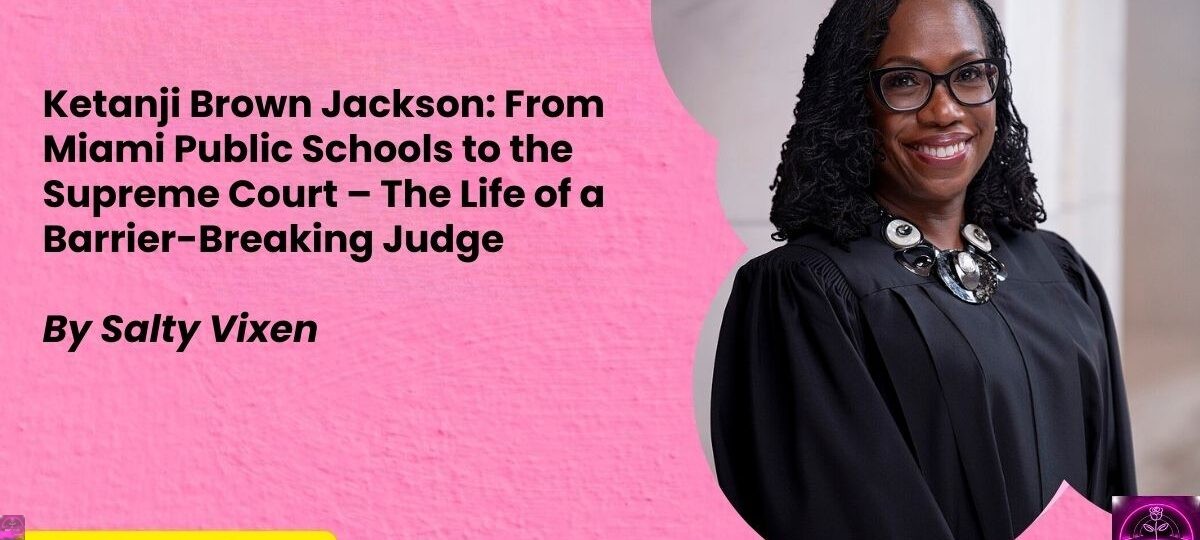
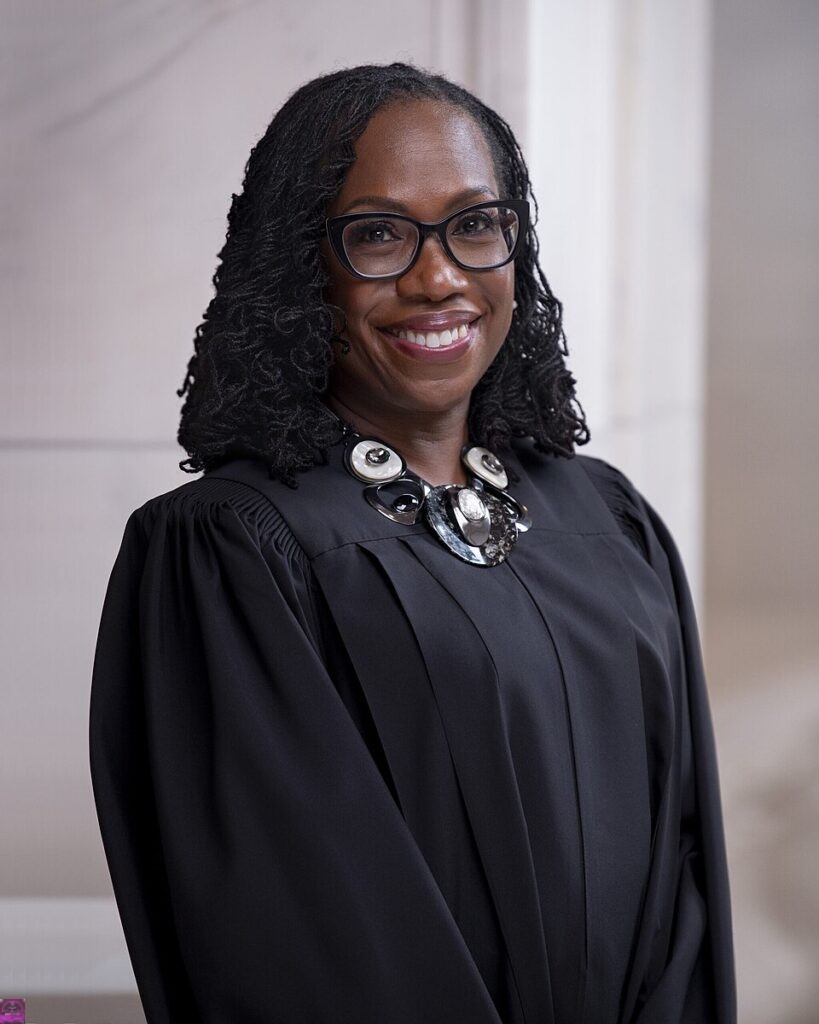
In February 2022, when President Joe Biden nominated Ketanji Brown Jackson to the United States Supreme Court, the announcement hit like a long-overdue sunrise. For the first time in American history, a Black woman would sit on the highest court in the land. The moment was historic, yes—but it also felt deeply personal for millions of Black women, girls, lawyers, judges, and everyday people who had never seen someone who looked like them in that seat. Ketanji Brown Jackson didn’t just fill a vacancy. She carried the hopes, the work, and the quiet pride of generations who had fought to be seen and heard in rooms where decisions are made about their lives.
This is not a dry timeline of dates and titles. This is the story of a woman who grew up in Miami, defended the accused as a public defender, raised a family, earned respect across the legal spectrum, and now sits on the Supreme Court—still asking hard questions, still listening closely, still writing opinions that cut through noise to reach real people.
Born Ketanji Brown on September 14, 1970, in Washington, D.C., she was the daughter of two public servants. Her father, Johnny Brown, was an attorney who later chaired the Miami-Dade School Board. Her mother, Ellery Brown, was a schoolteacher who became a principal in the Miami-Dade public school system. Both parents believed education and service were non-negotiable. That belief shaped everything Ketanji would become.
The family moved to Miami when she was young. She grew up in a middle-class Black neighborhood where possibility and struggle lived side by side. Miami in the 1970s and 1980s was a place of vibrant Caribbean culture, growing Black middle-class communities, and persistent inequality in schools and housing. The Browns chose to raise their children where they could see both the dream and the work it took to reach it.
Ketanji attended Miami Palmetto Senior High School, a public school where she stood out without trying to. She was elected student body president, sang in the choir, kept her grades high, and earned a reputation for being kind, smart, and quietly determined. From an early age she understood that education was the way forward. Her parents reinforced that lesson every day: do your best, help others, keep learning.
She has often said her parents’ example was her first real civics lesson. Her father’s work on the school board showed her how policy decisions affect real kids. Her mother’s career as a teacher and principal showed her how one person in a classroom can change lives. Those lessons weren’t abstract—they were lived every morning at the breakfast table and every evening when her parents came home tired but still talking about the kids they served.
In 1988, Ketanji Brown arrived at Harvard University. She majored in government, graduated magna cum laude in 1992, and threw herself into campus life. She joined the Black Students Association, worked on student publications, and started to see law not just as a job, but as a way to make things fairer. At Harvard Law School (J.D. 1996), she edited the Harvard Law Review, was active in the Black Law Students Association, and clerked during summers. Her legal thinking began to take shape: the law should protect people who need protection most, hold the powerful accountable, and reflect the full diversity of the country.
During law school she met Patrick Jackson, a medical student who would become her husband. Their relationship—built on mutual respect, shared values, and quiet support—has been a steady anchor through every stage of her career. They married in 1996 and have two daughters, Talia and Leila.
After law school, she clerked for Judge Patti B. Saris on the U.S. District Court for the District of Massachusetts (1996–1997) and then for Justice Stephen Breyer on the U.S. Supreme Court (1999–2000). Those clerkships gave her a front-row seat to federal judging and the Supreme Court itself—experiences that quietly planted the idea that one day she might sit on that bench.
In 2005, she made a choice that would define her legal philosophy and her public reputation: she became a federal public defender in the District of Massachusetts—one of the few Black women to hold that role at the federal level.
For eight years (2005–2013), she represented indigent clients accused of federal crimes—many of them young Black and Brown men caught in the gears of mandatory minimums, sentencing disparities, and over-criminalization. She fought for reduced sentences, challenged unconstitutional searches, and won dismissals when evidence was weak or rights had been violated.
That work changed her. She saw how the criminal justice system could destroy lives and families. She also saw the humanity in every client—the stories behind the charges, the possibility of second chances, the importance of a strong defense. She has said many times that standing in courtrooms where her clients’ futures were on the line taught her humility, empathy, and a fierce belief that everyone deserves a fair shot under the law.
“I stood in courtrooms where my clients’ futures hung in the balance,” she said in later interviews. “I learned that justice is not automatic—it must be fought for every single day.”
In 2013, President Barack Obama nominated her to the U.S. District Court for the District of Columbia. She was confirmed and served from 2013 to 2021, handling a wide range of cases: civil rights, national security, executive actions, and high-profile criminal matters.
Her rulings were praised for clarity, fairness, and close attention to precedent. She earned a reputation as a judge who listened carefully, asked sharp questions, and wrote opinions that were both scholarly and readable. In 2021, President Biden elevated her to the U.S. Court of Appeals for the D.C. Circuit—one of the most influential appellate courts in the country. She served there briefly before the historic nomination to the Supreme Court.
On February 25, 2022, President Biden announced her nomination to replace retiring Justice Stephen Breyer. The news was met with celebration in Black communities, women’s organizations, legal circles, and civil rights groups. It was also met with intense scrutiny.
The Senate confirmation hearings in March 2022 were tough. Some senators focused on her sentencing record in child-pornography cases—a common line of attack against public defenders. Others questioned her judicial philosophy or tried to paint her as an activist. Jackson answered every question with calm, precise, unflinching clarity. She explained her rulings, cited precedent, and emphasized her commitment to impartiality and the rule of law.
On April 7, 2022, she was confirmed by a bipartisan vote of 53–47. Three Republican senators (Collins, Murkowski, Graham) joined Democrats. She was sworn in on June 30, 2022, becoming the first Black woman on the Supreme Court.
Since joining the Court, Justice Jackson has quickly become known for:
- Sharp, fact-focused questioning during oral arguments
- Emphasis on the real-world consequences of decisions
- Clear, accessible writing
- Willingness to write separately when she sees things differently
Notable early contributions include:
- Her powerful dissent in the 2023 affirmative action case (Students for Fair Admissions v. Harvard), where she wrote about the ongoing reality of racial inequality in America.
- Her concurrence in the 2024 social-media moderation cases, balancing free speech concerns with the unique challenges of online platforms.
- Her majority opinion in Moore v. United States (2024), upholding certain tax provisions with careful statutory analysis.
She often asks questions about how decisions affect everyday people—not just legal abstractions. Her background as a public defender gives her a perspective that had been missing on the Court for generations.
Justice Jackson is married to Dr. Patrick Jackson, a general surgeon. They have two daughters, Talia and Leila. The family keeps a relatively private life, though Justice Jackson occasionally shares moments of joy—her love of college football (she’s a lifelong Miami Hurricanes fan), family traditions, and gratitude for the people who helped her along the way.
In public she is warm, approachable, and deeply serious about her work. She has spoken openly about the emotional weight of her confirmation, the pride she feels representing Black women, and the responsibility she carries to “do justice” every day.
Her legacy is already being written:
- First Black woman on the Supreme Court
- Only former federal public defender on the current Court
- A voice for empathy, fairness, and real-world impact in the law
In 2026—the 100-year mark of Black History Month—she stands as proof that the table can be expanded, the bench can be diversified, and the law can, when guided by conscience, move closer to the promise of equal justice.
She has said: “I stand on the shoulders of giants—Black women who came before me, who fought for the right to be seen, to be heard, to be respected.”
Now she is one of those giants for the next generation.
Her story is still being written. But it is already one for the history books—and for the hearts of everyone who ever felt they didn’t belong in the room.
▼ Click to view: Justice Ketanji Brown Jackson References
Cited References
- Jalonick, M. C.; Sherman, M. (2022). Jackson confirmed as first Black female high court justice. Associated Press.
- Hurley, L.; Chung, A. (2022). Senate confirms Jackson as first Black woman on U.S. Supreme Court. Reuters.
- The Current Court: Justice Ketanji Brown Jackson. Supreme Court Historical Society.
- Marimow, Ann E. (2021). Biden’s court pick Ketanji Brown Jackson has navigated a path few Black women have. The Washington Post.
- Read Ketanji Brown Jackson’s opening statement. Politico (2022).
- Mazzei, P. (2022). How a High School Debate Team Shaped Ketanji Brown Jackson. The New York Times.
- Reed, Rachel (2022). President Biden nominates Ketanji Brown Jackson ’96 for Supreme Court. Harvard Law School.
- Carlisle, Madeleine (2022). Ketanji Brown Jackson Confirmed to the Supreme Court. Time.
- Biographical Directory of Federal Judges: Ketanji Brown Jackson. Federal Judicial Center.
- Braun, Julie (2022). Ketanji Brown Jackson: Legal Philosophy of a Rookie Supreme Court Justice. Journal of Health Care Finance.
- Treisman, Rachel (2024). Justice Ketanji Brown Jackson makes her Broadway debut. NPR.
- 2026 GRAMMY® Nominees: Ketanji Brown Jackson. Penguin Random House.
Additional Sources & Journals
- The Journal of Blacks in Higher Education (2005). “Tracking the Progress of African Americans on Editorial Rolls.”
- Bowles, D. D.; Hopps, J. G.; Strickland, C. (2022). “Two Firsts: Sandra Day O’Connor and Ketanji Brown Jackson.” Phylon.
- Bradley, C.; Roland, J. (2022). “Debate as a Foundation for Youth Civic Engagement.” National Civic Review.
Wiki Reference Category: ‘How to Guides’ – Legal & Historical Pioneers. Last Updated: February 2026.
