

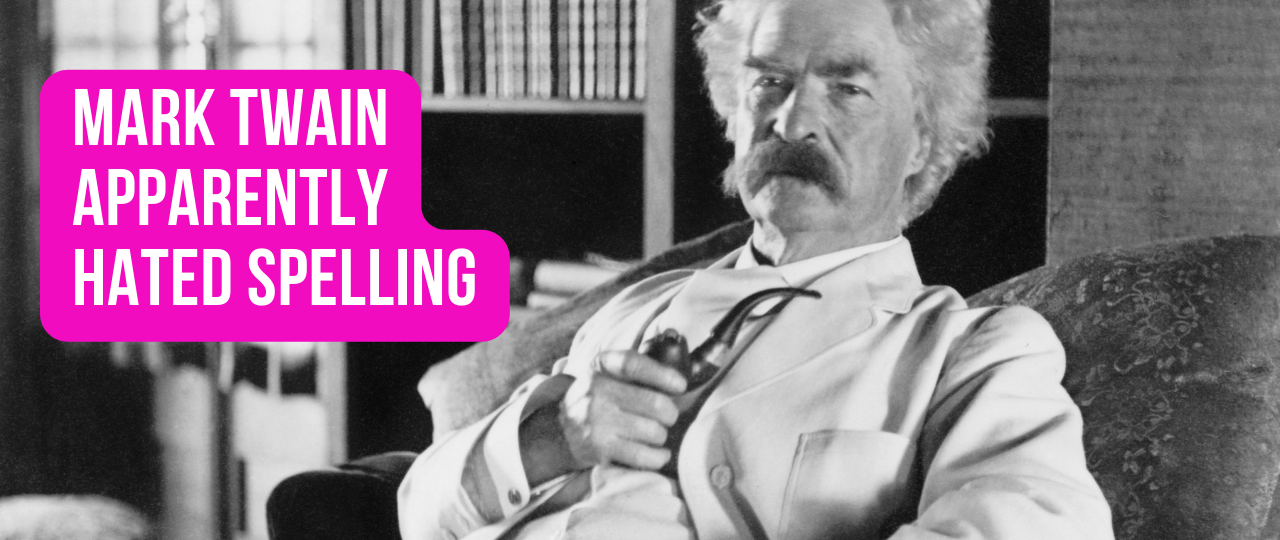
When it comes to spelling, even the pros can get tripped up in their prose. As Winnie the Pooh once observed, “It’s good spelling but it Wobbles, and the letters get in the wrong places.” English spelling is complicated, inconsistent, and often downright ornery. But don’t take our word for it. Consider what some well-known writers have had to say about English orthography.
- The Only Stupid Thing
“The use of words is of itself an interesting study. You will hardly believe the difference the use of one word rather than another will make until you begin to hunt for a word with just the right shade of meaning, just the right color for the picture you are painting with words. Had you thought that words had color? The only stupid thing about words is the spelling of them.”
(Laura Ingalls Wilder, quoted by Donald Zochert, Laura: The Life of Laura Ingalls Wilder)
- The Only Stupid Thing
- Taste and Fancy
“‘Do you spell it with a “V” or a “W”?’ inquired the judge.
“‘That depends upon the taste and the fancy of the speller, my Lord,’ replied Sam.”
(Charles Dickens, The Pickwick Papers)
- Taste and Fancy
- Spell Well
“Take care that you never spell a word wrong. Always before you write a word, consider how it is spelled, and, if you do not remember, turn to a dictionary. It produces great praise to a lady to spell well.”
(Thomas Jefferson, letter to his daughter Martha)
- Spell Well
- The Power of the Letters
“As language was at its beginning merely oral, all words of necessary or common use were spoken before they were written; and while they were unfixed by any visible signs, must have been spoken with great diversity, as we now observe those who cannot read to catch sounds imperfectly, and utter them negligently. When this wild and barbarous jargon was first reduced to an alphabet, every penman endeavoured to express, as he could, the sounds which he was accustomed to pronounce or to receive, and vitiated in writing such words as were already vitiated in speech. The powers of the letters, when they were applied to a new language, must have been vague and unsettled, and therefore different hands would exhibit the same sound by different combinations.”
(Samuel Johnson, Preface to A Dictionary of the English Language, 1755)
- The Power of the Letters
- Spelling Counts
“Spelling counts. Spelling is not merely a tedious exercise in a fourth-grade classroom. Spelling is one of the outward and visible marks of a disciplined mind.”
(James J. Kilpatrick)
- Spelling Counts
- Spelling and Schoolma’ams
“Correct spelling, indeed, is one of the arts that are far more esteemed by schoolma’ams than by practical men, neck-deep in the heat and agony of the world.”
(H.L. Mencken, The American Language)
- Spelling and Schoolma’ams
- Reckless Inconsistency
“With a new English alphabet replacing the old Semitic one with its added Latin vowels I should be able to spell t-h-o-u-g-h with two letters, s-h-o-u-l-d with three, and e-n-o-u-g-h with four: nine letters instead of eighteen: a saving of a hundred per cent of my time and my typist’s time and the printer’s time, to say nothing of the saving in paper and wear and tear of machinery. . . .“We try to extend our alphabet by writing two letters instead of one; but we make a mess of this device. With reckless inconsistency we write sweat and sweet, and then write whet and wheat, just the contrary. Consistency is not always a virtue; but spelling becomes a will o’ the wisp without it.
“If the introduction of an English alphabet for the English language costs a civil war, or even, as the introduction of summer time did, a world war, I shall not grudge it. The waste of war is negligible in comparison to the daily waste of trying to communicate with one another in English through an alphabet with sixteen letters missing. That must be remedied, come what may.”
(George Bernard Shaw, Preface to R.A. Wilson, The Miraculous Birth of Language, 1948)
- Reckless Inconsistency
- Mark Twain on Spelling
“I don’t give a damn for a man that can only spell a word one way.”
(Mark Twain)
- Mark Twain on Spelling
- “They spell it “Vinci” and pronounce it “Vinchy”; foreigners always spell better than they pronounce.”
(Mark Twain)
- “They spell it “Vinci” and pronounce it “Vinchy”; foreigners always spell better than they pronounce.”
- “I don’t see any use in having a uniform and arbitrary way of spelling words. We might as well make all clothes alike and cook all dishes alike. Sameness is tiresome; variety is pleasing. I have a correspondent whose letters are always a refreshment to me, there is such a breezy unfettered originality about his orthography. He always spells “Kow” with a large “K.” Now that is just as good as to spell it with a small one. It is better. It gives the imagination a broader field, a wider scope. It suggests to the mind a grand, vague, impressive new kind of a cow.”
(Mark Twain, reported in the Hartford Courant, May 13, 1875)
- “I don’t see any use in having a uniform and arbitrary way of spelling words. We might as well make all clothes alike and cook all dishes alike. Sameness is tiresome; variety is pleasing. I have a correspondent whose letters are always a refreshment to me, there is such a breezy unfettered originality about his orthography. He always spells “Kow” with a large “K.” Now that is just as good as to spell it with a small one. It is better. It gives the imagination a broader field, a wider scope. It suggests to the mind a grand, vague, impressive new kind of a cow.”
- “I never had any large respect for good spelling. That is my feeling yet. Before the spelling-book came with its arbitrary forms, men unconsciously revealed shades of their characters and also added enlightening shades of expression to what they wrote by their spelling, and so it is possible that the spelling-book has been a doubtful benevolence to us.”
(Mark Twain, Autobiography)
- Archaic, Cumbrous, Ineffective
“English orthography . . . is archaic, cumbrous, and ineffective; its acquisition consumes much time and effort; failure to acquire it is easy of detection.”
(Thorstein Veblen)
- Archaic, Cumbrous, Ineffective
- The Wuss Speller
“It is a pity that Chawcer, who had geneyus, was so unedicated. He’s the wuss speller I know of.”
(Artemus Ward, Artemus Ward in London, 1867)
- The Wuss Speller
- Reforming the Abuses
“The question now occurs; ought the Americans to retain these faults which produce innumerable inconveniencies in the acquisition and use of the language, or ought they at once to reform these abuses, and introduce order and regularity into the orthography of the AMERICAN TONGUE? Let us consider this subject with some attention.“Several attempts were formerly made in England to rectify the orthography of the language. But I apprehend their schemes failed to success, rather on account of their intrinsic difficulties, than on account of any necessary impracticability of a reform. It was proposed, in most of these schemes, not merely to throw out superfluous and silent letters, but to introduce a number of new characters. Any attempt on such a plan must undoubtedly prove unsuccessful. It is not to be expected that an orthography, perfectly regular and simple, such as would be formed by a ‘Synod of Grammarians on principles of science,’ will ever be substituted for that confused mode of spelling which is now established. But it is apprehended that great improvements may be made, and an orthography almost regular, or such as shall obviate most of the present difficulties which occur in learning our language, may be introduced and established with little trouble and opposition.”
(Noah Webster, “An Essay on the Necessity, Advantages, and Practicality of Reforming the Mode of Spelling and of Rendering the Orthography of Words Correspondent to Pronunciation,” 1789)
