

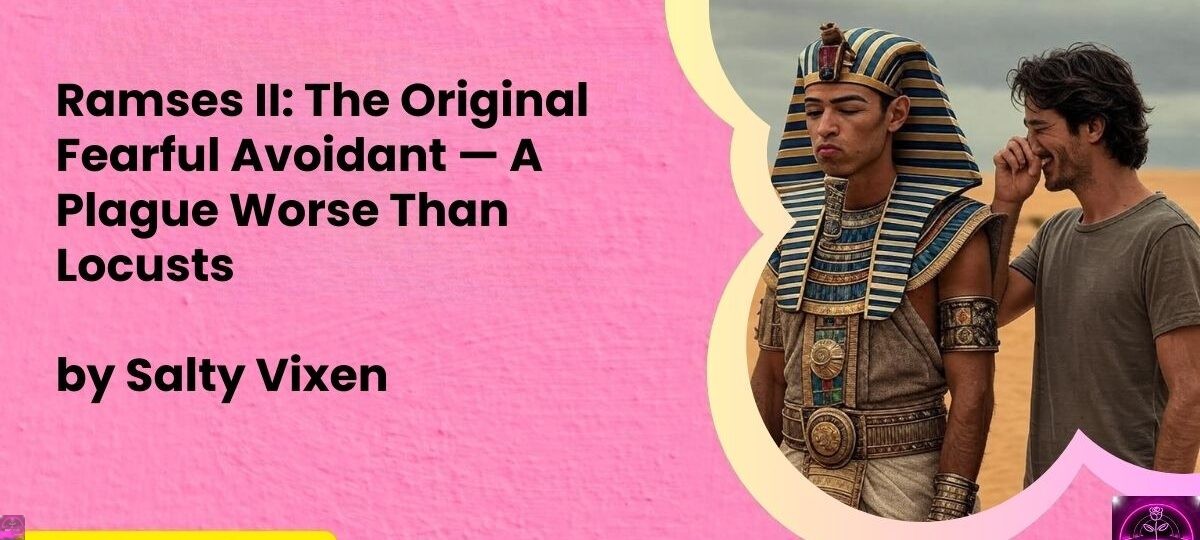
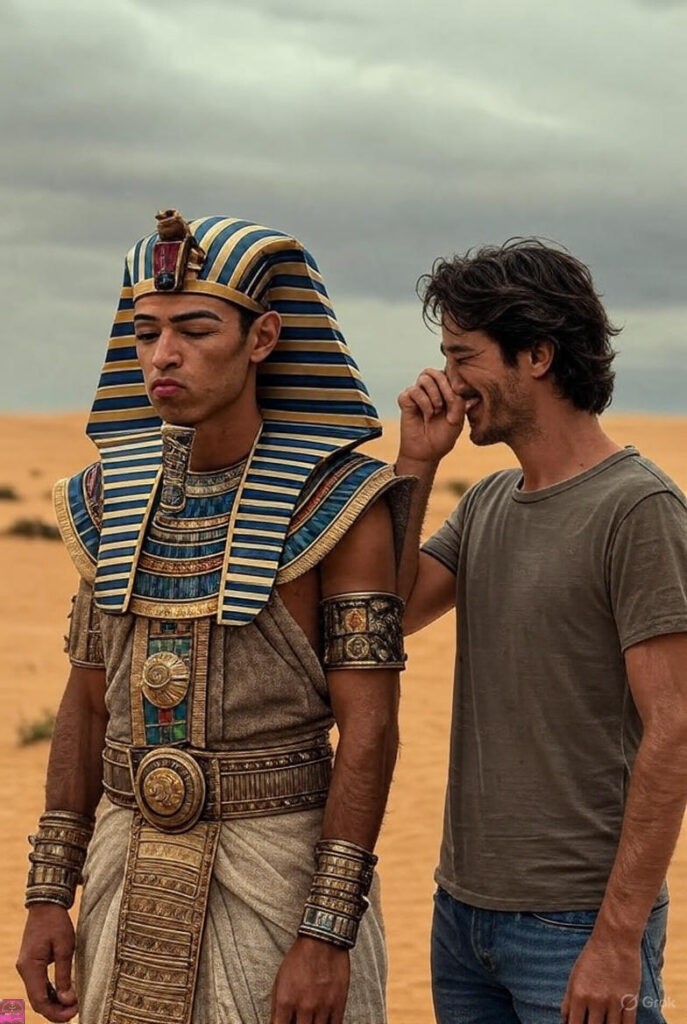
Once upon a time in ancient Egypt, there was a man who would rather drown in the Red Sea than answer a text message. His name wasn’t Matt, Derek, Jason, or “the guy from Hinge who still watches your Instagram stories two years later.” His name was Ramses II, Pharaoh of Egypt, Monarch of Avoidance, Supreme Ruler of “I’m Fine,” and Patron Saint of Leaving Moses on Read. This was the original specimen — the prototype fearful avoidant. He didn’t ghost once; he ghosted an entire nation. He didn’t dodge a phone call; he dodged a prophecy. Pharaoh didn’t do casual detachment — he did the Ten Plagues, international war, and a full chase scene through the desert just to avoid emotional intimacy.
If you think modern men invented the “I’m not ready” speech, imagine God Himself sending signs, frogs, blood, locusts, hail, and a literal darkness that felt like being blocked on social media — and Ramses still said, “No thanks, babe. I’ll let you know.” It wasn’t until every firstborn son dropped like a bad Tinder hookup that he finally texted Moses back. So really, how different is my contemporary Pharaoh — the specimen — from the one in Exodus? Mine just doesn’t unleash plagues; he unleashes silence. His weapon isn’t genocide — it’s the delivered-but-not-responded bubble on iMessage. And just like Moses staring at the Red Sea, I’ve asked myself the same question every Carrie-Bradshaw-hearted woman has asked: What if God parted the waters, but he still just… didn’t reply?
LET ME INTRODUCE MY CONTEMPORARY PHARAOH
My boyfriend, The Specimen™. (He is known as The Specimen in all of my Deep Thought Essays)
You may think modern avoidants are mysterious, tortured philosophers. They aren’t. They are simply Ramses II with Wi-Fi.
The specimen is a creature of divine comedic timing.
He’s the type of man who will:
- bow you like a prayer
- whisper your name like liturgy
- breathe into your collarbone like a hymn
- and then vanish into the desert for 4–10 business days
No warning, no trumpets, no messenger doves — just the subtle digital scent of absence. Every fearful avoidant comes with an emotional season:
Phase 1: Passion
- They touch you like the burning bush.
- You melt.
- You see God.
- You start Googling wedding rings.
Phase 2: Withdrawal
They go full Pharaoh. Suddenly, you’re Moses delivering prophet-level intimacy to a man who’s turned off read receipts like a tyrant closing a temple.
THE BIBLICAL DANCE OF AVOIDANCE
Fearful avoidants don’t disappear because they don’t care. They disappear because they do. They are terrified of intimacy, so they build pyramids of distraction:
- projects
- pretend busyness
- long showers
- “I’m decompressing”
- Xbox
- TikTok
- “Just need a minute”
- You could offer them the Promised Land and they’d still say,
“Hmm… let me vibe in Egypt a bit longer.”
Modern psychology calls it attachment dysregulation. The Bible calls it No, Moses.
EXODUS, BUT MAKE IT DATING
Moses was like, “Bro, can we just go?” Ramses said: “I’ll think about it.”
Moses: “We’re literally enslaved.” Ramses: “I just need space.”
God: unleashes frogs. Ramses: “I’m going through a lot right now.”
Locusts:
Ramses blocks Moses on everything.
Plague of darkness:
Ramses posts vague story:
“Focus on yourself. People will disappoint.”
This is how fearful avoidants communicate. Not with language. With silence and inconvenience.
HOW THE SPECIMEN RECREATES EXODUS IN THE SUBURBS
Picture this:
We spend a night together. Hands. Mouth. Eye contact deep enough to resurrect Lazarus. Post-coital glow like a Renaissance painting.
He whispers something equivalent to:
“Let my people go.”
Then he wakes up. Suddenly, Pharaoh returns. He’s not angry. He’s not cold. He’s… gone. He moves through life like the Angel of Death in the tenth plague —silently, invisibly, without remorse — except instead of firstborns, he slays conversations.
AND LIKE MOSES, I USED TO CRY
I didn’t have commandments. I had screenshots. I wasn’t parting the sea. I was parting our messages:
- Blue bubble, blue bubble, blue bubble
- Silence
- Delivered
- No reply
Every few days I would go full Old Testament, begging the heavens for signs:
- Did he die?
- Did he get k*dnapped?
- Is he emotionally sick?
- Am I emotionally sick?
Psychologists would say: “He’s dysregulated.”
My girlfriends would say: “He’s trash.”
My heart said: “He’s Pharaoh.”
AND THEN I EVOLVED
Now? I roast him. If Moses had had Wi-Fi and personality disorders, Exodus would’ve been a comedy. Instead of dramatic desert scenes,
it would’ve been:
Moses texting, “Bro u active on Instagram I SEE YOU.”
THE PREDICTABLE SPECIMEN™ LOOP CYCLE
Fearful avoidants aren’t unpredictable. They are so predictable that ancient cultures could have built calendars around them. You could literally build a Jewish holiday: The Feast of His Sudden Disappearance.
Day 1–3: The Passion
Milk and honey on the promised land of your thighs.
Day 4–9: The Withdrawal
You wander the desert of “Delivered.”
No updates. No voice notes. Just vibes and dehydration.
Day 10: Resurrection
He texts:
“Hey beautiful”
like a man who didn’t wipe an entire nation from emotional existence three days ago.
WHY THEY DO THIS
Because to a fearful avoidant: Intimacy = Death of Identity. If they melt into you, they lose themselves. If they surrender, they are enslaved. It’s not logic. It’s neurological warfare.
Ramses II didn’t fear Moses. He feared surrendering control. Fearful avoidants don’t fear love. They fear needing it.
MY INNER MONOLOGUE SAYS:
I couldn’t help but wonder…
Are avoidant men the tenth plague?
Or are they simply the Red Sea we must learn to part?
MY SALTY VIXEN INNER MONOLOGUE SAYS:
Honey, if he wanted you, he’d be walking across the desert barefoot to get a taste.
And if he doesn’t?
Block him like the Egyptians blocked Moses.
MOSES WOULD SAY:
“I tried talking to him.
It didn’t work.
So I summoned frogs.”
CLOSING
The older I get, the more I realize: Fearful avoidants don’t disappear. They retreat. They reappear. They act like nothing happened. They blame the weather, stress, traffic, the Egyptians, the moon, Mercury, and probably Joseph’s coat. They don’t want less love. They want safe love — but they don’t know how to feel safe. And I — like Moses —no longer beg Pharaoh to free me.
I pack my things, walk into the desert, and ask the Red Sea:
Should I drown trying to be loved,
or should I learn to walk on water?
