
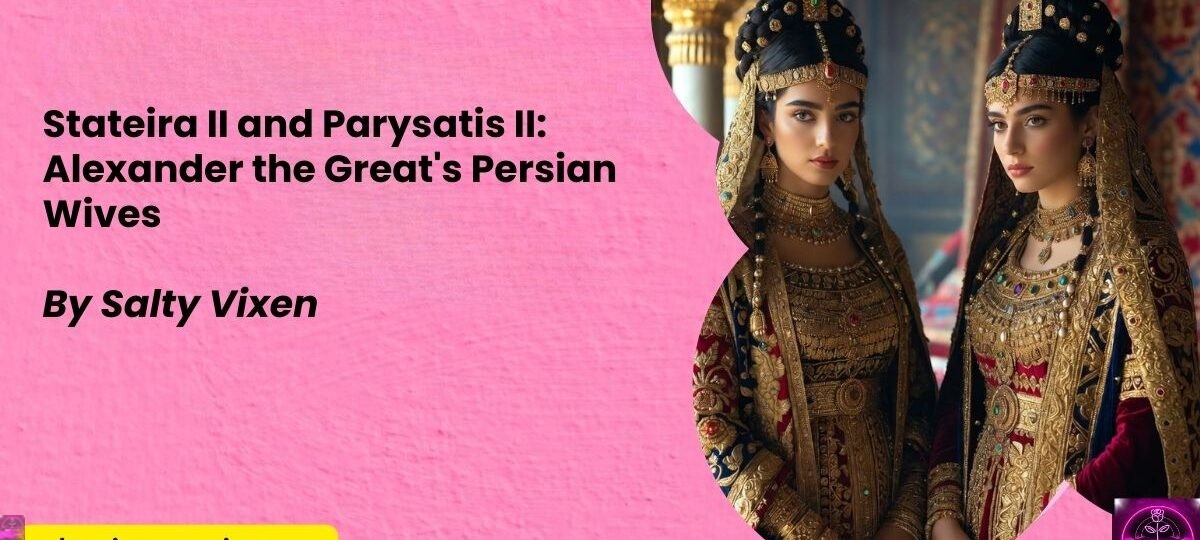
In the turbulent world of ancient empires, where conquests reshaped maps and destinies, the Susa weddings of 324 BCE stand out as one of history’s most audacious attempts at cultural fusion. Orchestrated by Alexander the Great, this lavish mass ceremony united Macedonian conquerors with Persian nobility through marriage, symbolizing his dream of a blended Greco-Persian realm. At its center were two Achaemenid princesses: Stateira II (also called Barsine or Statira in sources) and Parysatis II. As royal daughters of Persia’s fallen dynasty, they became Alexander’s wives, embodying the clash between old Persian sovereignty and new Hellenistic ambition.
Their lives—marked by privilege, captivity, symbolic elevation, and tragic ends—offer a poignant glimpse into the roles of women in one of antiquity’s greatest empires. Drawing from ancient historians like Arrian, Plutarch, Diodorus Siculus, Curtius Rufus, and modern analyses, this biography traces their stories, highlighting their significance in Persian (Iranian) heritage as the last links to the Achaemenid royal line.
❓ Who were Stateira II and Parysatis II?
▼
Stateira II (c. 340–323 BCE) was the eldest daughter of Darius III Codomannus, the last Achaemenid king of Persia, and Queen Stateira I — renowned as “the most beautiful woman in Asia.” She was captured by Alexander the Great after the Battle of Issus in 333 BCE and kept under honorable captivity for nearly a decade, learning Greek and maintaining her royal dignity before becoming one of Alexander’s wives at the Susa weddings in 324 BCE.
Parysatis II (c. 350–after 323 BCE) was the youngest daughter of Artaxerxes III Ochus, Darius III’s predecessor on the Persian throne. Both were Achaemenid princesses who became Alexander’s wives, embodying his ambition to blend Macedonian and Persian royal bloodlines into a unified Greco-Persian realm — the last living links to Persia’s greatest dynasty.
❓ What were the Susa Weddings of 324 BCE?
▼
In spring 324 BCE, Alexander the Great orchestrated a five-day mass marriage ceremony in Susa — one of Persia’s grandest cities. He married both Stateira II and Parysatis II; his companion Hephaestion wed Drypetis (Stateira’s sister); and approximately 80–90 Macedonian officers wed noble Persian and Median women. Alexander personally funded all dowries and hosted elaborate banquets blending Greek and Persian ritual traditions.
The event was one of antiquity’s most audacious acts of cultural engineering — legitimizing Alexander as Persian successor, linking him directly to Darius III’s bloodline, and easing governance over Persia’s diverse peoples. The historian Chares of Mitylene describes golden couches, magnificent tents, and dazzling performances. For the princesses, the weddings elevated them to queens, yet their agency remained limited by the top-down politics of a conqueror’s ambition.
❓ What happened to them after Alexander the Great died?
▼
When Alexander died suddenly in Babylon in June 323 BCE, his Bactrian wife Roxana — pregnant with the future Alexander IV — viewed Stateira II as a lethal rival for dynastic succession. According to Plutarch (Alexander 77), Roxana and the regent Perdiccas lured Stateira II with a forged letter in Alexander’s name, then murdered her and possibly her sister Drypetis, concealing their bodies in a well.
The fate of Parysatis II after Alexander’s death remains obscure — ancient records fall silent, and she likely perished or vanished into complete obscurity during the violent chaos of the Wars of the Diadochi (Successors). Roxana’s victory was short-lived: both she and Alexander IV were murdered in 310 BCE by Cassander. The violent elimination of these Achaemenid princesses sealed the total extinction of Persia’s royal female line.
❓ What is their legacy in Persian and Iranian history?
▼
Stateira II and Parysatis II represent the poignant close of the Achaemenid era — the last royal daughters of Persia’s greatest dynasty (c. 550–330 BCE). In Iranian historiography, they personalize the human cost of conquest: women of royal dignity and cultural sophistication caught between fallen Persian sovereignty and Hellenistic ambition. Their marriages to Alexander influenced later Seleucid intermarriages and the cultural syncretism that shaped Hellenistic, Parthian, and ultimately Sassanid Iran.
Unlike earlier powerful Achaemenid queens — Atossa, who shaped Xerxes’ succession, or the elder Parysatis, who dominated court intrigue — their legacy was primarily symbolic: bridges between colliding worlds, and living proof of Persian civilization’s enduring sophistication. Tragic yet profound, they remind us that behind the grand sweep of conquest are real human lives, and that women’s roles in shaping history — through lineage, symbolism, and survival — deserve their rightful place in memory.
Women in the Achaemenid Empire: A Legacy of Influence
The Achaemenid Empire (c. 550–330 BCE), founded by Cyrus the Great, was remarkably progressive in its treatment of women compared to many contemporaries. Royal women enjoyed substantial rights: they owned vast estates, managed wealth independently, issued commands, traveled freely, and participated in court decisions. Administrative records from Persepolis (the Fortification Tablets) show women receiving equal rations for work, supervising laborers (including men), and holding titles like dukšiš (princess) or queen.
Powerful queens shaped history. Atossa, daughter of Cyrus, wife of Darius I, and mother of Xerxes I, wielded immense influence as queen mother—advising on policy and succession. Parysatis (wife of Darius II) dominated intrigue, securing her son’s throne through cunning and vengeance. Artemisia I of Caria commanded fleets under Xerxes, earning praise from Herodotus for strategic brilliance at Salamis.
These precedents set the stage for princesses like Stateira II and Parysatis II. Born into opulence—palaces at Susa, Persepolis, and Ecbatana—they were educated in administration, languages, etiquette, and possibly diplomacy. Royal daughters often served as marriage pawns to forge alliances, yet their status carried symbolic weight: vessels of dynastic legitimacy in a multicultural empire that valued tolerance and integration.
Stateira II: From Royal Heiress to Captive Queen
Stateira II (c. 340–323 BCE) was the eldest daughter of Darius III Codomannus, the last Achaemenid king (r. 336–330 BCE), and Queen Stateira I (renowned for her beauty as “the most beautiful woman in Asia”). Born amid the empire’s twilight, she grew up in a world of splendor: gilded halls, multicultural courts, and the weight of Achaemenid legacy.
Her life changed forever at the Battle of Issus in 333 BCE. Darius fled, abandoning his family—mother Sisygambis, wife Stateira I, daughters Stateira II and Drypetis, and young son Ochus—in the camp. Alexander captured them but treated them with extraordinary respect, refusing to exploit them and providing luxuries befitting royalty. He reassured Sisygambis personally, famously saying Hephaestion was “also Alexander” when she mistook his companion for him.
Stateira I died around 332 BCE (possibly in childbirth, per some rumors), but the daughters remained in Susa under honorable captivity. For nearly a decade, Stateira II adapted: learning Greek, maintaining dignity, and symbolizing Persia’s enduring presence in Alexander’s world. Darius offered her in peace talks (with vast territories as dowry), but Alexander declined, insisting he already held both land and princess.
In 324 BCE, after his Indian campaigns, Alexander married her at Susa. Sources vary—Arrian (via Aristobulus) calls her Barsine; Plutarch uses Stateira. The union legitimized Alexander as Persian successor, linking him to Darius’s direct line and promising heirs blending bloodlines.
Parysatis II: Bridging Dynastic Fractures
Parysatis II (c. 350–after 323 BCE?) was the youngest daughter of Artaxerxes III Ochus (r. 359–338 BCE), Darius III’s predecessor. Artaxerxes III’s reign involved reforms and assassinations, but his family retained prestige.
Little survives about her early life—likely spent in court amid intrigue—but her marriage to Alexander at Susa connected him to an earlier Achaemenid branch. Arrian notes Alexander wed her alongside Stateira II, possibly polygamously for political gain. This dual marriage unified fractured royal lines, preventing rival claims and reinforcing Alexander’s adoption of Persian customs (titles, proskynesis, attire).
The Susa Weddings: Opulence and Ambition
In spring 324 BCE, Susa—one of Persia’s grandest cities—hosted five days of extravagance. Arrian (Anabasis 7.4) describes: Alexander married Stateira II (Barsine) and Parysatis II; Hephaestion wed Drypetis (Stateira’s sister); ~80–90 officers wed noble Persian/Median women. Alexander funded dowries, hosted banquets with Persian rites (veils, rituals, entertainments), and blended traditions—Persian customs prominent to honor locals.
The event symbolized fusion: easing governance over diverse peoples, creating hybrid elites, addressing Macedonian resentment over “Persianization.” Chares of Mitylene (quoted in Athenaeus) details tents, golden couches, performances— a spectacle of unity.
For the princesses, it elevated them to queens, yet agency remained limited: top-down politics driven by Alexander.
After Alexander: Jealousy, Murder, and Eclipse
Alexander died suddenly in Babylon, June 323 BCE. Chaos followed. Roxana (Bactrian wife, pregnant with Alexander IV) saw Stateira II (potentially pregnant or heir-bearing) as a threat. Plutarch (Alexander 77) reports Roxana, with Perdiccas, lured Stateira via a forged letter, murdered her (and possibly Drypetis), hiding bodies. Some theories suggest Parysatis II was targeted instead of Drypetis, but her fate is obscure—records fade, likely death or obscurity.
Roxana secured her son’s position temporarily, but she and Alexander IV were murdered in 310 BCE by Cassander.
The Achaemenid female line ended violently, sealing the dynasty’s extinction.
Legacy: Symbols of Persian Resilience and Transition
Stateira II and Parysatis II represent the Achaemenid era’s poignant close: loss of independence, yet seeds of cultural exchange shaping Hellenistic, Parthian, and Sassanid Iran. Their marriages influenced Seleucid intermarriages and syncretism.
In Iranian historiography, they personalize conquest’s human cost—royal women as dignified symbols amid empire’s fall. Unlike Atossa or Parysatis the elder’s active power, theirs was symbolic: bridges between worlds, reminders of Persia’s sophistication and endurance.
Tragic yet profound, they highlight women’s subtle roles in history—through lineage, symbolism, survival. In a conqueror’s narrative, these Persian wives endure as unforgettable figures of grace and legacy.
📚 References — Stateira & Parysatis II (All Sources)
▼
- 1. Anson, Edward M. (2014-07-14). Alexander’s Heirs: The Age of the Successors. John Wiley & Sons. pp. 11–12. ISBN 978-1-4443-3962-8.
- 2. “Dictionary of Greek and Roman Biography and Mythology, page 464 (v. 1)”. 2006-01-01. Archived from the original on 2006-01-01. Retrieved 2017-11-21.
- 3. Tarn (2002), p. 334.
- 4. Tarn (2002), p. 335.
- 5. Carney (2000), p. 108.
- 6. Tarn (2002), p. 336.
- 7. “Plutarch, Alexander, chapter 21, section 4”. www.perseus.tufts.edu.
- 8. Carney (2000), p. 109.
- 9. O’Brien (2005), p. 197.
- 10. Carney (2000), p. 110.
- 11. Stewart (1993), p. 186.
- Carney, Elizabeth Donnelly (2000), Women and Monarchy in Macedonia, Norman, OK: University of Oklahoma Press, ISBN 0-8061-3212-4
- O’Brien, John Maxwell (2001), Alexander the Great: The Invisible Enemy — A Biography, New York: Routledge, ISBN 0-415-10617-6
- Stewart, Andrew F. (1993), Faces of Power: Alexander’s image and Hellenistic politics, Berkeley, CA: University of California Press, ISBN 0-520-06851-3
- Tarn, W.W. (2002), Alexander the Great: Volume II Sources and Studies, Cambridge University Press, ISBN 0-521-22585-X originally published 1948
- 🔗 Pothos.org — Stateira, mother and daughter
- 🔗 Livius.org — Barsine/Statira (Archived 2014-11-06 at the Wayback Machine)
- 1. Garthwaite (2005), p. 39.
- 2. Carney (2000), p. 110.
- 3. O’Brien (2001), p. 197.
- Carney, Elizabeth Donnelly (2000), Women and Monarchy in Macedonia, Norman, OK: University of Oklahoma Press, ISBN 0-8061-3212-4
- Garthwaite, Gene R. (2005), The Persians, Malden, MA: Blackwell Publishing, ISBN 1-55786-860-3
- O’Brien, John Maxwell (2001), Alexander the Great: The Invisible Enemy — A Biography, New York: Routledge, ISBN 0-415-10617-6
📖 Sources: Salty Vixen Stories & More Lifestyle Magazine: Stateira (wife of Alexander the Great) & Parysatis II
