


I used to think the hardest thing in the world was finding the perfect little black dress—the one that cinched the waist, ignored the sins of last night’s tequila, and worked for a business meeting, an ex’s wedding, and a spontaneous trip to Paris.
Then someone I loved lost someone they loved, and suddenly I was standing in the stationery aisle at 11 p.m., holding seventeen different cards, palms sweating, wondering why every single one sounded like a robot wrote it after binge-watching Hallmark movies. I mean, “In Deepest Sympathy”? Who talks like that? It sounds less like genuine condolence and more like a tax form.
Because here’s the truth, darling: nothing exposes your emotional vocabulary quite like grief.
Breakups? We’ve got playlists, empowerment mantras, and the number of a really good divorce attorney. Birthdays? Champagne emojis, regrettable speeches, and credit card debt. We have a script for every social occasion, a filter for every fleeting emotion.
But death? Death makes us all suddenly thirteen again, terrified we’ll say the wrong thing and somehow make the hole even bigger. It’s the emotional equivalent of wearing white after Labor Day—a glaring, obvious faux pas we desperately want to avoid.
So we freeze.
We type “So sorry for your loss” on Facebook, add a cryptic, sad-face emoji, and hit send before we can overthink it. We convince ourselves that silence, perhaps a quiet, dignified withdrawal, is kinder than the wrong words.
Except it isn’t.
Silence is a void. Silence is where the mind invents rejection. Silence is a closed door.
A card—even an imperfect one, even one with a slight coffee stain from your panic writing session—says I see you. I’m here. This matters. It’s a tangible, physical piece of proof that the world hasn’t just continued spinning without them. And in a season where everything feels surreal, being seen is oxygen. It is the emotional equivalent of being handed a silk scarf when you’re freezing—small, luxurious, and immediately vital.
So pull up a chair. Pour something strong (a chilled rosé, maybe, because even tragedy needs balance) or chamomile, no judgment. Let’s set aside the fear of imperfection, ignore the clichés, and write the card that actually helps. The one they’ll keep in the drawer long after the flowers die and the parade of well-meaning but emotionally illiterate guests has gone home.
I. 💌 First, Choose the Right Card (Because “Thinking of You” With Puppies Is a Choice)
This is not the time for novelty. This is a time for quiet luxury. Your card is not a funny text message or a cheerful email sign-off. It’s an artifact.
The Aisle Audit: What to Skip and Why
We need to conduct an immediate intervention for the phrases that need to be retired forever. These are not comforting; they are linguistic sandpaper on an open wound.
“Heaven needed another angel.” This is not a greeting card; it’s a theological justification. Grief is messy, angry, and profoundly earthbound. No one grieving the loss of their sister wants a theological dissertation on celestial staffing. It’s dismissive of the agony of their human absence.
“Time heals all wounds.” Lies, darling. Time only teaches you how to function with the wound. And more importantly, the person reading this is currently in a time vortex where 24 hours feels like three centuries. Don’t rush their process with well-meaning but utterly useless aphorisms.
Anything with a rainbow bridge if it’s a pet. Unless you know they are specifically and wholeheartedly devoted to that poem, skip it. It’s often too close to the “angel” cliché. Their fur baby was not a metaphysical entity; they were a smelly, perfect creature who stole socks and gave unconditional love. Be specific, not spiritual.
The Stationery Checklist: Quiet Luxury Only
Your goal is to choose a card that feels like a quiet hug, not a party announcement. Think tactile, minimal, and timeless.
Heavy Cream Stock: The paper must feel expensive, substantial, almost architectural. When they hold it, the weight should communicate importance. If it feels like cheap copy paper, toss it.
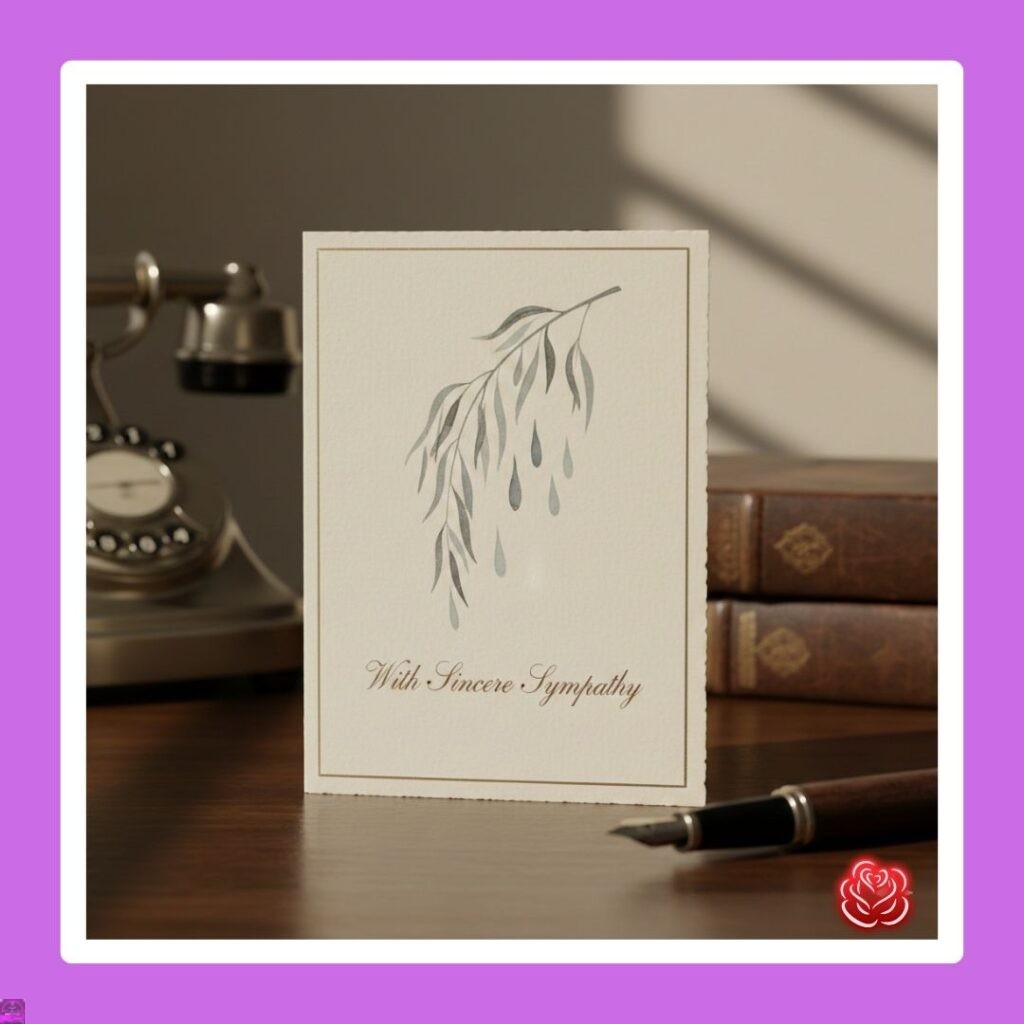
Simple Designs: A single pressed flower, a line drawing of a branch, a minimalist geometric pattern, or something totally blank inside. We are aiming for silence on the cover, volume inside.
The Rogue Choice: Go completely off-script. A photograph of a sunset, a vintage postcard of a place they both loved, a blank card with a gold foil edge that feels like quiet luxury. The unexpected choice signals you thought about them, not just the occasion.
Logistics of Delivery: If you’re within driving distance, hand-deliver it—either tuck it into their mailbox or leave it on the porch with a small, unpretentious gift (a good book, not flowers). If not, mail it the day you hear. Grief doesn’t wait for perfect timing, and getting a meaningful card two weeks later when the initial rush has subsided is often when they need it most.
II. 📝 The Anatomy of a Lifeline: Nine Steps to Graceful Prose
Writing a sympathy card is not about showing off your writing prowess; it’s about being a temporary anchor. Follow this structure, and you will achieve emotional elegance.
1. Start With Their Name (Because “Dear Friend” Is What Telemarketers Say)
The greeting sets the tone. Anonymity is the enemy of connection.
- Dear Samantha,
- Dear Olivia,
- My beautiful Emma,
Write their name like you’re saying it out loud, perhaps whispering it into the darkness of your own apartment. That alone is half the comfort. It immediately pulls them out of the anonymity of “grieving person” and back into the singularity of “my friend.”
2. Say the Thing We’re All Terrified to Say
We’re a culture of euphemisms. We “pass on,” we “depart,” we are “lost.” But in the card, be direct. It may feel sharp, but it cuts through the fog of denial.
Use the word died. Or passed away. Whatever feels natural to you.
Avoid “lost” unless you’re prepared to help them look for the person under the couch. They haven’t lost their father like they lost their keys; he is simply gone.
Examples that work:
“I heard about your dad and my heart broke for you.” “When I heard David died, I had to sit down. I’m so sorry.” “I just learned about Luna. I’m gutted for you.”
Short. Real. Zero sugar-coating. This shows you’re not avoiding the difficult reality, and by validating the event, you validate their pain.
3. Share One Specific Memory (The Secret Sauce)
This is where the card goes from polite to priceless. It is the diamond in the emotional rough. A simple memory proves that the life lived was real and observed.
Not: “He was a good man.” (Vague, obvious.) But:
“I’ll never forget the way he called everyone ‘champ’—even the grumpy barista at the corner coffee shop. It drove me crazy, and now I wish I could hear it one more time.”
“The way she danced at your wedding like no one was watching (because she genuinely didn’t care what anyone thought—that was her secret superpower).”
“I still laugh when I think about the time your dog stole his steak right off the grill and he just applauded instead of getting mad.”
The Goal: To give them back a piece of the person they lost, not the one everyone is currently mourning. The specific, often slightly embarrassing, detail is the humanizing touch they desperately need. It reminds them of the joy, not just the ending.
4. Tell Them Where They Live in Your Heart Right Now
Grief can feel isolating, like being encased in soundproof glass. This step is a gentle tap on that glass, saying I know you’re in there.
Good options:
“You’ve been in my thoughts all week. My brain keeps circling back to you, wanting to send you peace.”
“I keep thinking about you and wishing I could take some of the weight—just a fraction of it.”
“I’m holding you so tightly in my heart right now, even from miles away.”
The Prayer Clause: If you pray and you know they’re okay with it, you can offer that. “You’re in my prayers every night, asking for comfort for your spirit.” If you don’t pray, or they don’t, keep it secular and equally profound: “I’m sending you love that doesn’t need words or religion—just pure, human energy.”
5. Offer Something Real (Not “Let Me Know If You Need Anything”)
That sentence is the emotional equivalent of “Thoughts and prayers.” It sounds generous, but it forces the grieving person to manage your emotional labor. They have to stop grieving, assess their needs, formulate a request, and then call you. It’s an impossible homework assignment.
Stop asking. Start doing. Specific offers that actually get used:
Food: “I’m dropping lasagna (your mom’s recipe is sacred, I’m not touching that) on your porch Thursday between 5 and 6 PM. No need to answer the door or text back.”
Time/Presence: “I have next Tuesday afternoon free. I’ll come over, sit on your couch, and watch awful reality TV with you. Zero pressure to talk about anything important.”
Kids/Logistics: “I can pick your kids up from school any day next week. Just text me the carpool number. Consider me your personal chauffeur/babysitter until Thanksgiving.”
Money (The Unspoken Need): Grief is surprisingly expensive—funeral costs, time off work, last-minute travel. Don’t ignore it. “I’m Venmoing you $100 for Postmates because grief is expensive, and you need good takeout.”
If you’re far away:
“I booked you a massage at that place you love for whenever you’re ready—no expiration date. Use it when the tension finally breaks through.”
“I sent you the cozy, ridiculously expensive cashmere blanket we always fight over when we watch movies. I want you wrapped up in comfort.”
6. The Long Game: The Six-Month Check-In
Grief is not a 48-hour flu. Everyone shows up for the wake and the funeral. They stop showing up around month three. The emotional silence post-funeral is often when the real loneliness begins.
The Post-Script Commitment: Add a simple sentence promising to be there when the hype dies down.
P.S. I’m setting a reminder on my phone to check in with you in December, when everyone else has gone back to their normal lives. I promise, I’m in this for the long haul.
This small note is a massive gift. It tells them their agony has an end date, and someone will be there to catch them when the initial shock wears off.
7. Close Like You Mean It
End with sincerity, avoiding anything too casual.
- Love,
- All my love,
- With so much love,
- I’m here,
- Then sign your full name. They might not recognize just “xo M” through tears, especially if you have a complicated circle of friends. Clarity is kindness.
III. 🖤 When the Lost One Was a Fur Baby (Because Fur Babies Count)
Let’s be clear: losing a pet is losing a family member. They are the great, non-judgmental loves of our lives. They are the constant, quiet presence that asks only for belly rubs and ignores our bad dating choices. The grief is often profound and sometimes surprisingly lonely, as some people dismiss it.
Your job is to validate this agonizing loss.
Dear Alex,
I heard about Luna and my heart cracked right open. That beautiful, chaotic creature. She was the best greeter in the entire world—I still have the photo of her wearing that ridiculous birthday hat like she was born for Instagram, trying to lick the icing off your nose.
Fifteen years of love is no small thing. Fifteen years of unconditional, messy joy. That kind of devotion leaves a hole you can see and touch. I hope you can feel her curled up at the foot of your bed tonight, even when it gets quiet. The house will feel huge, I know.
I’m dropping off that bottle of ridiculously expensive red we always said we’d open “someday.” Tonight feels like the night. Open it. Don’t share it. And don’t you dare feel silly for being this distraught. That dog was a masterpiece.
Love you always, Salty Vixen
IV. 🚩 What Never, Ever to Write (Burn These Phrases)
These are the linguistic landmines of the sympathy card genre. They are comfort for the writer, not the reader.
“Everything happens for a reason.” This implies a purposeful cosmic cruelty. Grief has no logical reason, and trying to impose one is insulting to the chaos of sorrow.
“At least they’re not suffering.” While perhaps true, the focus must be on the person alive and suffering the absence. This shifts the focus away from their immediate, necessary agony.
“God needed another angel.” See point 1, concerning celestial staffing. This is a cliché that should be buried forever.
“I know exactly how you feel.” No, you don’t. Even if you’ve lost a parent, you didn’t lose their parent. Every grief is a distinct ecosystem. Instead, try: “I remember how impossible it felt when I lost my mother. Please know I’m here if you want to talk about the logistics of that impossible feeling.” (It relates without equating.)
“They’re in a better place.” Maybe. But the person grieving wants them in this place, on this couch, right now. Focus on the tangible reality of the loss, not the abstract comfort of the afterlife.
“Let me know if you need anything.” (See rule 5). Retire this phrase immediately. It’s an empty promise.
V. 🍸 The Full Example: The Manifesto of Presence
Let’s put it all together—the heavy stock, the witty sadness, the concrete action.
Dear Olivia,
I heard about your mom and honestly didn’t know what to do with myself. I ended up wandering the grocery store, staring at the tequila aisle for ten minutes—because honestly, who else is going to teach me how to make a truly lethal margarita?
She was the kind of person who made everyone feel like they were her favorite—remember when she insisted on teaching us all how to make those famous margaritas and ended up wearing most of the tequila? I still smile every time I see a salt rim because I know it will never be as perfect as hers. That was her magic: making small things feel like an event.
You’ve been in my thoughts constantly. I keep wishing I could teleport to your couch, eat ice cream from the carton, and not talk if you don’t want to. I’m here for all of it—the days that feel impossible, the days you’re surprisingly angry, and the days that feel almost normal.
I’m bringing dinner next Wednesday (lasagna, because your mom’s recipe is sacred, and I’m not touching that masterpiece). I’m leaving it on the porch between 6 and 6:30 PM—no need to see anyone, no need to thank me. I just want you to have one less thing to think about. And if you want to get out of the house, I have a reservation at that wine bar you love next month for whenever you’re ready. No pressure, no timeline.
You don’t have to go through this alone. And please, don’t try to be brave for anyone.
I love you so much. I’m here. Emma Thompson
Grief doesn’t need perfect words.
It needs presence.
And a card—even a slightly teary, slightly smudged one, penned with your favorite designer pen—is presence in an envelope. It is a piece of your emotional self, delivered to the person who needs it most.
So, write the messy truth. Say their name. Remember out loud. Offer something concrete. And mail it before you can talk yourself out of it.
Because years from now, when the flowers are long gone, the casseroles have stopped coming, and the initial shock has worn into a dull, constant ache, they’ll still have your words. And on the days when the missing feels too heavy, they’ll read them again.
That’s not just a card, darling.
That’s a lifeline. Now go find the pretty stationery.I’ll wait here.
