

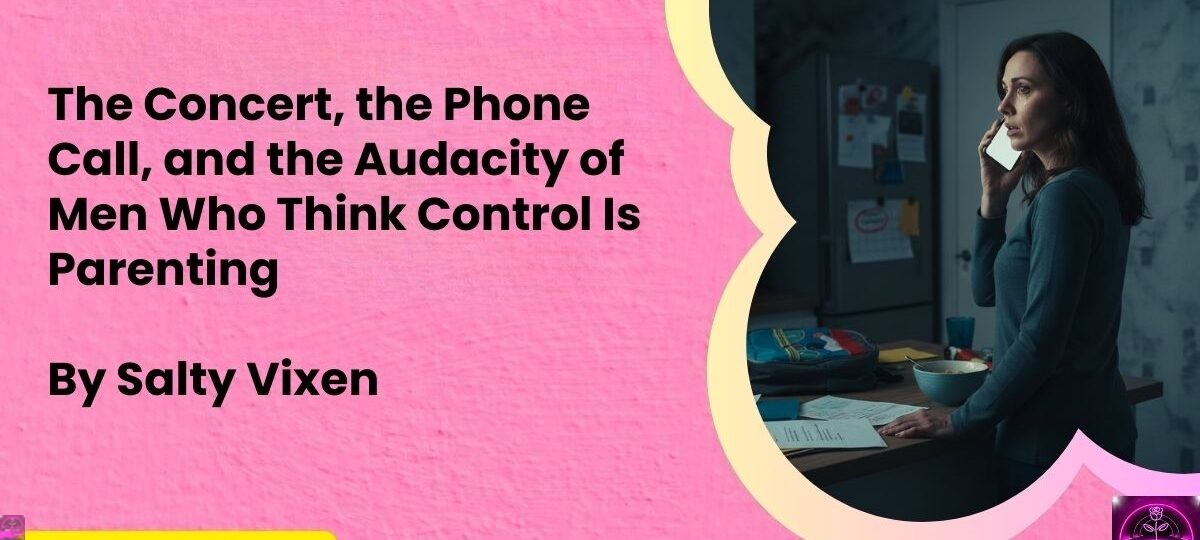

There is a very specific kind of phone call that turns your stomach cold. Not the kind where someone yells. Not the kind where someone threatens. The calm ones. The ones delivered in a reasonable tone, as if what’s being said is perfectly normal and definitely not unhinged. The kind of phone call that starts with,
“We’re not coming.”
Not I’m not coming. Not something came up. But we. Plural. Authoritative. Final. And suddenly you’re standing in your kitchen, staring at the wall, thinking: Oh. So this is what punishment sounds like when it’s wrapped in adult language.
Single Parenting, or: Congratulations, You Are Now the Only Adult in the Room
People love to tell single parents they’re “strong.” This is usually said by people who have never had to hold together a household, a schedule, a child’s emotional regulation, and their own sanity while someone else periodically drops in to destabilize the entire system like a bored raccoon.
Strength is not what’s happening here. What’s happening here is logistics under pressure. School schedules. Concerts. Permission slips. Emotional labor disguised as “just checking in.” Single parenting is less Eat Pray Love and more Project Management With Surprise Sabotage. And when you’re doing it well—when the kids are stable, routines are working, life is mostly calm—that’s usually when the other parent decides it’s time to make things… interesting.
The Concert That Was Apparently a Character Assessment
The concert had been on the calendar. Not a secret. Not a last-minute thing. Not optional in the way adult brunch is optional. A school concert. The kind where kids stand under fluorescent lights, gripping instruments like they’re holding their own nervous systems together, scanning the audience for faces that say, I showed up. Then came the phone call.
“We’re not coming after how you acted last week.”
Not about the concert. Not about the child. Not about logistics. About my behavior. Ah yes. The invisible tribunal. The emotional parole board. Apparently, I had failed a vibe check.
When Co-Parenting Turns Into Behavioral Correction
Here’s the thing about emotional control: It rarely announces itself with dramatic flair. It shows up as consequences. It shows up as:
- withdrawing presence
- canceling plans
- withholding support
- reframing access to children as a privilege you earn through compliance
It sounds like reason. It smells like concern. It dresses itself up as boundaries. And yet somehow, the only person being “corrected” is the one already doing all the work. Curious.
The Follow-Up: Surprise Interrogation Edition
A few days later—because emotional punishment loves a sequel—there was an unannounced visit. No heads-up. No coordination. Just sudden proximity and questions. Questions for me. Questions for my child. Casual ones. Friendly ones. The kind that sound harmless until you realize they’re not questions at all. They’re audits.
- Are you talking badly about me?
- What have you been saying?
- What does your child think?
Nothing says healthy co-parenting like storming in with a clipboard and a theory.
Let’s Pause for the Audience at Home
If you’re reading this and thinking, “Well, that’s not abuse, that’s just conflict,”
I invite you to consider this fun little metric: If the roles were reversed— If one parent burst into the other’s home, interrogated them and the child, withdrew presence as punishment, and framed access as conditional—Would you call that co-parenting? Or would you call it what it actually is: control with plausible deniability?
The Myth of the “Emotional” Man
We talk a lot about emotional men now. Men who are “in touch with their feelings.” Men who are “hurt.” Men who are “triggered.” And I fully support emotional literacy. What I do not support is using emotionality as a weapon. Because there is a difference between:
- feeling emotions
and
- externalizing them as authority
There is a difference between:
- being hurt
and
- punishing others for not managing your feelings for you
Crying does not make control gentle. Being upset does not excuse intimidation. Tone does not determine impact.
Single Parenting While Being Emotionally Policed
There’s a particular exhaustion that comes from knowing your emotional responses are being tracked. Not just noticed—tracked. As if you’re on probation for reactions you’re allowed to have. Too calm? Suspicious. Too upset? Unstable. Too articulate? Manipulative. Too quiet? Obviously hiding something. It’s a rigged game, and the prize is silence.
The Gaslight Special: “I’m Just Concerned”
Concern is a fascinating word. It can mean care. It can also mean control wearing a cardigan.
Concern says:
- “I’m worried about the kids” while making the kids’ lives more stressful.
Concern says:
- “I just want what’s best” while ignoring what’s actually best.
Concern is often used to bypass accountability. Because who argues with concern? I do.
The Private Aftermath No One Sees
After the phone calls and the confrontations, there’s the quiet. The dishes. The bedtime routine. The steadying of a child who felt the tension even if no one raised their voice. Single parents don’t get the luxury of processing later. We process while continuing.
Abuse Doesn’t Always Look Like Anger
Sometimes it looks like:
- unpredictability
- withdrawal
- conditional affection
- emotional surveillance
Sometimes it looks like someone who insists they’re the victim while holding all the leverage. And sometimes it looks like you, standing in your kitchen, wondering why something that feels so wrong is so hard to explain.
The Moment You Stop Explaining
Here’s the shift that happens eventually. You stop trying to prove it’s bad enough. You stop rehearsing the story. You stop waiting for permission to name what your body already knows. You realize: This isn’t confusion. This is clarity delayed by hope.
What To Do When This Happens (Without Burning Everything Down)
If you’re a single parent in this position, here’s what actually helps:
- Document, don’t argue.
You’re not trying to win a debate. You’re protecting reality.
- Do not justify your emotions.
You are allowed to feel things without submitting a defense.
- Maintain routine for the kids.
Stability is the antidote to control.
- Limit unannounced access.
Surprise interrogations are not a parenting right.
- Trust the pattern, not the apologies.
Patterns tell the truth faster.
The Final Truth
Single parenting doesn’t make you bitter.
It makes you observant.
And once you see it, you can’t unsee it. The difference between conflict and control is simple:
- Conflict seeks resolution.
- Control seeks compliance.
And I am no longer available for compliance masquerading as care.
Author’s Note (Unspoken but Understood)
If this essay feels familiar, it’s because it is. Not because you’re dramatic. Not because you’re sensitive. But because far too many single parents are quietly navigating emotional power plays while being told to “keep the peace.”
Peace is not silence. Peace is safety. And I choose that—sarcastically, intelligently, and without apology.
