

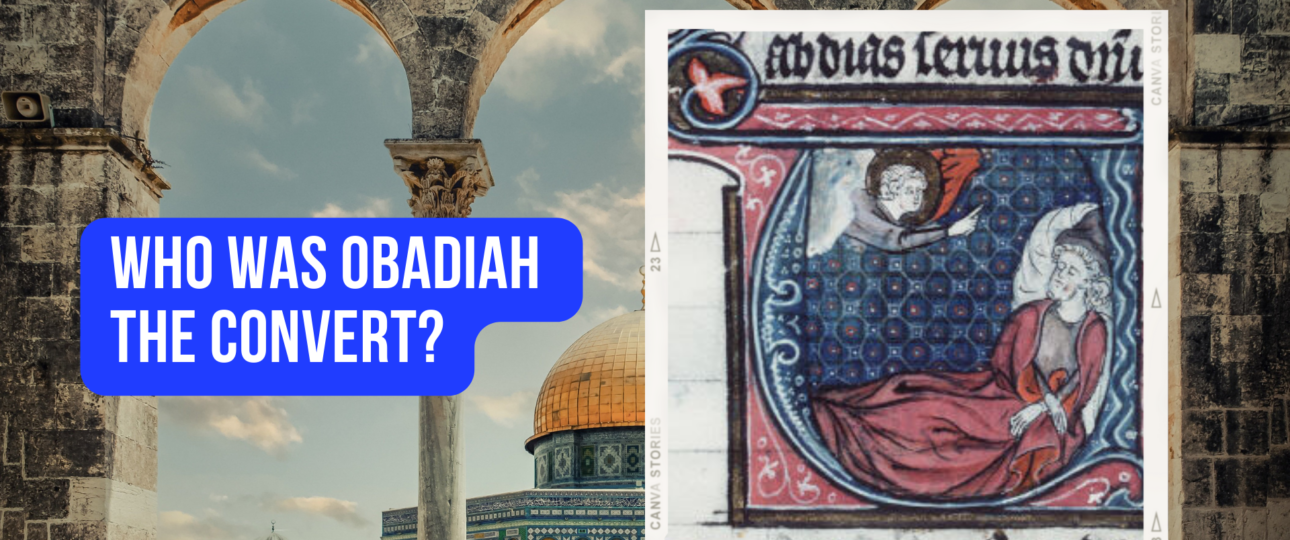
Obadiah (/oʊbəˈdaɪ.ə/; Hebrew: עֹבַדְיָה – ʿŌḇaḏyā or עֹבַדְיָהוּ – ʿŌḇaḏyāhū; “servant of Yah”, or “Slave of Yah [YHWH]”), also known as Abdias, is a biblical prophet. The authorship of the Book of Obadiah is traditionally attributed to the prophet Obadiah.
This is the vivid 12th-century testimony of a noble, Norman religious thinker turned convert to Judaism, which was discovered among hundreds of thousands of Jewish documents in the Cairo Genizah. It highlights not only a convert’s tale, but more importantly develops a narrative of important events of the Middle Ages, including the First Crusade (1095-96), medieval conversion, and false messiahs. Within this important chronicle, we discover that Johannes, son of Dreux, who became Obadiah the Convert (haGer)
“actually sought to be an observer and recorder of events of his day, while at the same time studying, either through oral tradition or Arabic and Hebrew chronicles or both, events which had taken place in previous generations” (Norman Golb, see further reading).
The goal of Johannes-Obadiah’s memoirs, then, was much larger than simply recording his conversion. What Johannes-Obadiah left us with, in the “refuse heap” of the Cairo Genizah was a unique look at how a refugee convert subsisted on the good nature of the Jewish communities that viewed these refugee proselytes as members of their households above all else.
Pronunciation
The nameis actually pronounced “oh-vad-yuh.”
The Discovery
The Cairo Genizah, which holds documents spanning the 9th through 19th centuries received its first visitor in the 18th century and was first popularized as an important repository of Jewish life by Solomon Schechter in the late 19th century. The development of the Johannes-Obadiah story, however, begins in 1901 with the publishing by a Jerusalem scholar named S.A.
Wertheimer of part of a medieval hebrew document containing a portion of an autographed letter of recommendation for an “Obadiah the Proselyte” written by Rabbi Baruch son of Isaac.
Thirty years later, in 1930, Professor Jacob Mann published the other half of the letter, which referenced the actual conversion of Obadiah the Proselyte, as well as another leaf from the same tattered prayer book that begins the chronicler’s narrative. The latter document provided much insight into Obadiah haGer’s level of worldliness, including that he was well versed in Arabic, Latin, Hebrew language, and Hebrew calligraphy. Further fragments from this narrative were found by Prof. S.D. Goitein in 1953 and Prof. A. Scheiber of Budapest in 1954. Today, the chronicle’s fragments are housed in Budapest, Cambridge, and Oxford. The Scholar Norman Golb is cited as having finessed the fragments into the following narrative as we know it today.
Obadiah’s Story
Johannes-Obadiah opens his chronicle in the third person with a genealogy, starting with a mention of his father, Dreux, a noble Norman, in Oppido, Italy. What is missing from the narrative, Golb predicts, is the story of the Norman conquest and how Dreux ended up in Italy. Dreux’s wife Maria gives birth to twins Rogerius and Johannes in the 11th century, with the later being a painful birth. Rogerius, being the older of the two, studied chivalry, while Johannes became a man of learning and religious education. Johannes-Obadiah tells the reader that he heard of conversion to Judaism at a young age with the supposed conversion to Judaism of Andreas the Archbishop of Bari.
This conversion, Johannes-Obadiah says, played a great role in his later conversion, not to mention that it had a huge impact on church officials in regards to Roman and Byzantine rites. The narrative follows with Johannes-Obadiah telling of an insightful dream of being asked to perform a religious act by a saintly or charismatic figure, but the manuscript breaks off, and we can only speculate how the dream relates to his eventual conversion in August or September of 1102.
A full twenty years after this dream, much is clearly missing from the chronicle.
As Obadiah haGer, our narrator takes a detailed journey, which chronicles the First Crusade, false messiahs, and life as a refugee proselyte living off of various communities of the Middle East. Obadiah travels from Italy to Aleppo in Syria, on to Baghdad, then back to Aleppo, on to Damascus, Banias, and Tyre. Finally, Obadiah arrives in Fustat-Misr, where he probably died a few decades after his arrival. The details of his journey are necessary in understanding our discussion on charitable giving and refugee proselytes during the 12th century.
Upon his arrival in Syria, Obadiah likely almost immediately visited Rabbi Baruch ben Isaac, from whom we have a recommendation letter — also uncovered in the Cairo Genizah. It’s possible that Obadiah’s conversion actually took place in Italy, probably in Bari or Otranto, before his journey began, because Rabbi Baruch ben Isaac, in his own recommendation letter for Obadiah, refers to a “letter from scholars who dwell in his lands, and they told us that he is of a great family.”
Thus, the letter that we have (in full) from Rabbi Baruch ben Isaac, the head of a Talmudic Academy in Aleppo, is actually a recommendation of a recommendation.
During Obadiah’s subsequent sojourn to Baghdad, he encounters troops fleeing westward, and it is believed that the events Obadiah chronicles are those of 1109, described by Muslim chronicler Ibn al-Athir, who records that the troops of Ghazi ibn Urtuk were fleeing those of Jawali. Both Jawali and Ghazi ibn Urtuk were enemies of the Christian crusaders.

Obadiah is believed to arrive in Baghdad in 1110, where he is supported by the community there. Obadiah reports that he is given living quarters in the synagogue, and the head of the academy invites him to study the “laws of Moses” with the orphaned youths. Obadiah also relates important and as-yet unheard of false messiahs and, perhaps more importantly, persecutions of the Jews of Baghdad by the Vizier Ibn al-Shuja during the reign of al-Muqtadi (1075-1094).
Obadiah returns to Syria and then travels to Damascus around 1119, where he again relates that he is supported by the community there. In 1121, he sojourns from Damascus to Banias in Northern Palestine, where he engages in conversation with a vegetarian Karaite, who predicts the ingathering of Jews to Jerusalem while urging Obadiah to ax his journey to Egypt in favor of a sojourn to Jerusalem.
In late 1121, Obadiah travels to Tyre and then on to Egypt’s chief city of Fustat-Misr, where portions of his memoirs and chronicle were buried in the Cairo Genizah, along with the earliest recorded Jewish music manuscript, Mi Al Har Chorev, composed by Obadiah himself.
Read more about medieval refugee converts and charitable giving.
Further Reading
Cohen, Mark R. Poverty and Charity in the Jewish Community of Medieval Egypt. Princeton: Princeton UP, 2005.
Freedman, H., and Maurice Simon. Midrash Rabbah. London: Soncino, 1983.
Golb, Norman. “The Autograph Memoirs of Obadiah the Proselyte of Oppido Lucano and The Epistle of Barukh B. Isaac of Aleppo.” Convegno Internazionale Di Studi. Oppido Lucano. 28-30 Mar. 2004.
Goodich, Michael. Other Middle Ages: Witnesses at the Margins of Medieval Society. Philadelphia: University of Pennsylvania, 1998.
Morag, Shelomo, Issachar Ben-Ami, Norman A. Stillman, and S. D. Goitein. Meḥḳere ‘edot U-Genizah. Yerushalayim: Hotsaʼat Sefarim ʻa. Sh. Y.L. Magnes, Ha- Universiṭah Ha-ʻIvrit, 1981.
Twersky, Isadore, and Jay Michael Harris. Studies in Medieval Jewish History and Literature. Cambridge, MA: Harvard UP, 1979.
