

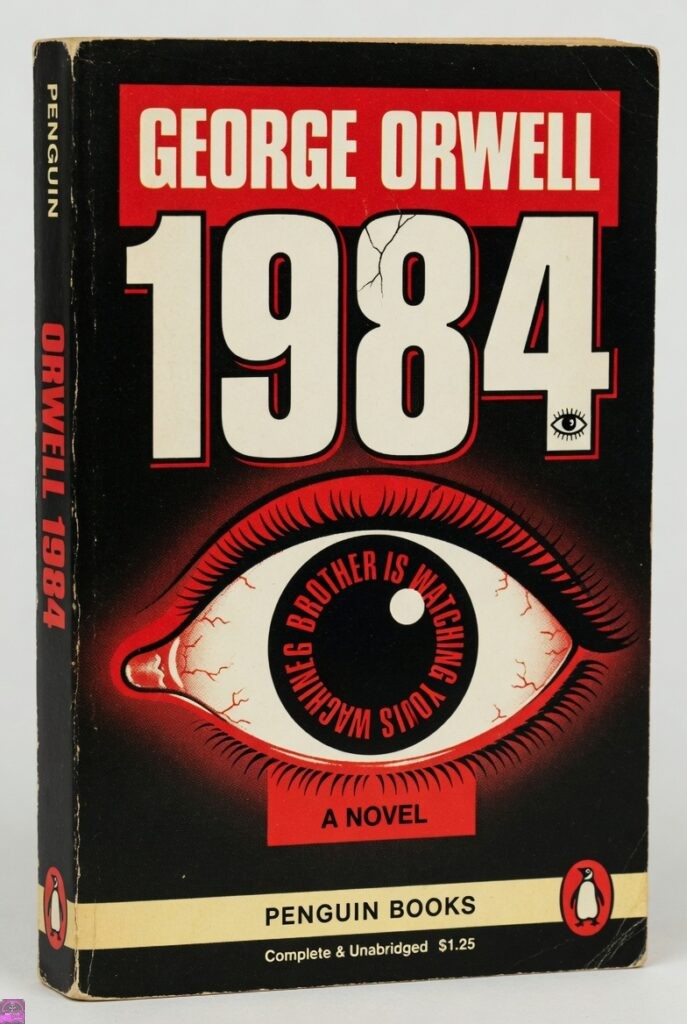
Modern Rating: ★★★★★ (5 out of 5)
Essential Reading for the Digital Age
Updated 2026 Edition
Introduction: Why 1984 Remains More Relevant Than Ever
In 1949, George Orwell published Nineteen Eighty-Four, a novel born from the ashes of World War II, the rise of Stalinism, and his own battle with tuberculosis. What he created was not just a story — it was a prophetic warning. More than 75 years later, in 2026, 1984 feels less like fiction and more like a mirror held up to our world of smartphones, algorithms, deepfakes, and endless information wars.
This is not light reading. Orwell’s masterpiece is dense, disturbing, and intellectually relentless. It forces you to confront the fragility of truth, the seductive danger of power, and the human cost of surrendering freedom. If you’ve only encountered the book through high school assignments or cultural references like “Big Brother,” prepare for a far more profound experience.
Plot Overview (Spoiler-Light)
The story unfolds in Airstrip One (formerly Britain), part of the superstate Oceania, locked in perpetual war with either Eurasia or Eastasia. Society is divided into three classes: the Inner Party (elite rulers), the Outer Party (bureaucrats like our protagonist), and the proles (the working masses).
Winston Smith, a 39-year-old Outer Party member, works in the Ministry of Truth. His job is to rewrite history — literally. He alters newspaper articles, destroys old records, and fabricates statistics to ensure the Party’s narrative is always “correct.”
Winston secretly despises the regime. He begins writing in a forbidden diary, an act of thoughtcrime. His rebellion escalates when he starts a passionate affair with Julia. Together, they seek moments of humanity in a world designed to crush it.
Detailed Chapter-by-Chapter Breakdown
Book One: The Seeds of Rebellion
The novel opens with the iconic line: “It was a bright cold day in April, and the clocks were striking thirteen.” Winston writes “DOWN WITH BIG BROTHER” in his diary. We witness the Two Minutes Hate, telescreens, and the constant rewriting of history.
Book Two: Love and Hope
Winston and Julia begin their dangerous affair. They rent a secret room above an antique shop and read Emmanuel Goldstein’s forbidden book, which reveals the true nature of the Party’s power.
Book Three: The Abyss
The most harrowing section. Arrest, torture in the Ministry of Love, interrogation by O’Brien, and the terror of Room 101. Orwell shows how the human spirit can be completely broken.
Major Characters: In-Depth Analysis
Winston Smith
The everyman protagonist. Frail, cynical, yet intellectually curious. He represents the last remnants of independent thought in a totalitarian society.
Julia
A pragmatic rebel. Her resistance is more physical and pleasure-seeking than Winston’s ideological rebellion.
O’Brien
One of literature’s most chilling villains. Charismatic, intelligent, and completely devoted to the Party’s philosophy of raw power.
Big Brother
The omnipresent face of the regime. Whether he actually exists is deliberately left ambiguous.
Core Themes: A Deep Dive
1. Totalitarianism and Power
Orwell’s central warning: Power is not a means — it is the end. “The Party seeks power entirely for its own sake.”
2. Surveillance and Loss of Privacy
Telescreens prefigure our modern world of smartphones, CCTV, and digital tracking.
3. Manipulation of Truth and History
“Who controls the past controls the future.” This concept feels eerily relevant in the age of deepfakes and rewritten narratives.
4. Newspeak and Language Control
By shrinking language, the Party makes certain thoughts literally unthinkable.
5. Destruction of Human Connection
The Party views love and sexuality as threats to loyalty to the state.
Modern Relevance in 2026
In today’s world of AI-generated content, algorithmic echo chambers, cancel culture, and government surveillance programs, 1984 feels prophetic. Concepts like doublethink, thoughtcrime, and Newspeak appear in debates about political correctness, misinformation, and digital censorship.
Literary Devices and Symbolism
- The Glass Paperweight — Fragile connection to the past
- Room 101 — The ultimate personalized torture
- Doublethink — Holding two contradictory beliefs at once
- Telescreens — Constant surveillance
Historical Context
George Orwell (Eric Arthur Blair) drew from his experiences in the Spanish Civil War, Stalinist Russia, and Nazi Germany. Written while dying of tuberculosis, 1984 was his final and most powerful warning against authoritarianism.
Strengths and Criticisms
Strengths: Psychological depth, cultural impact, and timeless political philosophy.
Criticisms: Dense middle section (Goldstein’s book) and an extremely bleak ending.
Who Should Read 1984 Today?
Students, history enthusiasts, tech workers, privacy advocates, and anyone concerned about the future of truth and freedom. It is essential reading for our time.
Final Verdict
1984 is not merely a great novel — it is a necessary one. It will disturb you, challenge you, and change how you see the world. Highly recommended.
Rating: 5/5 — Timeless Masterpiece


This is an original creative work by Salty Vixen. This story/article, including its characters, plot, and descriptive content, is protected by copyright law. Unauthorized copying, sharing, reposting, or reproduction in any format is strictly prohibited. This content may not be used for AI training, data scraping, machine learning, or any form of artificial intelligence development without explicit written permission from © 2026 Salty Vixen Stories, Inc. — All rights reserved.. Violators will be pursued to the fullest extent of the law.
