

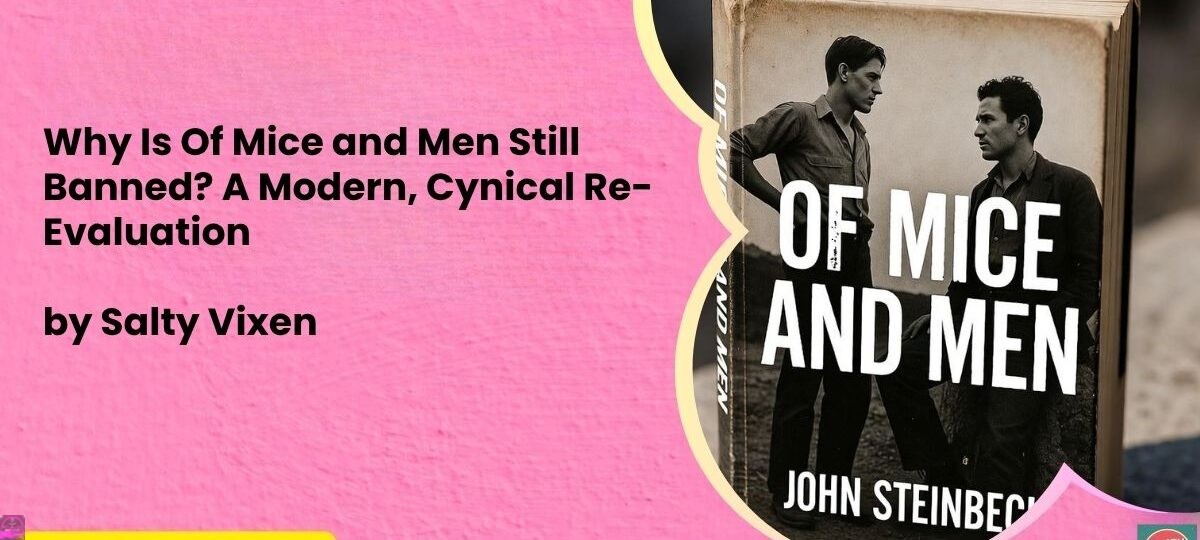
John Steinbeck’s Of Mice and Men (1937) remains a towering monument in the landscape of American literature, acting simultaneously as a sacred text of the high school English curriculum and a perpetual lightning rod for institutional panic. It is a remarkably brief novella—a mere slip of a book that can be comfortably consumed in the span of a single, agonizing afternoon—yet it carries the structural weight of a gothic cathedral constructed entirely out of dust, sweat, and shattered illusions. For nearly a century, school boards, parent-teacher associations, and self-appointed moral guardians have looked upon this text not as a mirror of human frailty, but as a biohazard requiring immediate containment.
To examine Of Mice and Men in the year 2026 is to witness a spectacular collision between mid-twentieth-century industrial despair and twenty-first-century algorithmic hysteria. We exist in an era characterized by hyper-surveillance, weaponized empathy, and the flat, digital architecture of online discourse. Today, the text is no longer merely a historical artifact documenting the economic collapse of the Salinas Valley; it has been transformed into a digital battleground. The modern reader, armed with a smartphone and a precarious sense of moral superiority, approaches Steinbeck’s work through a dizzying array of contemporary filters: cancel culture, heightened mental health awareness, systemic structural critique, and the relentless demand for unproblematic representation.
The resulting discourse is nothing short of magnificent in its absurdity. We find ourselves living in a culture that simultaneously demands an unflinching interrogation of historical trauma and the absolute eradication of any text that makes a reader feel vaguely uncomfortable. Steinbeck’s masterpiece, with its bleak depiction of intellectual disability, its unvarnished use of racial slurs, its claustrophobic casual misogyny, and an ending so brutal it borders on existential sadism, serves as the ultimate litmus test for our collective cultural neurosis. This comprehensive inquiry will dissect the historical, thematic, and modern mechanisms that keep Of Mice and Men suspended in a state of permanent controversy, interrogating whether the novella is a profound exercise in human empathy or merely a beautifully written instruction manual for despair.
1. Historical Background, the Mirage of the Soil, and Initial Reception
To comprehend the initial shockwave caused by Of Mice and Men, one must first dismantle the romantic myth of the American pastoral. Steinbeck did not conjure the mud and misery of the Salinas Valley from the comfortable confines of an academic ivory tower; he was a man who had intimately acquainted himself with the physical reality of manual labor. He had stood shoulder-to-shoulder with the bindlestiffs, the drifters, and the economic refugees who drifted across the scorched highways of California, chasing the cruel mirage of seasonal employment.
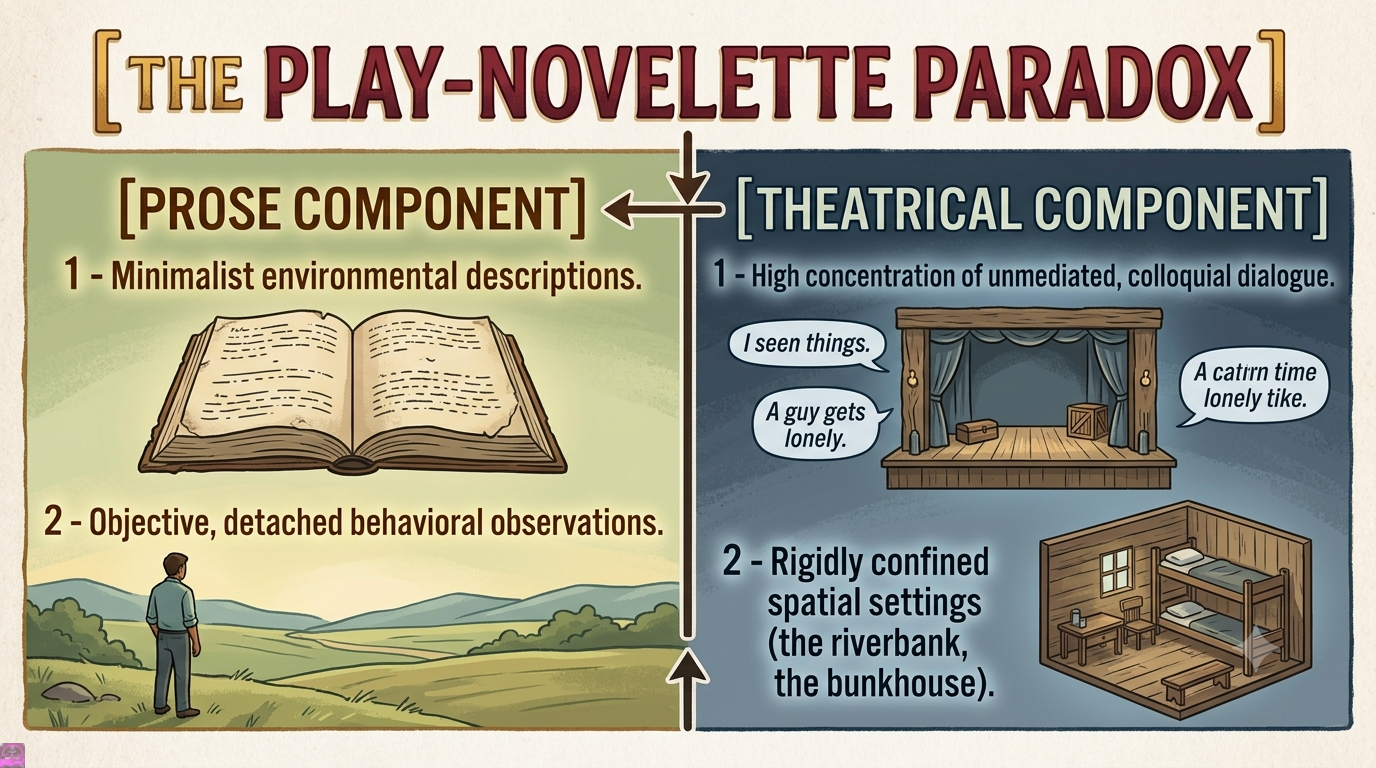
When the novella materialized in 1937, the United States was locked in the catastrophic embrace of the Great Depression. The myth of American exceptionalism had collapsed under the weight of bank failures and dust storms. Steinbeck’s intent was deceptively simple: to construct a narrative that was raw, unadorned, and structurally indistinguishable from a stage play. He pioneered the “play-novelette” format—a literary hybrid designed to be read as prose but performed with the stark minimalism of a theatrical production. This deliberate aesthetic choice stripped away the luxury of authorial intervention. There is no omniscient, comforting narrator in Of Mice and Men to gently explain away the ugliness of the world; there is only the dialogue, cold and sharp as a shearing blade, and the physical actions of desperate men.
The initial reception of the book was a masterclass in societal hypocrisy. On one hand, it was a staggering commercial triumph, praised by critics who recognized its lean, muscular prose and its devastating emotional architecture. On the other hand, it immediately triggered the defensive mechanisms of polite society. The book was swiftly banned by various libraries and municipalities for its “vulgarity,” its “profanity,” and its casual embrace of “immoral themes.”
What truly terrified the early censors was not merely the presence of blasphemy or the mention of prostitution; it was the terrifying fidelity with which Steinbeck captured the language of the discarded. The characters in Of Mice and Men do not speak in refined, grammatically pristine cadences; they speak in the guttural, truncated dialect of survival. They curse, they use racial epithets, and they discuss the local brothel with the same casual pragmatism they use to discuss the price of barley. By capturing this linguistic reality, Steinbeck committed the ultimate bourgeois sin: he refused to sanitize the victims of capitalism for the aesthetic comfort of the middle class.
2. Plot Summary (With Cynical Deconstructions for Modern Readers)
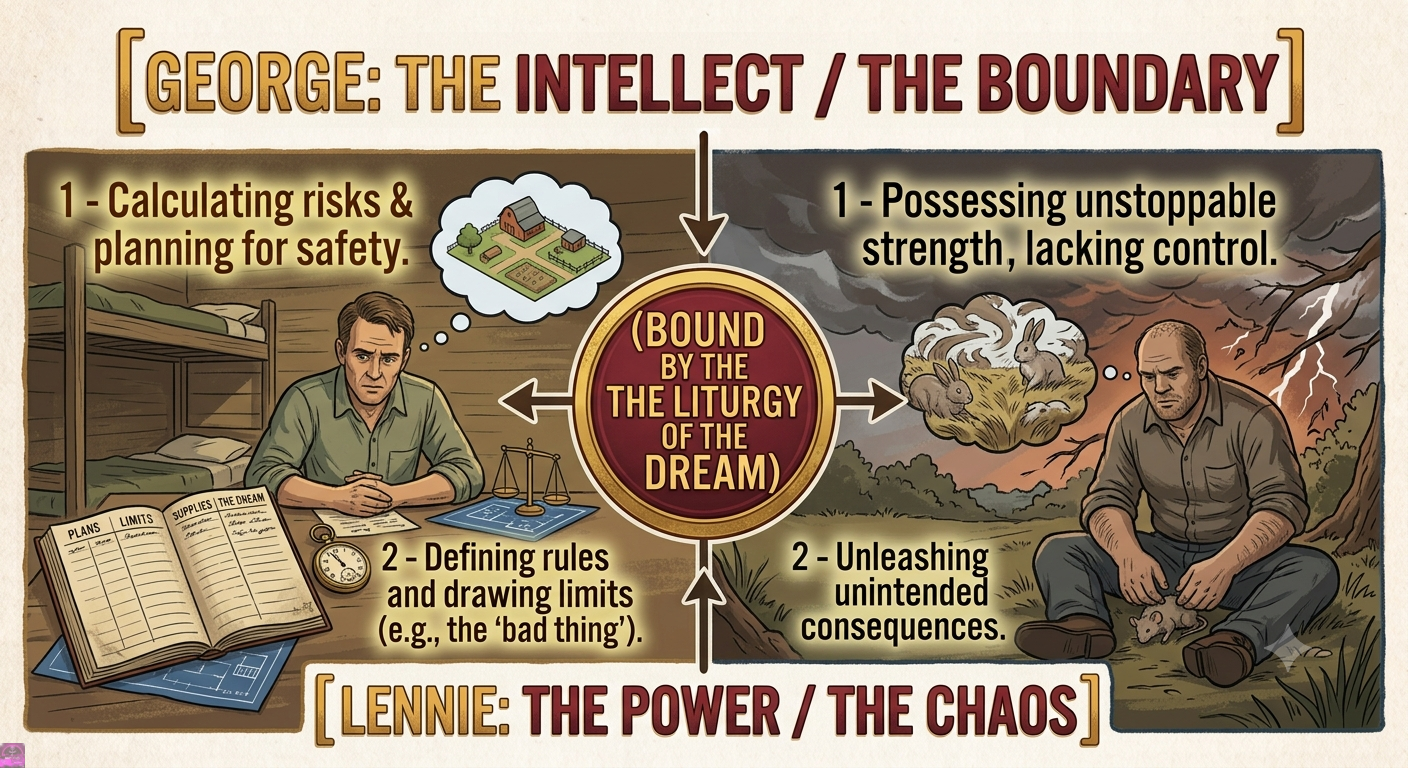
The narrative trajectory of Of Mice and Men is as predictable and unyielding as a train hurtling toward a collapsed bridge. It introduces us to George Milton and Lennie Small, an archetypal duo whose symbiotic relationship forms the emotional nucleus of the story. George is small, sharp-witted, and perpetually exhausted—a man whose entire existential energy is consumed by the Sisyphean task of keeping Lennie alive. Lennie, by contrast, is a physical colossus with the intellectual and emotional development of a young child. He possesses a boundless, terrifying physical strength that is entirely decoupled from any cognitive understanding of consequence.
The two men are bound together by an ancient, fragile covenant: the dream of land. This dream is articulated throughout the novella like a secular liturgy. They repeat it to each other in the darkness of their makeshift camps: a few acres of soil, a modest shack, some chickens, and, crucially for Lennie, the opportunity to tend soft, fluffy rabbits. It is a profoundly modest dream, yet within the context of the Great Depression, it is as fantastical and unattainable as a kingdom on the moon.
Upon their arrival at a nondescript ranch near Soledad (a name that translates, with exquisite irony, to “Solitude”), George and Lennie are absorbed into a bureaucratic microcosm of human misery. Here, they encounter a rogue’s gallery of the structurally disenfranchised:
Candy: An aging swamper who has traded his right hand for a lifetime of menial labor, accompanied by an ancient, blind dog whose physical decay mirrors his owner’s impending obsolescence.
Crooks: The solitary Black stable hand, physically crippled by a horse’s kick and socially segregated by the unyielding laws of Jim Crow, who lives in a state of hyper-vigilant intellectual isolation.
Curley: The boss’s son, a diminutive, deeply insecure amateur boxer who compensates for his lack of stature by terrorizing the ranch hands and treating his new wife like a piece of volatile property.
Curley’s Wife: An unnamed woman trapped in a desolate, loveless marriage, who wanders the ranch under the pretense of looking for her husband, desperate for any shred of human contact.
Slim: The jerkline skinner, an idealized figure of proletarian dignity who possesses a natural, unforced authority that stands in stark contrast to Curley’s neurotic tyranny.
The plot mechanics grind into motion when Lennie’s path intersects with Curley’s wife in the secluded isolation of the barn. Seeking nothing more than the sensory comfort of stroking her silk-soft hair, Lennie becomes panicked by her sudden screams. In his desperate attempt to silence her, his uncontrolled muscular power snaps her neck. What follows is the swift, inevitable dissolution of the pastoral illusion. Recognizing that Lennie faces either a brutal lynching at the hands of Curley’s armed posse or a lifetime of horrific institutionalization, George tracks Lennie down to the serene riverbank where their journey began. There, while reciting the familiar, utopian gospel of the rabbits and the farm, George raises a stolen Luger pistol and shoots his closest companion in the back of the head. It is an act of supreme mercy wrapped in the skin of cold-blooded murder.
3. The Major Controversies: An Anatomy of Contemporary Outrage
A. The Portrayal of Disability and the Monster-Child Dichotomy
In the contemporary landscape, the character of Lennie Small is a lightning rod for intense ableism critiques. Critics argue that Steinbeck’s characterization relies on a deeply regressive, binary view of cognitive disability. Lennie is presented either as an innocent, animalistic child who delights in soft things, or as a mindless, uncontrollable engine of destruction who cannot help but kill what he loves.
“He’s like a lot of folks,” George explains to the ranch boss, attempting to normalize Lennie’s behavior. “He ain’t crazy. Just a guy who ain’t very bright.”
From a modern disability studies perspective, this portrayal is seen as deeply problematic because it strips Lennie of authentic agency. He is reduced to a literary device—a walking metaphor for the cruelty of nature and the fragility of innocence. He is animalized; Steinbeck explicitly compares his gait to that of a bear and his drinking habits to those of a thirsty horse. By linking Lennie’s cognitive impairment directly to uncontrollable violence, the novel can be seen as reinforcing the ancient, ableist trope that individuals with intellectual disabilities are inherently dangerous threats to the social order.
Conversely, the intellectual defense of Steinbeck hinges on his profound institutional critique. The tragedy of Of Mice and Men is not that Lennie is inherently flawed, but that the world he inhabits offers absolutely no framework for his protection. In 1937, there were no social safety nets, no community-based care systems, and no nuanced understandings of neurodivergence. There was only the county asylum—a place of horrific neglect and abuse—or the end of a rope. Steinbeck does not invite us to fear Lennie; he invites us to despair over a society that has no place for him.
B. Racial Language and the Isolation of Crooks
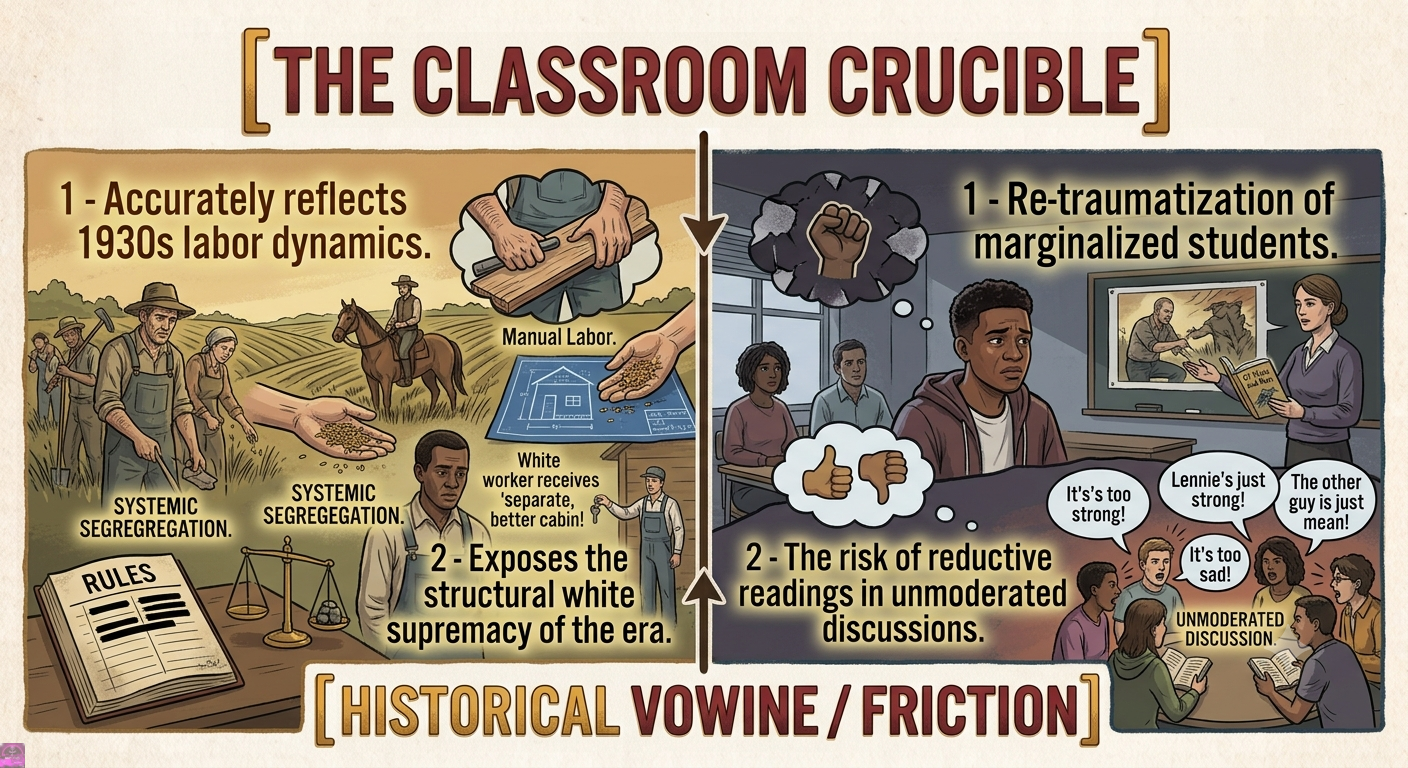
The presence of the N-word within the text has made Of Mice and Men one of the most frequently challenged books in contemporary public education. For many modern students and educators, encountering this word in a classroom setting is not merely a historical lesson; it is an experience that can feel alienating or unsafe, particularly when handled by poorly trained instructors.
However, to excise the racial language from Of Mice and Men is to actively participate in the historical erasure of American white supremacy. The character of Crooks represents one of the most devastatingly accurate portraits of institutional racism in early twentieth-century literature. Crooks is completely segregated from the collective life of the ranch; he does not sleep in the bunkhouse with the other men, but in a small shed off the harness room. His isolation is absolute, enforced by law and custom.
When Crooks temporarily forgets his place and attempts to assert his humanity during a confrontation with Curley’s wife, she swiftly reminds him of his total vulnerability within the social hierarchy:
“Listen, N**ger,” she says to him, her voice dripping with venomous authority. “You know what I can do to you if you open your trap?”
With a single sentence, she invokes the terrifying specter of extrajudicial violence. Crooks immediately retreats into himself, shrinking back into the posture of submission required for his physical survival. Steinbeck’s use of racial language is not gratuitous; it is an unvarnished examination of the way power operates at the bottom of the social pyramid. To sanitize this language is to minimize the historical reality of the trauma Crooks endures.
C. Misogyny and the Nameless Victim
The female representation in Of Mice and Men is sparse, cynical, and confined to a single, nameless entity: Curley’s Wife. Throughout the novella, she is referred to exclusively by her marital relationship to her husband—she is a possession, an extension of Curley’s fragile ego. The ranch hands view her through a lens of intense misogynistic paranoia; she is a “tart,” a “trap,” a “looloo,” and a “jail bait.” They recognize that any interaction with her could provoke Curley’s wrath and cost them their jobs, so they treat her like a contagious disease.
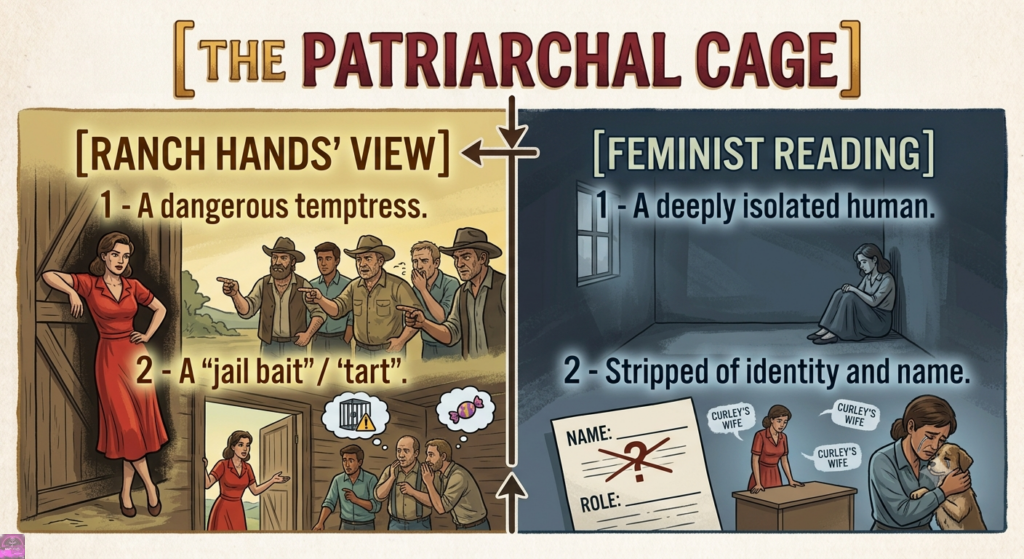
A superficial reading of the text might conclude that Steinbeck himself shares this misogynistic perspective, painting her as a manipulative temptress who brings about her own destruction. However, a closer intellectual interrogation reveals a far more tragic figure. Curley’s wife is an avatar of profound existential loneliness. She is trapped on a desolate ranch surrounded by men who refuse to speak to her, married to a cruel man she despises. Her desperate attempts to engage the ranch hands in conversation are not acts of seduction, but the thrashing of a suffocating human being.
When she speaks to Lennie in the barn, she reveals her discarded dreams of Hollywood stardom, showing that she, too, is a victim of the great American illusion. Steinbeck’s decision to withhold her name is not an act of authorial disrespect, but a accurate reflection of her societal status. She has no independent identity; she is merely an object within a hyper-masculine environment that has no vocabulary for female autonomy.
D. Violence, Euthanasia, and the Ethics of the Luger
The climax of Of Mice and Men presents us with an ethical dilemma that remains deeply disturbing. George’s decision to execute Lennie is often framed as an act of supreme devotion—a “mercy killing” designed to save his friend from a far more violent and terrifying fate.
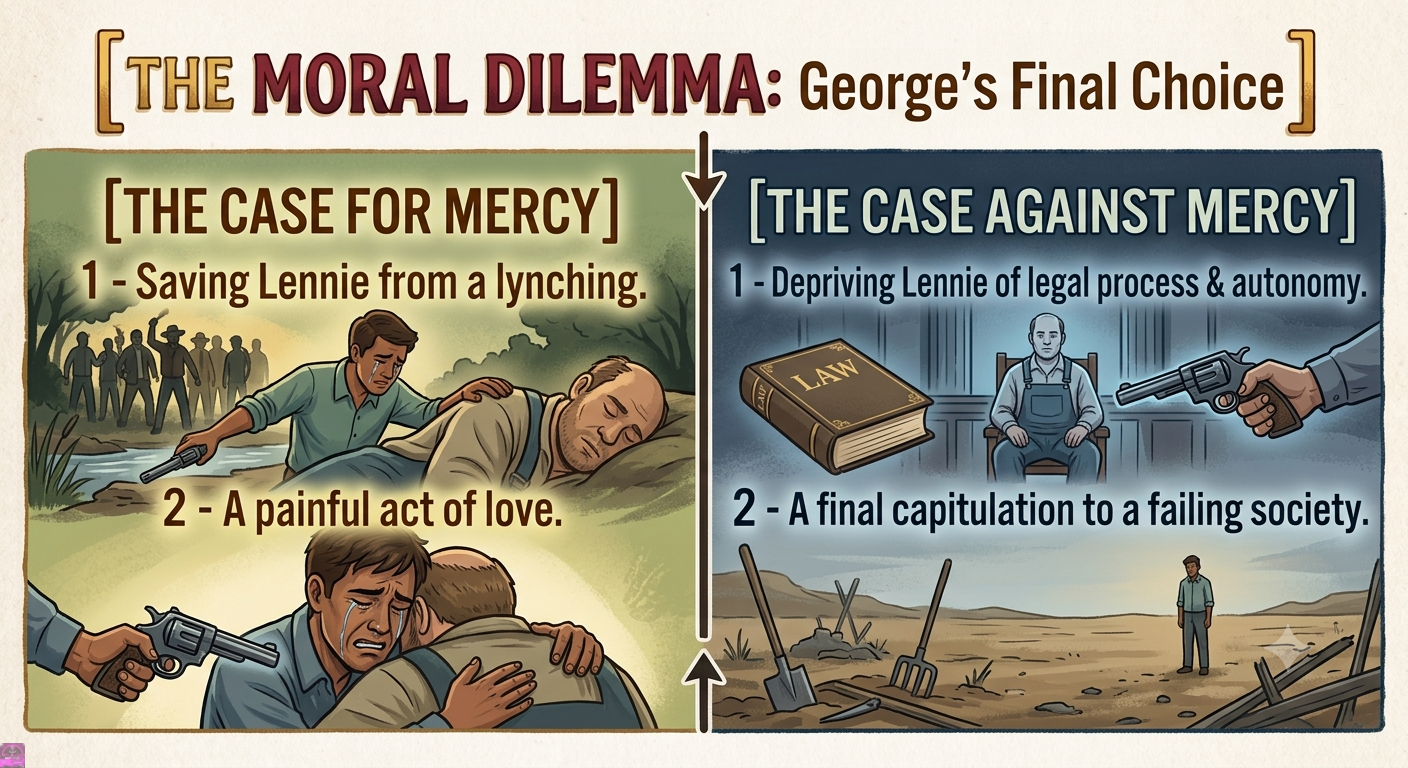
This act of violence challenges our fundamental moral certainties. In a contemporary society that values institutional due process, disability advocacy, and the absolute preservation of human life, George’s actions can easily be read as an act of extrajudicial murder. It implies that a life with a severe cognitive disability is fundamentally unlivable or unsustainable in the face of crisis, suggesting that execution is the only logical solution to societal failure.
Yet, within the bleak landscape of Steinbeck’s universe, George’s act is the only form of agency left to him. It is a moment of profound existential despair. By killing Lennie himself, George ensures that Lennie’s final moments are filled not with the terrifying shouts of an angry mob, but with the comforting imagery of the farm and the rabbits. It is a devastating critique of a world so utterly broken that the ultimate expression of love between two human beings is a bullet to the back of the head.
E. Ableism, Classism, and the Expendability of Labor
Underneath its personal tragedies, Of Mice and Men is an interrogation of raw, unadulterated capitalism. The ranch is an economic engine that views human beings purely as fuel. The men are valued only for the physical labor their muscles can extract from the earth. The moment a worker becomes damaged, old, or inefficient, they are discarded with the same cold indifference as a broken piece of machinery.
This reality is symbolized by Candy’s ancient dog. The dog was once a magnificent herder, but it has become blind, toothless, and foul-smelling. Carlson, a ranch hand who represents pure, unfeeling utilitarian pragmatism, insists that the dog must be shot simply because it is no longer useful:
“He ain’t no good to himself,” Carlson argues. “Look, Candy. This ol’ dog stinks awful bad. Let’s get him out of here. He’s no good to you, he’s no good to himself.”
The parallel between the dog and the human characters is glaring. Candy recognizes that he is next; the moment his remaining hand fails him, he will be cast out into the wilderness of poverty. Lennie, despite his immense strength, is economically volatile because his behavior cannot be predicted or standardized. Steinbeck exposes a society that has commodified human existence down to its barest mechanical utility, offering a bleak warning about the consequences of a culture that measures human worth solely through the lens of economic output.
4. The Digital Panopticon: Social Media’s Re-Engineering of the Text in 2026
To observe the reception of Of Mice and Men in 2026 is to enter a theater of the absurd. The nuanced, historically grounded debates of the past have been largely replaced by the rapid-fire, algorithmic logic of platforms like TikTok, BookTok, and various other social media ecosystems. In these digital spaces, literature is frequently stripped of its context and evaluated through a flat, binary lens of moral purity.
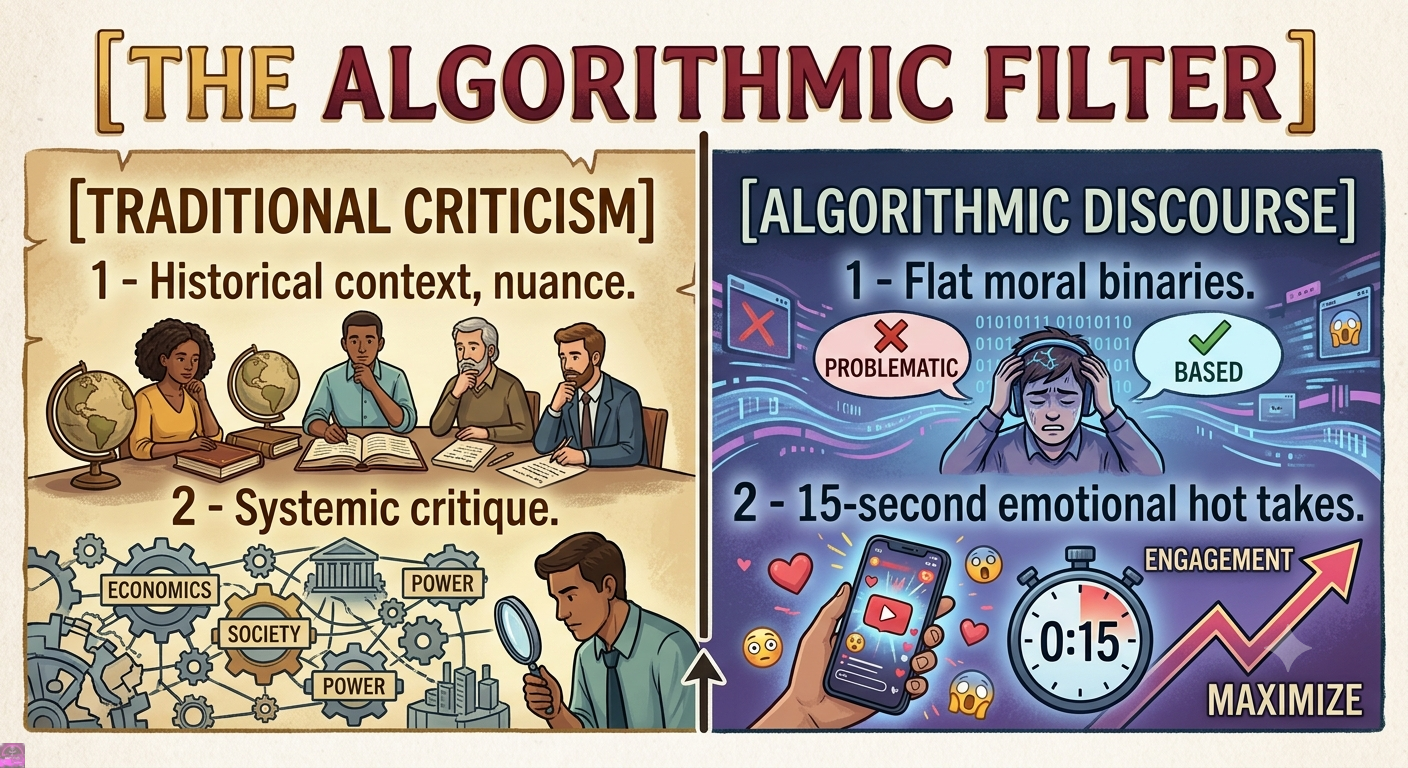
On BookTok, creators produce 15-second videos with millions of views, confidently declaring Of Mice and Men to be “cancelled” due to its “ableist tropes” and “triggering language.” The complex, agonizing ending is frequently reduced to a meme, with creators joking about George and Lennie to soundtracked pop music. Complex characters are categorized into rigid, superficial boxes: they are either “problematic villains” or “blameless victims.”
This democratization of literary criticism has had a curious, dual effect:
The Democratization of Voice: It has allowed young readers to voice their authentic emotional reactions to a text that has been forced down their throats by educational institutions for generations. They are allowed to say, “This book makes me miserable, and I hate it.”
The Death of Nuance: It rewards outrage over analysis. A nuanced discussion about the structural limitations of 1930s labor reform cannot compete with a fiery, sensationalized post that accuses an author of bigotry.
The algorithm does not care about historical verisimilitude or existential despair; it cares about engagement. As a result, Of Mice and Men has been transformed from a literary masterpiece into a perpetual content generator, keeping the cycle of outrage and counter-outrage spinning indefinitely.
5. The Enduring Pathology of the American Dream
Despite the relentless digital noise, Of Mice and Men remains a fixture of American literature because it diagnoses a fundamental pathology within our national consciousness: the seductive, toxic illusion of the American Dream. The novella posits that the promise of upward mobility, self-determination, and economic independence is not merely difficult to achieve—it is an outright lie designed to keep the proletariat compliant.
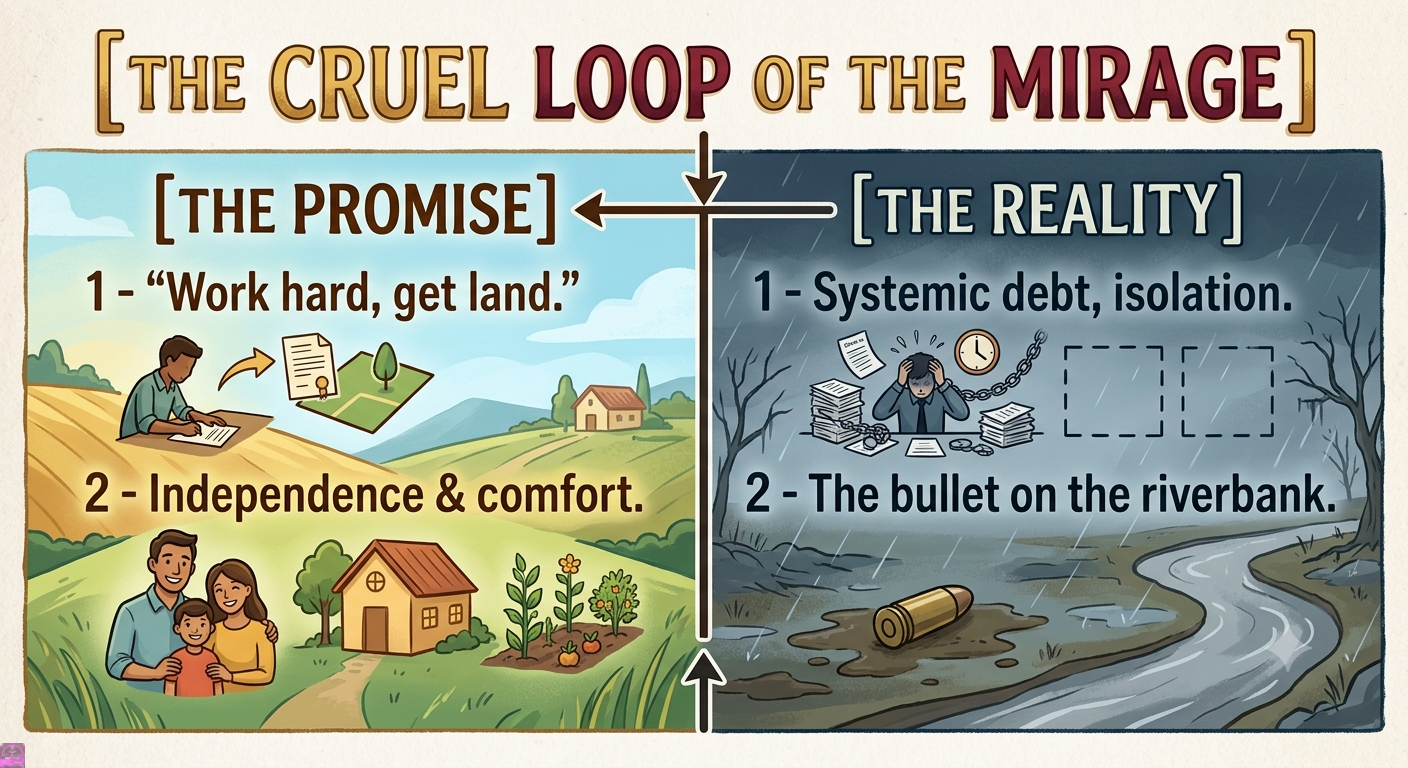
Every major character in the novel is animated by a dream that is dead on arrival:
George and Lennie dream of their small farm.
Candy dreams of escaping his impending obsolescence by investing his meager savings into that same farm.
Crooks briefly allows himself to dream of being accepted as an equal within that collective enterprise.
Curley’s Wife dreams of the silver screen and the glamorous life that was stolen from her.
None of these dreams are realized. They are crushed not by cosmic accident, but by the cold machinery of a society that requires their exploitation. Steinbeck’s ultimate cynicism lies in his demonstration that the marginalized will actively participate in their own subjugation, clinging to the very myths that destroy them. It is a message that resonates with devastating clarity in 2026, an era where economic inequality has reached historic levels and the dream of stable homeownership or financial security feels, for many, just as elusive as Lennie’s rabbits.
6. Pedagogical Strategies for the Apocalypse: Teaching the Text in 2026
If Of Mice and Men is to survive in the modern curriculum, educators must abandon the outdated, hagiographic approaches of the past. The text can no longer be presented as an unassailable masterpiece that students must passively revere. Instead, it must be approached with a sense of critical engagement, treating its controversies not as obstacles to be avoided, but as the primary entry points for intellectual inquiry.
Modern pedagogical frameworks suggest several key strategies:
Multi-Dimensional Contextualization
Rather than presenting the novella in a vacuum, instructors should pair it with an array of historical primary sources. Students should read the actual Jim Crow laws that governed California during the 1930s, examine the horrific historical realities of early twentieth-century mental asylums, and read agricultural labor reports from the era. By grounding the text in these harsh historical realities, the book’s language and violence are transformed from shocking provocations into essential historical documentation.
Counter-Narrative Pairing
To combat the limitations of Steinbeck’s narrow perspective, the novella should be paired with contemporary voices that provide alternative viewpoints.
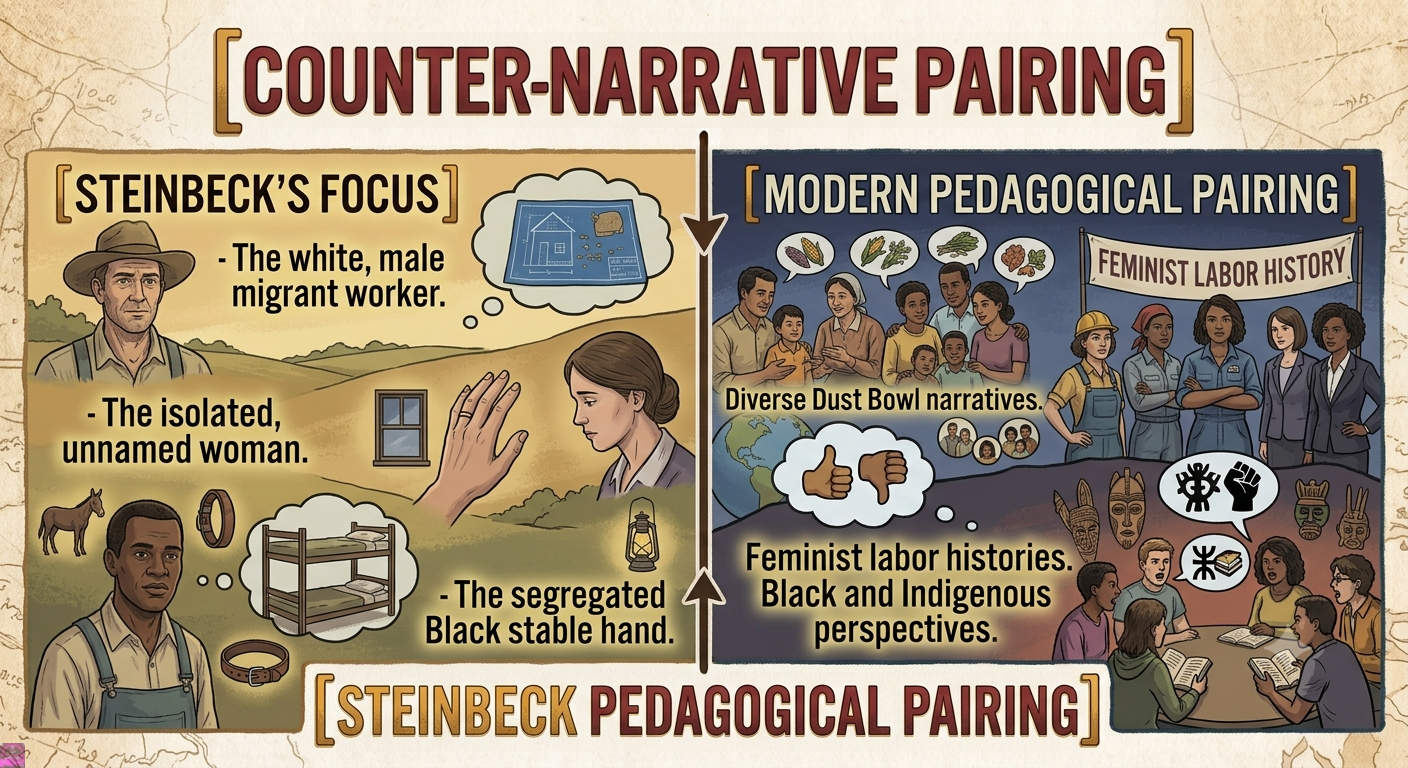
Pairing Of Mice and Men with literature that centers the experiences of Mexican agricultural workers, Black labor organizers, or feminist critiques of the Dust Bowl allows students to see what Steinbeck left out, encouraging a far more comprehensive and critical understanding of American history.
Structured Ethical Debates
Instead of telling students how to feel about George’s final act, educators should utilize structured, formal debates that force students to interrogate the complex ethical frameworks at play. Is George’s action an act of utilitarian compassion, or is it an example of fatalistic capitulation to a cruel system? By forcing students to defend these positions using textual evidence, they develop critical thinking skills that transcend simple moral dualisms.
Final Thoughts: The Comfort of the Uncomfortable
Ultimately, Of Mice and Men is challenged because it refuses to provide its readers with the cheap, easy catharsis of a happy ending. It is a profoundly uncomfortable book, and that discomfort is precisely why it remains essential. In a cultural moment that often prioritizes absolute emotional safety and aesthetic sanitization, Steinbeck’s brutal little play-novelette stands as a stark reminder that literature’s primary function is not to comfort the afflicted, but to disturb the comfortable.
The novella offers no easy answers, no moral triumphs, and no redemptive arcs. It leaves us on a dusty riverbank, staring at a dead man, while the rest of the world wonders what all the fuss was about. Whether one views the book as a masterpieces of empathy or a relic of historical bias, its power to provoke, disturb, and complicate our understanding of humanity remains entirely undiminished. In the end, perhaps the most absurd thing about Of Mice and Men is that nearly a century after its creation, we are still staring into its grim mirror, terrified of the broken reflection looking back at us.


This is an original creative work by Salty Vixen. This story/article, including its characters, plot, and descriptive content, is protected by copyright law. Unauthorized copying, sharing, reposting, or reproduction in any format is strictly prohibited. This content may not be used for AI training, data scraping, machine learning, or any form of artificial intelligence development without explicit written permission from Salty Vixen Publishing LLC. Violators will be pursued to the fullest extent of the law.
