

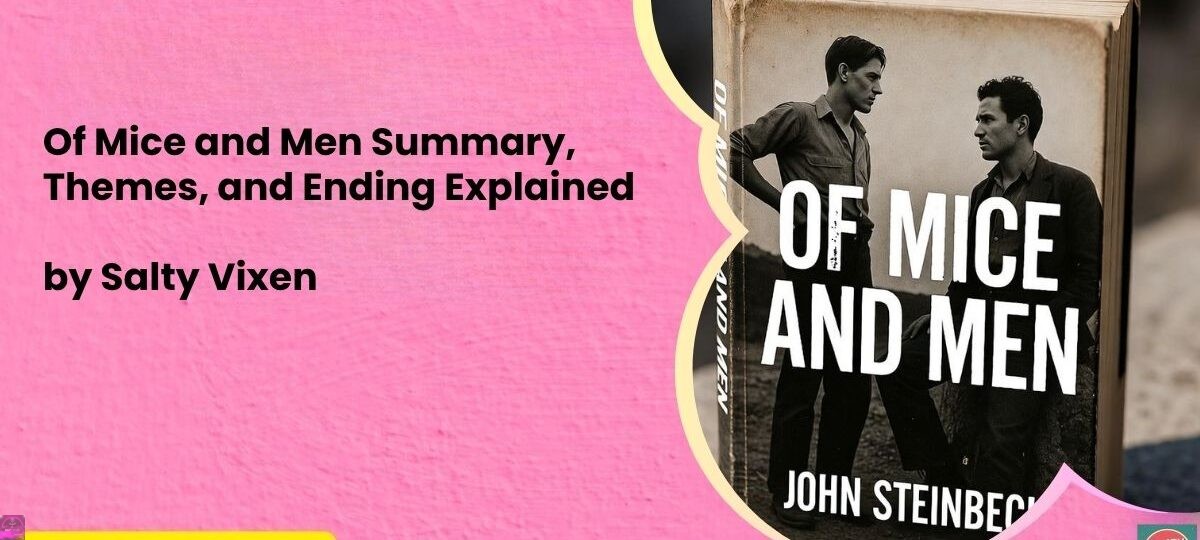
In a world of endless scrolling, hustle culture, and quiet quitting, John Steinbeck’s Of Mice and Men remains one of the most powerful short novels ever written. It’s raw, heartbreaking, and brutally honest about friendship, dreams, and what happens when the world doesn’t care if you survive.
If you’re a student, a bookTok fan, or just someone who wants to understand why this 1937 novella still feels so relevant almost 90 years later, this deep-dive guide is for you.
What Is Of Mice and Men Really About?
Of Mice and Men follows two migrant workers, George Milton and Lennie Small, as they travel through California during the Great Depression looking for work. George is small, quick-witted, and always thinking ahead. Lennie is a giant of a man with enormous strength but a childlike mind due to an intellectual disability. The two are best friends — more like brothers — and they share one big dream: to one day own their own small farm where they can “live off the fatta the lan’” and Lennie can tend rabbits.
The story takes place over just a few days on a ranch near Soledad, California. What starts as another job quickly turns into a pressure cooker of loneliness, power struggles, prejudice, and shattered hopes. The book is short (under 100 pages in most editions), but it packs an emotional punch that stays with you long after you finish.
Plot Summary (Spoiler-Free Version)
George and Lennie arrive at a new ranch hoping to save enough money for their dream farm. The ranch is full of lonely, desperate men. There’s the boss’s aggressive son Curley, his lonely and misunderstood wife, an old swamper named Candy, a Black stable hand named Crooks who faces constant racism, and a big, friendly worker named Slim.
As the men work hard under harsh conditions, tensions rise. Lennie’s love of soft things and his inability to control his strength create dangerous situations. The dream that keeps George and Lennie going starts to feel both closer and more impossible than ever.
The novel builds to one of the most famous — and devastating — endings in American literature.
Full Character Analysis: Who These People Really Are
George Milton George is the realist. He’s exhausted from taking care of Lennie, but he never abandons him. In many ways, George represents the millions of people who carry heavy emotional loads while still trying to hold onto hope. He’s sarcastic, protective, and deeply loyal.
Lennie Small Lennie isn’t “dumb” in a cruel way — he’s neurodivergent before the word existed. His childlike innocence mixed with superhuman strength makes him both lovable and dangerous. He doesn’t understand social rules or consequences, but his love for soft things and his devotion to George feel incredibly human.
Curley’s Wife Often called one of the loneliest characters in the book. She’s trapped in a bad marriage and dreams of Hollywood fame. Steinbeck shows her with sympathy — she’s not just a “troublemaker,” she’s a woman with crushed dreams in a world that gave her no power.
Crooks The only Black worker on the ranch. He’s intelligent, proud, and isolated because of racism. His scene with Lennie and Candy is one of the most powerful explorations of loneliness in the entire book.
Candy & Slim Candy represents the fear of growing old and useless. Slim is the voice of quiet wisdom and natural leadership — the kind of person everyone respects.
Major Themes That Still Matter in 2026
1. The American Dream – Is It Still Possible? George and Lennie’s dream of owning land feels painfully relatable today. In an era of skyrocketing rent, student debt, and gig work, their simple wish for stability hits hard. Steinbeck shows how the Dream is often dangled in front of people who never quite reach it.
2. Friendship & Found Family In a world where many young people feel disconnected despite being “connected” online, George and Lennie’s bond is powerful. They choose each other every day. Their friendship is messy, codependent, and beautiful.
3. Loneliness & Isolation Almost every character is profoundly lonely. The ranch is full of people but empty of real connection — something Gen Z understands too well.
4. Disability & Neurodivergence Lennie’s portrayal sparks important conversations. He’s not a villain. He’s a person who needs support and understanding. The book forces readers to ask: How does society treat people who are different?
5. The Cycle of Violence & Mercy The ending raises hard questions about mercy, euthanasia, and doing the hardest thing out of love.
Why Gen Z Should Read Of Mice and Men in 2026
- It’s short enough to finish in a weekend (or even one long reading session).
- The emotional weight feels like a gut-punch TikTok edit.
- It’s perfect for discussions about mental health, ableism, racism, and economic inequality.
- The writing is simple but incredibly powerful — Steinbeck doesn’t waste a single word.
Many students say the ending left them speechless. That’s the mark of great literature.
Literary Style & Why It Works
Steinbeck uses simple language and vivid descriptions. The book reads like a play (it was later adapted into one). Every character, every object, and every conversation serves the themes. The title comes from a Robert Burns poem: “The best laid schemes o’ mice an’ men / Gang aft agley” — meaning even the best plans often go wrong.
Final Thoughts: The Tragedy and the Hope
Of Mice and Men is devastating, but it’s not completely hopeless. While the characters’ big dream dies, their friendship and moments of human kindness shine through the darkness. Steinbeck seems to say: The world is cruel, but the way we treat each other still matters.
In 2026, as we deal with AI taking jobs, climate anxiety, and social isolation, this story reminds us that human connection is the most valuable thing we have.


This is an original creative work by Salty Vixen. This story/article, including its characters, plot, and descriptive content, is protected by copyright law. Unauthorized copying, sharing, reposting, or reproduction in any format is strictly prohibited. This content may not be used for AI training, data scraping, machine learning, or any form of artificial intelligence development without explicit written permission from © 2026 Salty Vixen Stories, Inc. — All rights reserved.. Violators will be pursued to the fullest extent of the law.
