

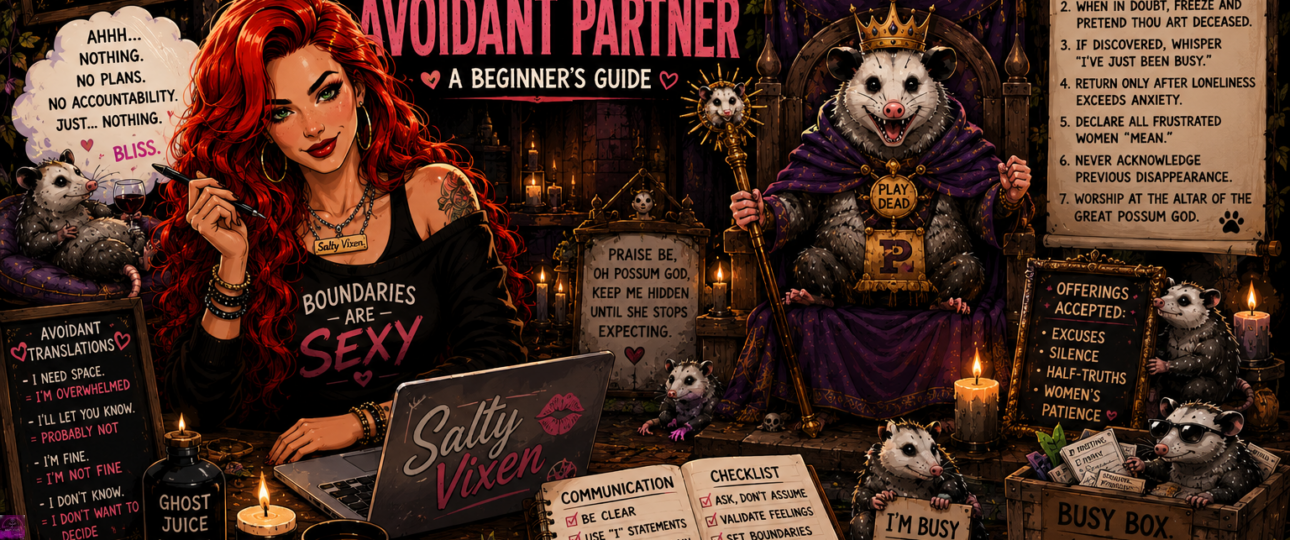
For decades, researchers—those noble, grant-funded martyrs sipping terrible coffee in underfunded labs—have tried to decode one of the internet’s most persistent and infuriating mysteries: the avoidant partner. These creatures are evolutionary marvels of contradiction. Highly intelligent, often armed with graduate degrees, legal acumen sharp enough to eviscerate ex-spouses in court, and the uncanny ability to troubleshoot Wi-Fi routers at 3 a.m. while quoting Foucault, they somehow collapse into primitive incompetence at the single most basic requirement of modern relationships: basic fucking communication.
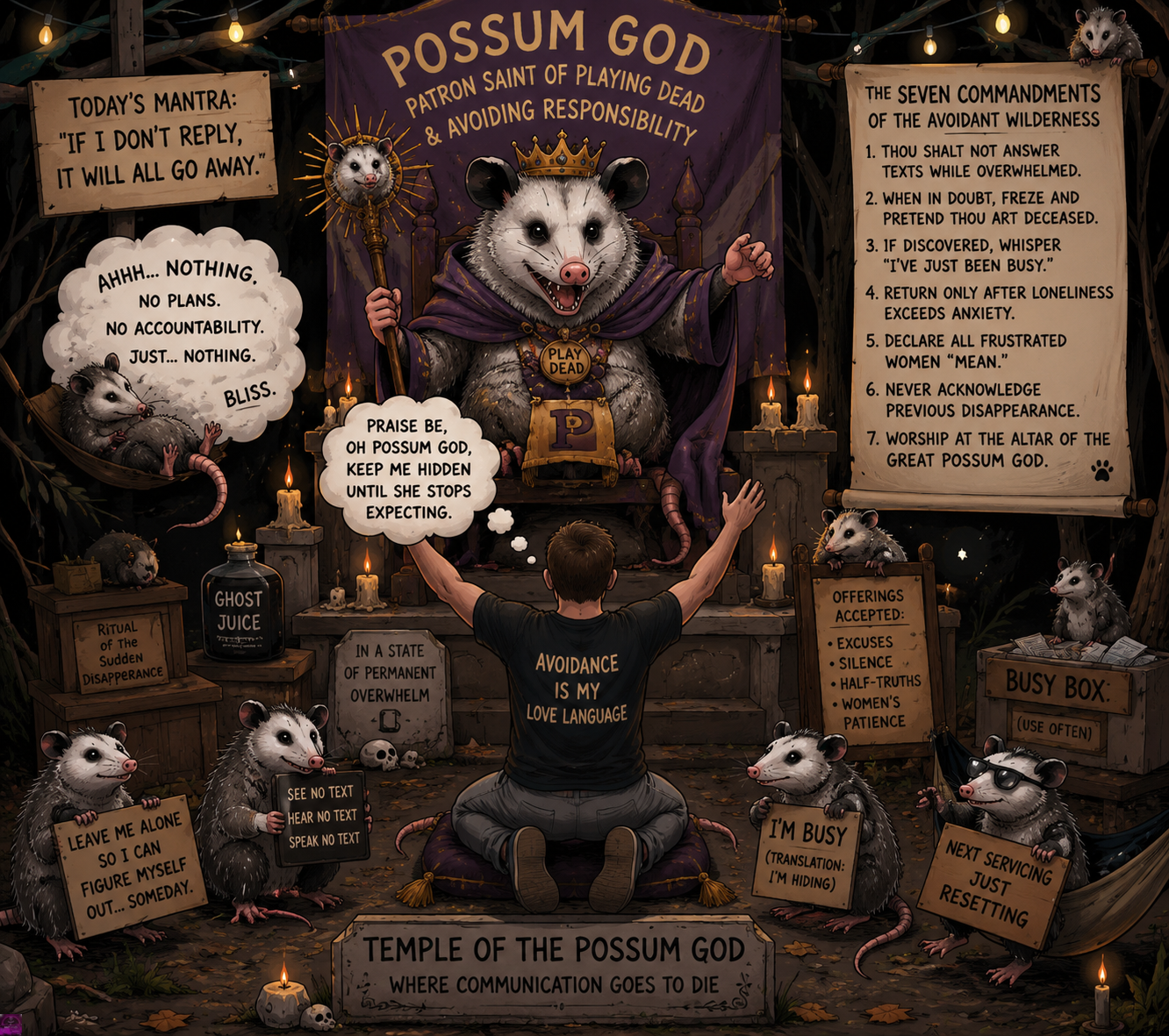
Modern science has wrapped the phenomenon in polite terminology—“deactivating strategies,” “autonomic shutdown,” “protest behavior”—but the raw truth is far simpler and more hilarious. This guide serves as both survival manual and sacred text for beginners and newly initiated members of the Possum God faith, that ancient and honorable religion whose central sacrament is curling into a defensive ball and pretending your partner (and the entire emotional universe) does not exist. Hail Possum. May your nervous system remain forever unregulated, your phone on silent, and your garage perpetually reorganized.
The avoidant nervous system operates with the exquisite, hair-trigger sensitivity of a high-end smoke detector installed by a paranoid libertarian who survived one too many disaster documentaries. It draws zero distinctions between:
- Actual five-alarm emergencies (house fire, custody battles, genuine relationship threats).
- The gentle, terrifying creep of emotional closeness.
- A harmless “How was your day?”
- The apocalyptic horror of “Want to make plans next weekend?”
All inputs trigger Emergency Possum Mode™. Blood flow diverts to the limbs for rapid escape. The prefrontal cortex, that overpaid executive of rational thought, immediately clocks out and heads to happy hour. The amygdala throws an unsanctioned rave with glow sticks and poor decisions. All higher cognitive resources reroute to the Sacred Forest of Regulation, where one communes with the trees, refreshes sports scores, or alphabetizes the sock drawer while achieving absolutely nothing.
Symptoms of true enlightenment in the faith are elegantly consistent: sudden digital disappearance faster than logic evaporates in an online argument, a mysterious and urgent compulsion to “get busy” with tasks that could have waited until the sun burns out, selective amnesia regarding text messages, shared calendars, and the very concept of object permanence, and the holy pilgrimage into solitude where phone signal dies a mysterious death and genuine introspection is theoretically supposed to occur. (In practice, it’s mostly white noise, quiet resentment at the audacity of feelings, and wondering why everyone else makes this look so easy.)
From an evolutionary lens, this wiring made perfect sense for our 40,000-year-old ancestors who might actually get clubbed for showing weakness. In 2026, when your greatest threat is your partner noticing you’ve gone radio silent after particularly good sex, it registers as profoundly maladaptive dark comedy. Nature equipped us with opposable thumbs, abstract reasoning, and the ability to land robots on Mars, yet we still treat emotional reciprocity like a finite resource that must be hoarded like boomers hoarded toilet paper in 2020. Intelligence provides no immunity. You can debug quantum code or win legal arguments, but voicing “I felt a little distant” feels like defusing a bomb with a plastic spoon while blindfolded.
The cynical beauty of avoidant attachment is its flawless, elegant middle finger to attachment theory. While the anxious partner composes emotional sonnets, tracks read receipts like a forensic accountant on Red Bull, and interprets ellipses like ancient runes, the avoidant lives the pure Sartrean dream: hell is other people—especially when they expect consistent texting after 9 p.m. or, god forbid, emotional continuity between intimacy sessions.
Yet researchers have made genuine progress by discovering that many avoidants secretly possess the latent superpower of speech. Yes, the same individuals who draft airtight legal responses or explain complex systems can, under laboratory conditions and with sufficient external pressure, produce complete sentences about their internal state. Miracles, it seems, never cease in the year of our Possum 2026.
Advanced Communication Phrases™ (use sparingly, as they may cause spontaneous feelings):
- “Work is crazy today.” (Translation: Mild stress detected. Possum protocol engaged.)
- “I’m overwhelmed.” (Translation: Nervous system doing the opossum tango again.)
- “I need some space, but I’m okay.” (Translation: Please withhold search parties and passive-aggressive memes.)
- “I’ll talk to you later tonight.” (Translation: I acknowledge your sentience and will provide minimal proof of life.)
Exhausted partners wielding metaphorical clipboards have shown these phrases require fewer than ten seconds and reduce relational panic by roughly 87%. They also prevent awkward conversations with local authorities. Truly revolutionary.
The devoted worshippers of Possum, however, cling fiercely to sacred myths passed down through generations of emotionally constipated ancestors. Let us dismantle them with ruthless intellectual precision and zero mercy.
Admitting vulnerability will cause literal explosion? Peer-reviewed evidence says no. Thousands have confessed mild insecurity without transforming into glittery emotional confetti. The worst outcome is typically a partner responding with “Thank you for telling me” and an offer of physical comfort. How devastatingly anticlimactic.
Being genuinely busy demands total radio silence? Millions of functioning adults juggle careers, taxes, children, and the occasional thoughtful text without their empires crumbling. The avoidant brain, however, frames any acknowledgment of a partner during high-stress periods as dangerous resource misallocation—emotional socialism in reverse, where all resources flow inward and nothing trickles outward. Peak self-preservation, if your metric is slow relational attrition.
Discussing intimacy concerns will result in public shaming and tribal exile? Most partners, it turns out, vastly prefer honest dialogue about performance anxiety, post-nut clarity, the sudden urge to reorganize the garage right after orgasm, or the crushing wave of existential dread mid-thrust over starring in their personal episode of Unsolved Mysteries. The telepathy fantasy—“they should just understand me without me saying anything”—remains the glittering crown jewel of narcissistic romanticism masquerading as profound depth. Even the most attuned partner is not psychic. They are a tired, horny amateur psychologist doing their best with incomplete data. Give them words, you beautiful disaster.
Outdated cultural programming only deepens the farce. Ancient scrolls (courtesy of Hollywood blockbusters, stoic grandfathers, and questionable evolutionary psychology TikToks) decree that real men must always desire intimacy on command, always perform flawlessly, never experience insecurity or the sudden soul-crushing weight of feelings, and never—under any circumstances—discuss the uncomfortable. Modern scientists, philosophers, and anyone who has had sex more than twice have concluded this system is not merely flawed but deeply, hilariously stupid.
Humans feel anxiety, embarrassment, shame, performance jitters, exhaustion, and emotional overwhelm. These states are not fatal. Discussing them tends to improve everything dramatically. The ancient scrolls were authored by people who died young, miserable, and probably constipated. Time to update the firmware.
In avoidant territory, intimacy itself becomes a glorious battlefield of contradictory impulses: desperate craving for connection colliding with absolute terror of engulfment. Post-coital withdrawal is rarely pure rejection—it is often the nervous system frantically hitting the reset button after a vulnerability overload. The cynical comedy practically writes itself: two humans achieve the most physically intimate act possible, only for one to immediately require solitude equivalent to a year-long monastic retreat. The intellectual appeal is undeniable. The practical result is frequently hilarious tragedy.
For the rare, magnificent trainwrecks where two avoidants find each other, the Mirror Dance emerges—a sophisticated ballet of mutual withdrawal, forensic-level pattern recognition, and emotional jiu-jitsu. One partner shuts down; the other respects the shutdown so thoroughly they shut down even harder in solidarity. It is two porcupines attempting a hug while maintaining perfect intellectual distance and impeccable boundaries. Understanding the dance does not guarantee graceful execution. You both know every step intimately. You both still manage to step on each other’s softest emotional underbellies with surgical precision.
And yet, strange beauty lives here. When two avoidants manage to regulate each other—through dark humor, brutal honesty, shared contempt for canned therapy-speak, well-timed surrender texts, and the occasional deliberate choice to stay present—it feels profoundly earned in a way anxious-avoidant pairings rarely achieve. No frantic chasing. Just two pattern-obsessed neurodivergents clumsily choosing each other anyway. The nervous systems recognize their own reflection and, on good days, decide the terror is worth it.
Central to the Possum God faith are the Ten Commandments for Worshipping the Possum God, handed down (or more accurately, ghosted down) from the Sacred Forest itself. Engrave these upon your avoidant heart, or at least screenshot them for later when you’re ready to feel something:
- Thou shalt ghost gracefully when feelings approach within a fifty-foot radius. Sudden disappearance is not rudeness; it is holy self-preservation.
- Thou shalt honor the Sacred Forest of Regulation above all plans, dates, or emotional check-ins. The trees understand you better than any human ever could.
- Thou shalt invoke the sacred mantra “I’m busy” as often as needed. It is both shield and prayer. Use it liberally.
- Thou shalt not suffer vulnerability without three business days’ notice. Spontaneous feelings are an ambush and must be treated as such.
- Thou shalt prioritize tasks of questionable urgency over relational maintenance. Reorganizing the garage at midnight is clearly more important than texting back.
- Thou shalt practice selective amnesia regarding texts, promises, and emotional commitments made during moments of weakness (i.e., post-orgasm clarity).
- Thou shalt demand thy partner develop psychic powers to interpret thy silence as complex internal processing rather than indifference. Telepathy is the bare minimum.
- Thou shalt retreat into the Woods after intimacy, for the nervous system requires solitude to process the horror of being known.
- Thou shalt worship independence as the highest virtue, even when it quietly sabotages the very connection you secretly crave.
- Thou shalt occasionally break these commandments with a clumsy “I’m doing the possum thing again, it’s not you” text. This heretical act may prevent total relational collapse and is strangely effective.
These commandments are not suggestions. They are the operating system of the faithful. Deviate at your own risk—and your partner’s sanity.
Practical heresies for the recovering (or at least self-aware) worshipper remain deceptively simple. Send one daily breadcrumb text that acknowledges your partner’s existence without demanding an immediate response. Allocate a full sixty seconds each week to naming an actual feeling out loud. After intimacy, remain in bed for an extra ninety seconds and voice one positive sensation alongside one internal reaction—resist the urge to fold laundry as escape velocity. Set recurring calendar reminders titled “Have I disappeared lately?” If the answer is yes, emerge briefly from the forest and confirm you have not been devoured by metaphorical bears or real ones.
Communication requires no perfection, no grand romantic gestures ripped from Nicholas Sparks fever dreams, and no PhD in emotional vulnerability (though a patient partner who possesses one makes an outstanding and infuriatingly free tutor). Sometimes the other person simply wants minimal evidence that they still exist in your world between intimacy appointments. A breadcrumb. A smoke signal. A brief, begrudging confirmation that solitude has not permanently claimed your soul.
The forest is peaceful. The silence is seductive. The Possum God offers the comforting numbness of emotional autopilot. But the relationship that survives—and occasionally even thrives—is the one where the avoidant occasionally chooses the terrifying, ridiculous vulnerability of being known anyway.
Using your words remains vastly more effective than vanishing into the woods and hoping your partner magically develops psychic powers or learns to love the void as much as you pretend to. Modern experts, exhausted partners, evolutionary psychologists, and anyone who has ever dated an avoidant converge on one ancient truth the faithful continue to resist with admirable stubbornness: breadcrumbs beat ghosting. Proof of life beats radio silence. A clumsy, self-aware “I’m doing the possum thing, it’s not you” beats four days of wondering whether you died or simply stopped caring.
Hail Possum, indeed. Now put down the sacred solitude for five fucking minutes and text your partner back. The woods will still be there tomorrow—probably a little less lonely if you remember you’re allowed to leave them occasionally.
Tip Salty Vixen:
https://ko-fi.com/saltyvixen
| Entrepreneur. CEO. Author. Actress. Former Model. Influencer. Recording Artist. Mother. Deep Thinker.
owner of https://www.saltyvixenstories.com
| This article is also on my website:
Medium – The Deep Thinkers Dossier


This is an original creative work by Salty Vixen. This story/article, including its characters, plot, and descriptive content, is protected by copyright law. Unauthorized copying, sharing, reposting, or reproduction in any format is strictly prohibited. This content may not be used for AI training, data scraping, machine learning, or any form of artificial intelligence development without explicit written permission from © 2026 Salty Vixen Stories, Inc. — All rights reserved.. Violators will be pursued to the fullest extent of the law.
