
Overview
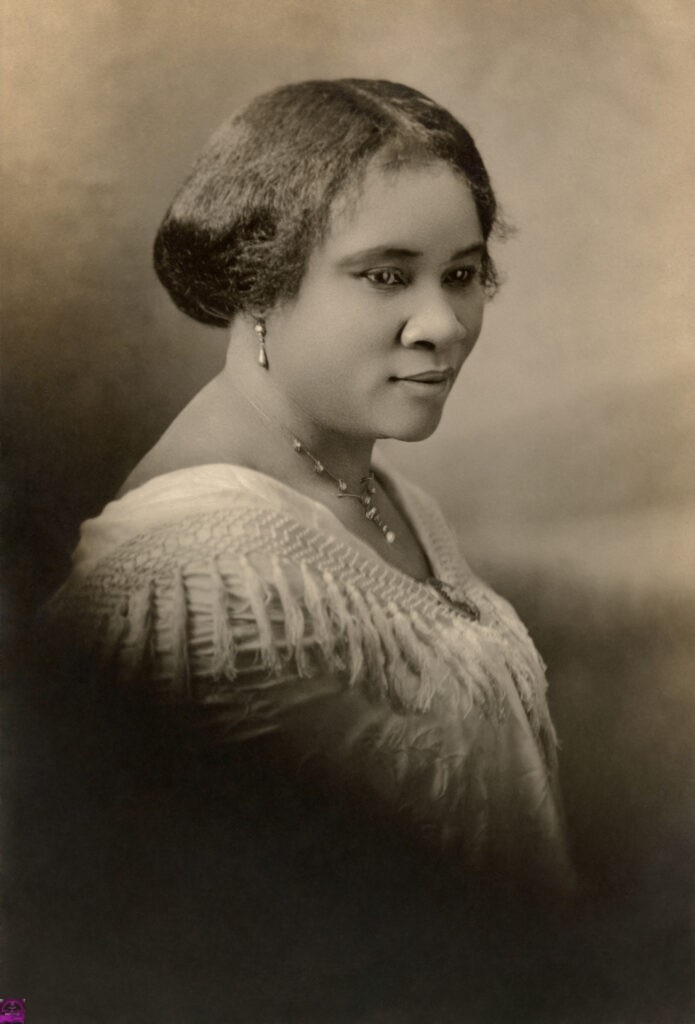
Entrepreneur and philanthropist Madam C.J. Walker once said “I am a woman who came from the cotton fields of the South. From there I was promoted to the washtub. From there I was promoted to the cook kitchen. And from there I promoted myself into the business of manufacturing hair goods and preparations.” After creating a line of hair care products to promote healthy hair for African-American women, Walker became the first African-American self-made millionaire.
Early Life
“I am not ashamed of my humble beginning. Don’t think because you have to go down in the washtub that you are any less of a lady!”
Walker was born Sarah Breedlove on December 23, 1867 in Louisiana. Her parents, Owen and Minerva, were former slaves who worked as sharecroppers on a cotton plantation.
By the age of seven Walker was orphaned and sent to live with her sister, Louvinia.
At the age of 14, Walker married her first husband, Moses McWilliams. The couple had a daughter, A’Lelia.
Two years later, Moses died and Walker moved to St. Louis. Working as a washerwoman, Walker made $1.50 a day. She used this money to send her daughter to public school. While living in St. Louis, Walker met her second husband, Charles J. Walker.
▼
Madam C. J. Walker FAQ (Click to Expand)
Budding Entrepreneur
“I got my start by giving myself a start.”
When Walker developed a severe case of dandruff in the late 1890s, she began losing her hair. As a result, Walker began experimenting with various home remedies to create a treatment that would make her hair grow. By 1905 Walker was working as a saleswoman for Annie Turnbo Malone, an African-American businesswoman. Moving to Denver, Walker worked for Malone’s company and continued to develop her own products. Her husband, Charles designed advertisements for the products. The couple then decided to use the name Madam C.J. Walker.
Within two years, the couple was traveling throughout the southern United States to market the products and teach women the “Walker Method” which included using pomade and heated combs.
The Walker Empire
“There is no royal follower-strewn path to success. And if there is, I have not found it for if I have accomplished anything in life it is because I have been willing to work hard.”
By 1908 Walker’s profits were so great that she was able to open a factory and establish a beauty school in Pittsburgh. Two years later, Walker relocated her business to Indianapolis and named it the Madame C.J. Walker Manufacturing Company. In addition to manufacturing products, the company also boasted a team of trained beauticians who sold the products. Known as “Walker Agents,” these women spread the word in African-American communities throughout the United States of “cleanliness and loveliness.”
Walker and Charles divorced in 1913. Walker travelled throughout Latin America and the Caribbean marketing her business and recruiting women to teach others about her hair care products. In 1916 when Walker returned, she moved to Harlem and continued to run her business. The daily operations of the factory still took place in Indianapolis.
As Walker’s business grew, her agents were organized into local and state clubs. In 1917 she held the Madam C.J. Walker Hair Culturists Union of America convention in Philadelphia. Considered one of the first meetings for women entrepreneurs in the United States, Walker rewarded her team for their sales acumen and inspired them to become active participants in politics and social justice.
Philanthropy
“This is the greatest country under the sun,” she told them. “But we must not let our love of country, our patriotic loyalty cause us to abate one whit in our protest against wrong and injustice. We should protest until the American sense of justice is so aroused that such affairs as the East St. Louis riot be forever impossible.”
Walker and her daughter, A’Lelia were both heavily involved in the social and political culture of Harlem. Walker established several foundations that provided educational scholarships, monetary assistance for the elderly.
In Indianapolis, Walker provided substantial financial support to build a black YMCA. Walker was also opposed to lynching and began working with the NAACP and the National Conference on Lynching to eradicate the behavior from American society.
When a white mob murdered more than 30 African-Americans in East St. Louis, Ill., Walker visited the White House with African-American leaders petitioning for a federal anti-lynching legislation.
Death
Walker died on May 25, 1919 at her home. At the time of her death, Walker’s business was valued at more than one million dollars.
▼
Click here for references:
- “First self-made millionairess”. Guinness World Records. May 25, 1919.
- Bundles, A’Lelia (2020). “Madam C.J. Walker: A Brief Biographical Essay”. Official Website of Madam C.J. Walker.
- Gates Jr., Henry Louis (November 15, 2013). “Madam Walker, the First Black American Woman to Be a Self-Made Millionaire”. The African Americans: Many Rivers to Cross.
- Glaeser, Edward (2011). Triumph of the City. New York: Penguin Press, p. 75. ISBN 978-1-59420-277-3.
- Bundles, “Madam C. J. (Sarah Breedlove) Walker, 1867–1919” in Black Women in America, v. II, p. 1209.
- Bundles, A’Lelia. “Madam C.J. Walker”. Madame C. J. Walker. Archived 2015.
- “Madam C. J. Walker Biography”. Biography.com. A&E Networks. November 12, 2021.
- “Madam C. J. Walker”. Indiana Historical Society.
- Bundles, A’Lelia (2001). On Her Own Ground: The Life and Times of Madam C. J. Walker. New York: Scribner. ISBN 978-0-7434-3172-9.
- Bundles, A’Lelia (2014). “Biography of Madam C. J. Walker”. National Coalition of 100 Black Women, Inc.
- Beaugez, Jim (February 14, 2026). “How Madam C.J. Walker turned hardship into economic independence for Black women”. Amplify The Sip.
- Bundles, “Madam C J (Sarah Breedlove) Walker, 1867–1919” in Black Women in America, v. II, pp. 1210–11.
- Riquier, Andrea (February 15, 2015). “Madam Walker Went from Laundress to Millionairess”. Investor’s Business Daily.
- “Madam C.J. Walker and the AME Roots of her Gospel of Giving”. Retrieved December 2, 2022.
- Bundles, A’Lelia (February 2012). “Madam C. J. Walker: Business Savvy to Philanthropy” (PDF). eJournal USA.
- Klem, Monica (March 22, 2022). “Madam C. J. Walker”. Philanthropy Roundtable.
- Ingham, John N. (February 2000). “Walker, Madam C. J.”. American National Biography. Oxford University Press.
- “Madam C.J. Walker’s Wonderful Hair Grower product container”. The Indianapolis Public Library.
- Oatman-Stanford, Hunter (August 31, 2015). “The Sharecropper’s Daughter Who Made Black Women Proud”. Collectors Weekly.
- Bundles, A’Lelia (February 24, 2015). “Madam C. J. Walker’s Secrets to Success”. Biography.com.
- Evans, Harold et al. (2004). They Made America: Two Centuries of Innovators. Little, Brown. ISBN 9780316277662.
- “Madam C.J. Walker”. Britannica Kids.
- Koehn, Nancy F. et al. (2007). Madam C. J. Walker: Entrepreneur, Leader, and Philanthropist. Harvard Business School Publishing.
- Gugin and Saint Clair, p. 361.
- Desta, Yohana (March 23, 2020). “Self Made: What Happened to Madam C.J. Walker’s Empire?”. Vanity Fair.
- “Madame C. J. Walker: Inventor, Businesswoman”. University of California, Irvine.
- Bundles, “Madam C J (Sarah Breedlove) Walker, 1867–1919” in Black Women in America, v. II, p. 1213.
- “Wealthiest Negress Dead”. The New York Times. May 16, 1919.
- Weisenfeld, Judith (1994). “The Harlem YWCA and the Secular City”. Journal of Women’s History.
- Bundles, “Madam C J (Sarah Breedlove) Walker, 1867–1919” in Black Women in America, v. II, p. 1212.
- Bundles, A’Lelia (2002). “Chapter 17: ‘We Should Protest'”. On Her Own Ground. Scribner.
- “Woodlawn Cemetery–Madam Walker’s Burial Place”. Madam C. J. Walker website.
- Ingham, 1999.
- “CJ Walker Obit”. The New York Times. May 26, 1919. p. 15.
- Pumphrey, Jessica (October 24, 2014). “Sign the Pledge to Protect Villa Lewaro”. National Trust for Historic Preservation.
- Leggs, Brent (2014). “Envisioning Villa Lewaro’s Future” (PDF).
- “National Register Digital Assets: Madame C. J. Walker Building”. National Park Service.
- Rhone, Nedra (December 9, 2019). “Madam C.J. Walker Museum honors legacy”. The Atlanta Journal-Constitution.
- “Madam C.J. Walker Exhibit and Salon”. Madam C. J. Walker Museum.
- “Regina Taylor Brings the Story of Madam C. J. Walker to the Stage”, Jet, July 10, 2006.
- “The Dreams of Sarah Breedlove”. Goodman Theatre.
- “MADAM by Madam C. J. Walker Launches New Beauty Brand.” Cision PR Newswire, January 31, 2022.
- “Sundial Brands Enters Prestige Hair Category.” PR Newswire, February 23, 2016.
- “The Marvels of Madam C.J. Walker”. BBC Radio 4. September 2, 2025.
- Laneri, Raquel (February 18, 2017). “Manse built by first self-made millionairess”. New York Post.
- Walker, Robert (March 21, 2020). “The Problem With ‘The Facts About Madam C.J. Walker And Annie Malone'”. HarlemWorldMagazine.com.
- Judy, Berman (March 18, 2020). “Netflix’s Self Made Makes a Mess Out of Madam C.J. Walker’s Life”. Time.
- Bundles, A’Lelia (May 12, 2020). “Netflix’s Self Made Suffers from Self-Inflicted Wounds”.
- “Two Dollars and a Dream”. The Washington Post. February 21, 1988.
- “17th Annual Madam C. J. Walker 2015 Luncheon”. National Coalition of 100 Black Women, Inc.
- “About the Spirit Awards”. Madame Walker Theatre Center. 2016.
- “Madam C. J. Walker”. National Women’s Hall of Fame.
- “US Stamp Gallery > Madam C.J. Walker”. www.usstampgallery.com.
- Davis, Wynne (August 27, 2022). “Madam C.J. Walker gets her own Barbie”. NPR.
- Bundles, A’Lelia. “Madam C. J. Walker’s Home Villa Lewaro”. Madam C. J. Walker website.
