Introduction
The Red Summer of 1919 stands as one of the most violent and pivotal episodes in American racial history, a season of widespread white supremacist terrorism that engulfed more than three dozen cities and rural areas across the United States. Coined by NAACP field secretary James Weldon Johnson, the term “Red Summer” evokes the bloodshed that stained the nation from spring through fall, as white mobs unleashed fury on African American communities in a frenzy of lynchings, riots, and massacres. Between January and December 1919, at least 25 major race riots erupted, alongside 97 recorded lynchings, resulting in hundreds of deaths—predominantly African American—and thousands injured, displaced, or economically devastated.
This wave of violence was no random outburst but the explosive culmination of deep-seated tensions exacerbated by World War I’s end. Returning Black soldiers, who had fought for democracy abroad only to face intensified racism at home, symbolized a threat to white supremacy. The Great Migration had brought hundreds of thousands of African Americans to Northern industrial cities, competing for jobs and housing amid post-war economic slump, inflation, labor strikes, and the First Red Scare’s paranoia about Bolshevism infiltrating Black activism. White workers, often recent immigrants, resented Black strikebreakers and perceived encroachments on segregated spaces.
Yet, Red Summer marked a turning point: for the first time on a large scale, African Americans fought back fiercely, defending their communities and asserting self-defense rights. This resistance fueled the “New Negro” movement, inspiring poets like Claude McKay (“If We Must Die”), intellectuals like W.E.B. Du Bois, and organizations like the NAACP to demand federal intervention and civil rights. Though immediate justice was rare—perpetrators faced little prosecution—the events galvanized Black organizing, boosted NAACP membership from 9,000 to over 100,000 by the early 1920s, and laid groundwork for the long Civil Rights Movement.
▼
Red Summer FAQ (Click to Expand)
This article goes deeply into the causes, major incidents, government and media responses, cultural legacies, and enduring significance of Red Summer, drawing on historical accounts to illuminate this dark chapter.
Historical Context: The Powder Keg of 1919
The roots of Red Summer trace to the seismic shifts of World War I (1914–1918). Over 380,000 African Americans served, many in segregated units like the 92nd and 93rd Divisions, facing discrimination yet earning praise abroad—particularly from French allies who treated them with respect denied in America. Returning veterans expected equality but encountered intensified Jim Crow enforcement, job discrimination, and violence. As W.E.B. Du Bois wrote in his May 1919 Crisis essay “Returning Soldiers,” these men refused to accept second-class citizenship: “We return. We return from fighting. We return fighting.”
The Great Migration (1916–1970) accelerated during the war, with roughly 500,000 Black Southerners moving North by 1919 for industrial jobs in steel, railroads, and munitions. Northern cities like Chicago saw Black populations double, straining housing and igniting territorial disputes. White ethnic workers—Irish, Italian, Polish—viewed Black arrivals as threats, especially when employers used them as strikebreakers during 1917–1919 labor unrest.
Post-armistice demobilization flooded the labor market with unemployed veterans, while inflation soared after price controls lifted. Economic anxiety fused with racial resentment. The First Red Scare (1919–1920), triggered by the Russian Revolution, painted Black demands for rights as Bolshevik subversion. President Woodrow Wilson privately feared returning Black soldiers would spread communism. Attorney General A. Mitchell Palmer and J. Edgar Hoover spied on Black leaders, linking riots to “radical propaganda.”
Pre-1919 violence set precedents: East St. Louis (1917) killed dozens; Houston (1917) saw Black soldiers mutiny against abuse. The Ku Klux Klan’s resurgence in 1915, fueled by The Birth of a Nation, amplified white supremacist fervor.
Causes: Intersection of Race, Labor, and Fear
Red Summer’s violence stemmed from multiple converging forces:
- Labor Competition: Black workers filled wartime shortages but faced backlash as strikes ended. Industrialists’ use of Black strikebreakers inflamed white unions.
- Housing and Segregation: Overcrowded Black neighborhoods expanded into white areas, sparking “invasion” fears. Segregated beaches, parks, and streets became flashpoints.
- Veteran Status: Black soldiers’ assertiveness—wearing uniforms, demanding respect—threatened white authority. Many attacks targeted returning troops.
- Sensationalist Media: Newspapers amplified rumors of Black crime, especially assaults on white women, echoing lynching justifications. Washington, D.C., papers called for “clean-up” of Black neighborhoods.
- Political Inaction: Local authorities often sided with white mobs or stood idle; federal response was slow and biased toward viewing Black resistance as insurrection.
These factors created a national tinderbox, ignited repeatedly in 1919.
Major Riots and Massacres: A Chronicle of Violence
The violence unfolded in waves, from rural South to urban North.
- Jenkins County, Georgia (April 13, 1919): Rural clash destroyed Carswell Grove Baptist Church and Masonic lodges; 6 deaths.
- Charleston, South Carolina (May 10, 1919): Naval riot; 3 Black deaths, 23 injured.
- Longview, Texas (July 1919): White mob burned Black district; at least 4 deaths.
- Washington, D.C. (July 19–24, 1919): Rumors of Black assault on white woman sparked 4-day rampage by white servicemen. Mobs dragged Black people from streetcars, beat passersby. Black residents armed and fought back. Casualties: ~15–40 deaths (more white due to resistance), hundreds injured. Wilson deployed troops after days of inaction.
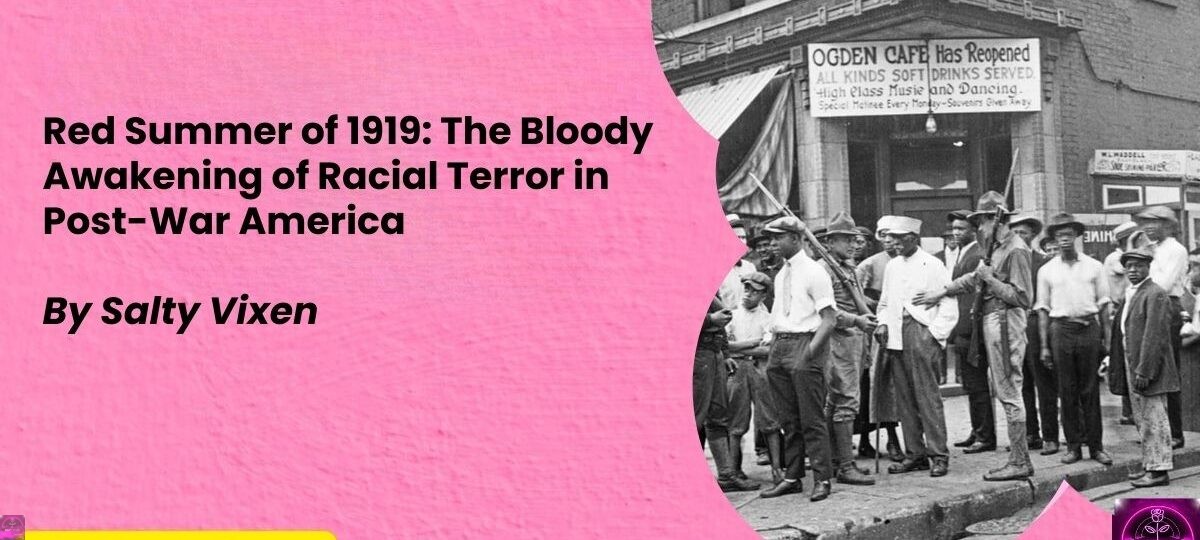
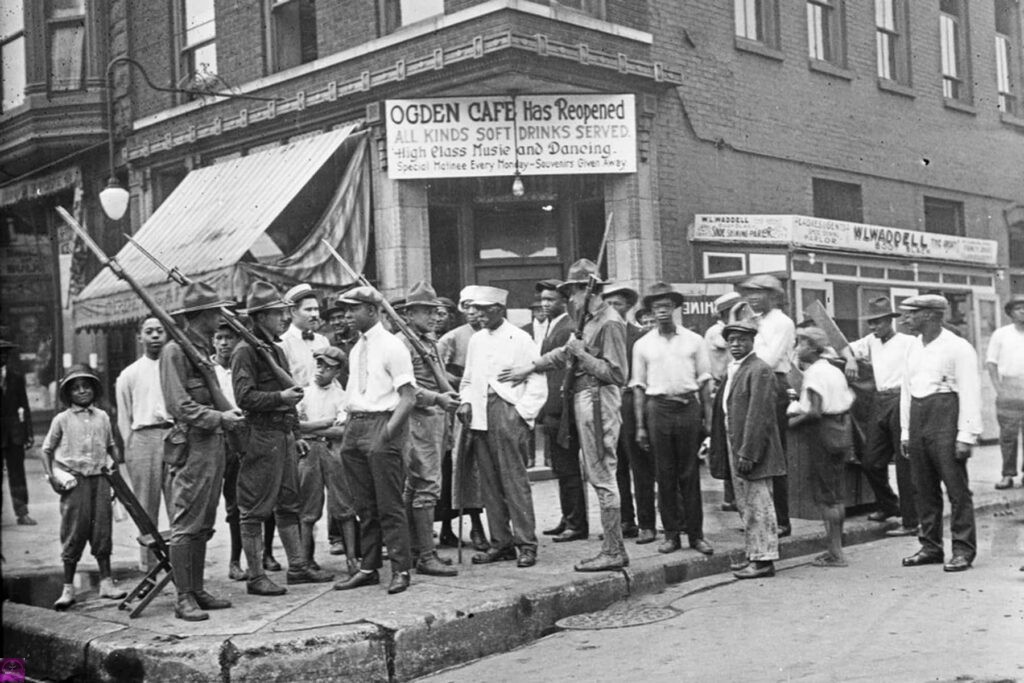
- Chicago, Illinois (July 27–August 12, 1919): Most infamous. Black teen Eugene Williams drowned after white rock-throwers targeted him for crossing invisible beach line. Police refused arrest, sparking 13-day war. White gangs (often Irish-led) invaded Black South Side, burning homes; Black defenders resisted. Casualties: 38 deaths (23 Black, 15 white), 537 injured, 1,000 Black families homeless.
- Knoxville, Tennessee (August 30–31, 1919): Lynch mob stormed jail; Black business owners fought back. 7+ deaths. [my great grandmother, Rachel Henderson, lived in Knoxville at the time and the stories she told me from her childhood, from what I recall as a white person, a lot of single mothers, regardless of race lived in the slums. Knoxville was segregated, but for women, who wanted to survive, race did not matter, and that was the words of my great grandmother,]
- Omaha, Nebraska (September 28–29, 1919): 10,000+ mob lynched Will Brown, burned courthouse, attacked Black neighborhoods. Army troops intervened. Massive property damage.
- Elaine Massacre, Arkansas (September 30–October 2, 1919): Deadliest. White planters crushed Black sharecroppers’ union organizing (Progressive Farmers and Household Union). After shootout, militia massacred; estimates 100–240 Black deaths, 5 white. Governor labeled it insurrection; 79 Black men tried, 12 death sentences (later overturned by Supreme Court in Moore v. Dempsey, precedent for due process).
Other incidents spanned Bisbee, Arizona (attack on Buffalo Soldiers); Norfolk, Virginia; Baltimore; and dozens more, with lynchings continuing.
Some of the events in detail, to remind people history of our ancestors:
The Chicago Race Riot of 1919 (July 27 – August 3, 1919)
The Chicago riot remains the most extensively documented and symbolically significant event of Red Summer, both for its scale and for the official investigation that followed. It began on a sweltering Sunday afternoon at the 29th Street beach on Lake Michigan, where an invisible but rigidly enforced color line divided the sand: the area south of 29th Street was unofficially reserved for Black bathers, while north was for whites.
Seventeen-year-old Eugene Williams, a Black teenager, was swimming with friends and drifted across the line on a makeshift raft. White beachgoers began hurling stones at him. One rock struck Williams in the head; he slipped beneath the surface and drowned. When Black onlookers demanded that police arrest the stone-thrower (identified by witnesses as George Stauber), the white officer refused. Tensions exploded. A group of Black men pulled Stauber from the crowd and began beating him; white mobs retaliated by attacking any Black person in sight.
Over the next thirteen days, the city descended into open warfare. White gangs—many composed of Irish-American youths affiliated with athletic clubs that doubled as street enforcers—roamed the South Side in automobiles, shooting into Black homes and setting fires. Black residents, particularly World War I veterans, organized armed self-defense squads, barricading streets and returning fire when attacked. Snipers fired from rooftops; arson destroyed hundreds of homes, especially in the predominantly Black neighborhoods between Cottage Grove Avenue and the stockyards.
The violence claimed 38 lives (23 Black, 15 white), injured more than 537 people (the majority Black), and left approximately 1,000 Black families homeless. Property damage ran into the millions. The Illinois National Guard was eventually called in, but reports documented instances where guardsmen disarmed Black defenders while allowing white mobs to continue unchecked.
In the aftermath, Illinois Governor Frank Lowden appointed the Chicago Commission on Race Relations, an interracial body that included prominent Black leaders such as Charles S. Duke and white business and civic figures. After two years of hearings and investigation, the commission released its landmark 1922 report, The Negro in Chicago: A Study of Race Relations and a Race Riot. The 672-page document explicitly rejected the prevailing white narrative that blamed Black criminality or radical agitation. Instead, it placed primary responsibility on white aggression, deep-seated racial prejudice, discriminatory housing practices, police bias, and sensationalist journalism. The report recommended sweeping reforms in housing, employment, policing, and public accommodations—many of which were ignored for decades but later influenced civil rights advocacy.
The Chicago riot crystallized the shift from passive endurance to active resistance and became a reference point for future analyses of urban racial violence.
The Elaine Massacre, Arkansas (September 30 – October 1, 1919)
The Elaine Massacre stands as the bloodiest single episode of Red Summer and one of the deadliest racial massacres in U.S. history. Unlike urban riots triggered by street-level confrontations, Elaine arose from economic grievances and organized Black resistance to exploitative sharecropping.
In the Arkansas Delta, Black tenant farmers and sharecroppers—many of them World War I veterans—faced systemic fraud by white landlords and merchants who routinely cheated them at settlement time. In response, about 100 Black men formed the Progressive Farmers and Household Union of America (PFHUA), a fledgling labor organization seeking fair contracts and collective bargaining. The union held a meeting on September 30 at a church in Hoop Spur, near Elaine, to discuss strategy and dues collection.
White authorities and planters viewed any Black organizing as insurrectionary. A white posse, accompanied by a county sheriff, approached the church after dark, ostensibly to investigate rumors of an armed uprising. Shots were exchanged—accounts differ on who fired first—but the encounter left several white men dead or wounded. This incident provided the pretext for a massive, state-sanctioned counterattack.
Arkansas Governor Charles Brough requested federal troops, framing the events as a “Negro insurrection.” Over the next two days, an estimated 500–1,000 white vigilantes, local posses, and federal soldiers from nearby Camp Pike descended on Phillips County. They rounded up hundreds of Black residents, many of whom were unarmed farmers fleeing into the canebrakes and forests. Eyewitnesses and later investigations described summary executions, machine-gunning of fleeing people, and bodies dumped in the Mississippi River or burned in mass pyres.
Official death tolls claimed five white deaths and “several” Black deaths, but credible estimates—based on contemporary Black press reports, NAACP investigations, and oral histories—place Black fatalities between 100 and 240, with some historians arguing the number could exceed 300. Thousands more were displaced or forced to flee.
In the legal aftermath, Arkansas courts rushed to prosecute 122 Black men on charges ranging from murder to insurrection. Twelve received death sentences in sham trials lasting minutes, with all-white juries and no adequate defense. The NAACP, led by Walter White and Moorfield Storey, appealed the cases. In the landmark 1923 Supreme Court decision Moore v. Dempsey, the Court overturned the convictions, ruling that the trials violated due process because of mob-dominated courtrooms and the systematic exclusion of Black jurors. The decision set an important precedent for federal oversight of state criminal proceedings in cases of racial terror and helped dismantle the most egregious forms of legal lynching.
The Elaine Massacre exposed the intersection of racial violence with economic exploitation in the rural South and demonstrated how quickly local power structures could mobilize state and federal resources against Black self-organization.
The Omaha Race Riot (September 28–29, 1919)
Omaha’s riot culminated in one of the most grotesque public spectacles of Red Summer: the near-lynching, mutilation, and burning of Will Brown, followed by the near-destruction of the city’s courthouse.
Tensions had been building for months, fueled by inflammatory newspaper coverage of alleged Black crime and growing resentment over Black migration into Omaha’s packinghouse district. On September 28, 14-year-old Agnes Loebeck accused Will Brown, a 41-year-old Black packinghouse worker, of assaulting her. Whether the accusation was true or fabricated remains disputed; Brown maintained his innocence.
A white mob of thousands—eventually swelling to 10,000–15,000—gathered outside the Douglas County Courthouse, where Brown was held. By evening the crowd had grown uncontrollable. Rioters stormed the building, set it ablaze, and dragged prisoners out. Police and sheriff’s deputies, overwhelmed, allowed the mob to seize Brown. He was stripped, beaten, stabbed, hanged from a traffic signal at 14th and Farnam Streets, then shot repeatedly. The corpse was dragged through the streets, tied to the back of an automobile, and burned on a bonfire while the crowd cheered and took souvenirs.
The violence continued into the night. Mobs attacked Black neighborhoods, looted homes, and burned buildings. Black residents armed themselves and defended their communities, particularly in the Near North Side. Federal troops from Fort Omaha and Fort Crook finally arrived after midnight on September 29, declaring martial law and restoring order.
At least three people died directly in the rioting (including Brown), with dozens injured and significant property damage. No one was ever convicted for Brown’s murder. The Omaha riot became a national symbol of unchecked mob rule and the spectacle of public lynching in an urban, Midwestern setting—far from the stereotypical Deep South. It also prompted local Black leaders to strengthen community defense organizations and contributed to the national conversation about federal anti-lynching legislation.
Cultural Reflections
Literature and the Birth of Protest Poetry
Red Summer produced an outpouring of literary response that helped define the emerging Harlem Renaissance and the “New Negro” ethos. Claude McKay’s sonnet “If We Must Die,” published in the July 1919 issue of The Liberator, became the most famous poetic response to the violence:
If we must die, let it not be like hogs
Hunted and penned in an inglorious spot,
While round us bark the mad and hungry dogs,
Making their mock at our accursed lot.
Written in the heat of the Chicago and Washington riots, the poem rejected victimhood and called for dignified, courageous resistance—“pressed to the wall, dying, but fighting back!”—without explicitly mentioning race, allowing it to resonate universally while clearly speaking to Black experience.
W.E.B. Du Bois used the editorial pages of The Crisis as a platform for searing commentary. In his May 1919 “Returning Soldiers” piece, he declared: “We return fighting. Make way for Democracy! We saved it in France, and by the Great Jehovah, we will save it in the U.S.A., or know the reason why.” In the wake of Red Summer, Du Bois published “The Souls of White Folk” (August 1919) and other essays that dissected white paranoia and the myth of Black criminality.
Other writers—James Weldon Johnson, Fenton Johnson, and later Langston Hughes—drew on Red Summer imagery in poetry, short stories, and essays that emphasized dignity, self-defense, and the absurdity of American racial hypocrisy.
Art Depicting Resistance
Visual artists of the period responded more slowly, but Red Summer influenced the emerging tradition of protest art. Early 20th-century Black illustrators and painters, including those associated with the NAACP’s The Crisis and Opportunity magazine, created covers and drawings that portrayed armed Black defenders, burning homes, and defiant figures. Jacob Lawrence’s later Migration Series (1941) indirectly referenced the violence that drove the Great Migration, while Romare Bearden and others in the 1930s–1940s evoked the memory of Red Summer in depictions of urban Black life under siege.
Photographs—both official and vernacular—circulated widely: images of burned Black districts in Chicago, the charred courthouse in Omaha, and armed Black men standing guard became part of the visual archive of resistance.
Media’s Role in Perpetuating Myths
Mainstream white newspapers played a dual and often sinister role. Sensational headlines in Washington, D.C., papers like the Washington Post (“Negroes Attack Girl,” “Race Riot Feared”) inflamed mobs before violence began. In Chicago, the Chicago Tribune and other dailies routinely described Black neighborhoods as breeding grounds for crime, amplifying white fears.
Black newspapers—the Chicago Defender, The Crisis, the New York Age—countered with detailed reporting, photographs of victims, and calls for self-defense. Robert S. Abbott’s Defender urged Southern Blacks to migrate North while simultaneously warning of Northern dangers, creating a complex narrative of hope and caution.
The contrast between white and Black press coverage underscored the racial divide in perception and helped radicalize readers toward demands for federal protection and civil rights.
Conclusion
Red Summer exposed America’s racial fault lines with brutal clarity, revealing how deeply white supremacy was embedded in institutions, media, and everyday life. Yet the extraordinary resilience of Black communities—fighting back in the streets, organizing politically, and articulating a new vision of dignity through literature and activism—transformed terror into a powerful catalyst for change. The events of 1919 did not end racial violence, but they accelerated the growth of national civil rights organizations, inspired generations of artists and intellectuals, and planted seeds for the long freedom struggle that followed.
Its memory urges continued vigilance against injustice. In an era when racial terror still manifests in different forms, Red Summer reminds us that resistance is not only survival—it is the foundation of progress.
▼
Click here for references:
- Erickson, Alana J. 1960. “Red Summer.” Pp. 2293–94 in Encyclopedia of African-American Culture and History. New York: Macmillan.
- Cunningham, George P. 1960. “James Weldon Johnson.” Pp. 1459–61 in Encyclopedia of African-American Culture and History. New York: Macmillan.
- The New York Times 1919.
- Public Broadcasting Service (PBS) 2018, p. Part 3.
- Kennedy 2004, pp. 279, 281–282.
- Barnes 2008, p. 4.
- “The Great Migration”. December 15, 2023.
- McWhirter 2011, p. 56
- McWhirter 2011, pp. 19, 22–24
- McWhirter 2011, p. 13
- McWhirter 2011, p. 15
- McWhirter 2011, p. 14
- Maxouris 2019.
- McWhirter 2011, pp. 31–32, emphasis in original
- Sieber, Karen (February 7, 2022). “In 1919, a Mob in Maine Tarred and Feathered Two Black College Students”. Smithsonian Magazine.
- “Near Race Riot Follows Hazing Univ. of Maine”. Evening Express. May 1, 1919. p. 17.
- Rucker & Upton 2007, pp. 92–93.
- Rucker & Upton 2007, p. 554.
- Brockell, Gillian (July 15, 2019). “The deadly race riot ‘aided and abetted’ by The Washington Post”.
- Perl 1999, p. A1
- Mills 2016.
- Ackerman 2008, pp. 60–62.
- The New York Times 1919h.
- Encyclopædia Britannica 2019.
- William Z. Foster (1952). History of the Communist Party of the United States. p. 231.
- The New York Times 1919j.
- The New York Times 1919i.
- Wheeler 2017.
- Whitaker 2009, p. 53.
- Lakin 2000, pp. 1–29.
- Lewis 2009, p. 383.
- Pietrusza 2009, pp. 167–172.
- Freedman 2001, p. 68.
- Whitaker 2009, pp. 131–142.
- Urell, Aaryn (October 17, 2021). “Historical Marker Dedicated for Veterans Lynched in Jacksonville, Florida”. Equal Justice Initiative.
- Cassanello, Robert (2003). “Violence, Racial Etiquette, and African American Working-Class Infrapolitics”.
- “Why the Great Steel Strike of 1919 Was One of Labor’s Biggest Failures”.
- United States House Committee on the Judiciary 1920, p. 9
- United States House Committee on the Judiciary 1920a, p. 19
- McWhirter 2011, p. 291.
- Whitaker 2009, p. 51.
- Marcelle 2016.
- The New York Times 1919e.
- Jaffe 1972, pp. 121–122.
- New-York Tribune 1919, p. 1.
- Brown, Smith & Johnson 1922, p. 313.
- The New York Times 1919c.
- The Daily Ardmoreite 1919, p. 1.
- The New York Times 1919d.
- McWhirter 2011, p. 160
- The New York Times 1919a.
- The New York Times 1919b.
- The New York Times 1919f.
- The New York Times 1919g.
- McWhirter 2011, p. 159
- McWhirter 2011, pp. 239–241
- “If We Must Die” poetryfoundation.org.
- McKay 2007.

This is an original creative work by Salty Vixen. This story/article, including its characters, plot, and descriptive content, is protected by copyright law. Unauthorized copying, sharing, reposting, or reproduction in any format is strictly prohibited. This content may not be used for AI training, data scraping, machine learning, or any form of artificial intelligence development without explicit written permission from © 2026 Salty Vixen Stories, Inc. — All rights reserved.. Violators will be pursued to the fullest extent of the law.
