

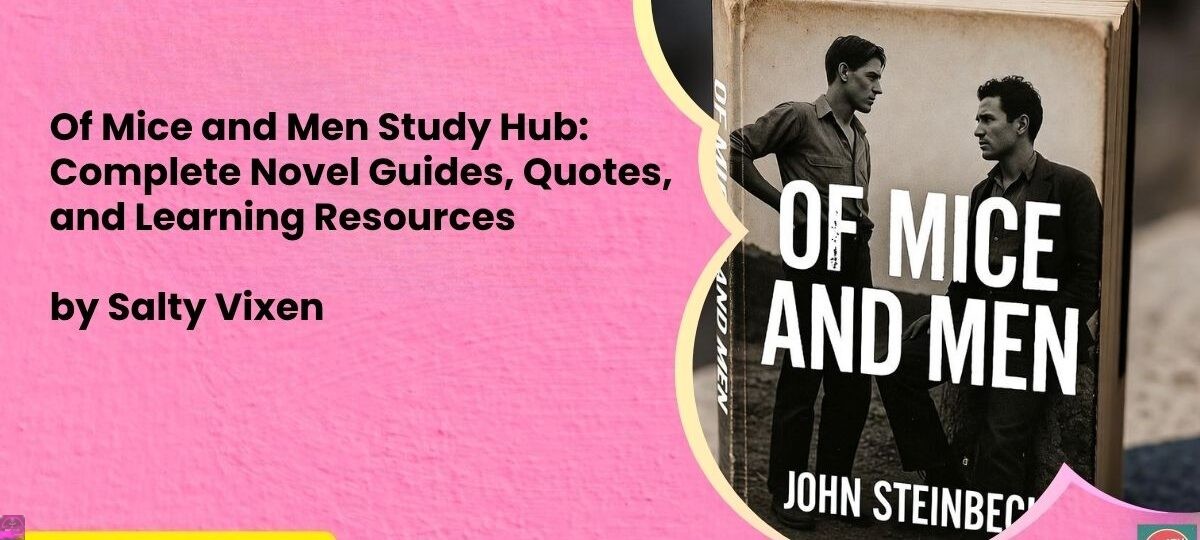

It is a truth universally acknowledged that any high school English student handed a slim, double-spaced novella about two dust-caked California dreamers is about to get their emotional teeth kicked in.
John Steinbeck’s Of Mice and Men is barely over a hundred pages long, yet it occupies an outsized chunk of our collective literary consciousness. Written in 1937, it is less a sprawling novel and more a tightly wound theatrical tragedy masquerading as a Great Depression campfire story. It is a masterpiece of economic storytelling—and by economic, we mean both Steinbeck’s lean, unforgiving prose and the crushing financial desperation that drives every single character into an early moral bankruptcy.
The Odd Couple of the Dust Bowl
At the center of this tragedy is the original literary odd couple: George Milton, a sharp-witted, cynical migrant worker who carries the intellectual burden for two, and Lennie Small, a towering, intellectually disabled gentle giant whose physical strength is tragically inverse to his mental capacity.
Their relationship is a bizarre anomaly in a world where everyone else is an aggressively isolated island. They travel together—a concept so thoroughly foreign to the suspicious, transient bunkhouse community that the ranch boss immediately assumes George is running an illegal financial grift on Lennie. In reality, their grift is much more dangerous: they are practicing mutual human empathy in a decade that had entirely rationed it out.
The American Dream as a Bunkhouse Ponzi Scheme
The beating heart of the novella is “The Dream”—the small, self-sustaining farm where George and Lennie can “live off the fatta the lan'” and Lennie can, famously and catastrophically, tend the rabbits.
Steinbeck treats this dream not as an inspiring beacon of hope, but as a devastatingly effective psychological sedative. It is the carrot dangled in front of the beaten-down work mules of the global economy. What makes the story so masterfully painful isn’t just that the dream is impossible; it’s that it is contagious. The moment the aging, one-handed swamper Candy offers his life savings to buy in, followed briefly by Crooks, the cynical, isolated Black stable buck, the reader realizes this isn’t just George and Lennie’s delusion. It is the collective hallucination of an entire disenfranchised underclass.
A Universe Without a Safety Net
Steinbeck’s world is a cold, Darwinian ecosystem where worth is calculated strictly by utility:
-
Candy’s Dog is shot in the back of the head by a callous ranch hand simply because he smells bad and can no longer herd sheep. It is a brutal piece of foreshadowing that screams a central thesis of the book: once you are no longer useful to the machine, the machine disposes of you.
-
Curley’s Wife, trapped in a loveless marriage to a deeply insecure bully, is denied even a proper name. She is treated as a radioactive hazard by the men, a walking landmine of domestic trouble, until her tragic encounter with Lennie transforms her from a figure of sexual frustration into a static, pristine monument of lost potential.
-
Crooks lives a literal lifetime of social distancing, segregated to a harness room because of his skin color, forced to watch the white workers engage in a society that uses his labor but reviles his presence.
The Final Act: A Mercy with a Trigger
When Lennie inevitably does what Lennie does—petting things too hard until their spines snap—the clock runs out on the grand illusion.
The climax of Of Mice and Men is one of the most agonizingly perfect sequences in Western literature. George, standing by the quiet pool of the Salinas River, recites the rabbit-farm liturgy one last time to a blissfully unaware Lennie. It is a devastating subversion of Abraham and Isaac; there is no divine intervention coming from the heavens, only the cold reality of a Luger pistol. George’s final act is simultaneously a murder and an ultimate act of love—saving his best friend from the violent, vengeful mob of the civilized world by delivering him to the permanent safety of the ultimate dream.
Nearly a century later, Of Mice and Men remains a towering achievement because it refuses to offer easy comfort. It is a witty, devastatingly precise biopsy of the American psyche, proving that the best-laid schemes of mice and men don’t just go awry—they are systematically dismantled by the world we built.


This is an original creative work by Salty Vixen. This story/article, including its characters, plot, and descriptive content, is protected by copyright law. Unauthorized copying, sharing, reposting, or reproduction in any format is strictly prohibited. This content may not be used for AI training, data scraping, machine learning, or any form of artificial intelligence development without explicit written permission from © 2026 Salty Vixen Stories, Inc. — All rights reserved.. Violators will be pursued to the fullest extent of the law.
