

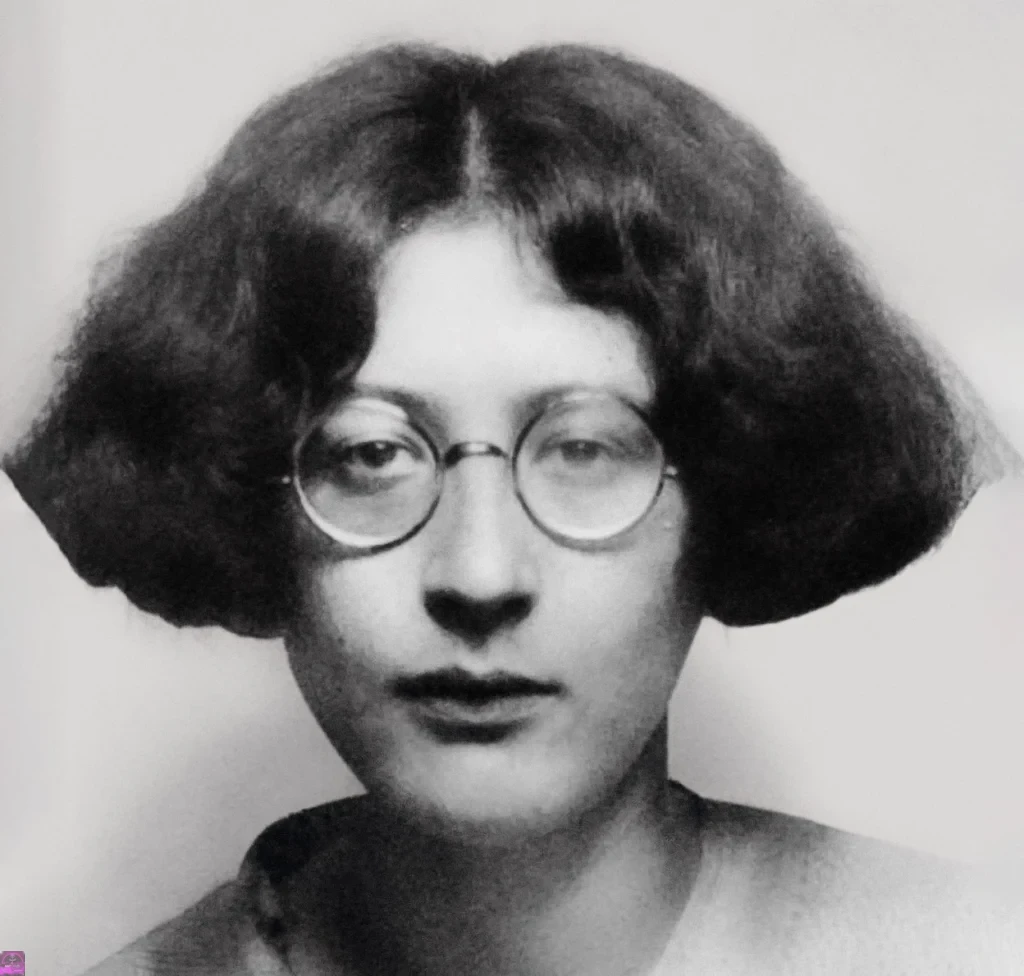
Simone Weil remains one of the most enigmatic and uncompromising thinkers of the 20th century. A French philosopher, mystic, political activist, and factory worker, she lived a life that blurred the boundaries between thought and action, theory and lived experience. Dying at just 34, she left behind a body of work—mostly published posthumously—that continues to challenge readers with its intensity, paradoxes, and moral rigor. Albert Camus hailed her as “the only great spirit of our times,” while T.S. Eliot called her “the greatest saint” of the century. Charles de Gaulle reportedly dismissed her as insane. Her ideas span politics, spirituality, ethics, and metaphysics, often defying easy categorization. Weil’s philosophy is not abstract speculation; it emerges from personal encounters with suffering, labor, war, and divine absence. Central to her thought are concepts like attention—the purest form of generosity—and affliction (malheur), a crushing suffering that strips the soul bare. These ideas, forged in the crucible of her life, offer profound insights into justice, rootedness, and the human condition in an uprooted modern world.
Weil’s legacy endures because she refused compromise. She lived her philosophy with ascetic ferocity, working in factories to understand oppression, volunteering in the Spanish Civil War, and starving herself in solidarity with occupied France. Her writings—fragmentary notebooks, essays, letters—reveal a mind wrestling with gravity (the mechanical pull of necessity) and grace (supernatural intervention). In an era of totalitarianism, industrialization, and spiritual crisis, Weil proposed alternatives rooted in obligation, compassion, and decreation—the deliberate undoing of the self to make room for truth.
This exploration traces her life chronologically while weaving in her evolving ideas, major works, and enduring influence. It highlights how her experiences shaped concepts that remain urgently relevant today: the dehumanizing force of power, the spiritual dimension of work, and the need for roots in a deracinated age.
Early Life: A Precocious Mind in a Secular Jewish Family
Simone Adolphine Weil was born on February 3, 1909, in Paris, into an affluent, agnostic Jewish family. Her father, Bernard Weil, was a respected physician who had studied at the prestigious École normale supérieure. Her mother, Salomea “Selma” Reinherz, came from a cultured background and encouraged intellectual pursuits. Simone’s older brother, André Weil, became one of the 20th century’s greatest mathematicians, a member of the Bourbaki group and pioneer in algebraic geometry. The siblings shared a deep intellectual bond, with André teaching young Simone ancient Greek by age 12.
The family provided a nurturing environment, yet Simone’s childhood was marked by fragility and empathy. At six months, she suffered severe appendicitis, foreshadowing lifelong health struggles including chronic migraines and tuberculosis. During World War I, her father’s military service distressed her profoundly; at age six, she refused sugar in solidarity with rationed soldiers. By ten, she joined striking workers chanting revolutionary songs. These early acts of identification with suffering reveal the seeds of her later ethic: a refusal to enjoy privileges while others endured hardship.
Frequently Asked Questions: Simone Weil
Q: What is Simone Weil best known for?
Q: What are Simone Weil’s most important works?
Q: Was Simone Weil a religious mystic?
Q: Why did Albert Camus call her “the only great spirit of our times”?
Weil displayed extraordinary precocity. She taught herself Sanskrit to read the Bhagavad Gita and excelled in philosophy at Lycée Henri IV under Émile Chartier (“Alain”), whose emphasis on attention as disciplined perception profoundly shaped her. Known as the “Red Virgin” or “Martian” for her radical views, she organized against military drafts, ignored school norms on dress and smoking, and was once suspended. At the École Normale Supérieure (ENS) from 1928, she finished first in the agrégation in philosophy in 1931, ahead of all male competitors. Her thesis on “Science and Perception in Descartes” explored how mathematical precision could lead to ethical clarity.
Influences included Alain’s moral introspection, Plato’s metaphysics, Descartes’ method, and early Marxism. Yet Weil rejected bourgeois comforts, adopting a masculine appearance—short hair, no makeup, workman’s clothes—to downplay her attractiveness and focus on ideas. She viewed physical contact warily, maintaining emotional distance even from close friends. This asceticism stemmed partly from an obsessive sense of cleanliness and self-perceived “disgust,” contrasting with her affectionate nature.
Political Awakening and Factory Years: Confronting Oppression
In the early 1930s, Weil immersed herself in left-wing activism. She joined the Democratic Communist Circle and supported trade unions, writing tracts and marching for workers’ rights. Teaching philosophy in Le Puy-en-Velay (1931), she advocated for underpaid municipal workers, joining protests and donating her salary. Her solidarity provoked backlash—antisemitic slurs and elite criticism—but also wage gains.
Dissatisfied with intellectual detachment, Weil took a radical step in 1934–1935: she left teaching to work incognito in factories (Alstom, Renault, and others) for nearly a year. This “factory journal” documented dehumanizing conditions—repetitive tasks, exhaustion, constant surveillance—experiences she termed affliction (malheur). Unlike mere suffering (douleur), affliction crushes the soul, branding it with helplessness and social degradation. Workers became “things,” unable to rebel; she critiqued Marxism for overlooking this bureaucratic oppression by technocrats.
Her writings from this period, including “Reflections on the Causes of Liberty and Social Oppression” (1934), analyzed how technology and power alienate labor. She questioned proletarian revolution, fearing it would replace one elite with another. Visiting Germany in 1932, she aided fleeing Marxists after Hitler’s rise. In 1936, despite pacifism, she joined the anarchist Durruti Column in the Spanish Civil War as a nurse and fighter. Nearsighted and clumsy, she was burned in an accident and left traumatized by Republican atrocities, shifting her from strict pacifism.
A 1937 mystical experience in Assisi—reciting George Herbert’s “Love” and feeling Christ’s presence—marked a religious turn, though she remained outside institutional Christianity.
World War II: Exile, Resistance, and Final Writings
As Nazi forces advanced, Weil fled Paris in 1940, settling in Marseille. She distributed resistance papers and risked arrest. Spiritual guidance came from Dominican Father Joseph-Marie Perrin and farmer-philosopher Gustave Thibon, who housed her and later edited her notebooks.
In 1942, she reluctantly traveled to New York with her parents, then to London to join the Free French under de Gaulle. Frustrated by desk work, she proposed dangerous missions and radical post-war reforms: decentralizing power, worker cooperatives, compassion-based patriotism. Key texts from this period include “The Need for Roots” (1943), her “magnum opus,” arguing that uprootedness (déracinement)—from industrialization, colonialism, nationalism—destroys the soul’s need for multiple roots (place, tradition, community). She prioritized obligations over rights: “All human beings are bound by identical obligations… performed differently according to circumstance.”
Other works: “Draft for a Statement of Human Obligations,” “Note on the General Suppression of Political Parties” (critiquing party dogmatism), and essays on colonialism and justice.
Health failed rapidly. Diagnosed with tuberculosis, she limited food to occupied France’s rations in solidarity, exacerbating malnutrition. She died on August 24, 1943, in Ashford, Kent, from cardiac failure. The inquest verdict—”killed herself by refusing to eat”—sparked debate: suicide, solidarity, or anorexia-like asceticism? Biographer Simone Pétrement insisted it was unintended; others saw “death by love.”
Core Philosophical Concepts: Attention, Affliction, Decreation, and Grace
Weil’s philosophy resists systematization, emerging from notebooks and essays. Central is attention (attention): suspending the self to perceive reality without appropriation. “Attention is the rarest and purest form of generosity.” It forms the basis of love, justice, and education—school studies train this capacity for divine encounter.
Affliction destroys personality, revealing the void (le vide) where grace enters. Evil is not a problem but mercy’s form—God’s self-limitation allows creation. Decreation counters creation’s ego: renounce power, consent to necessity via grace. “To forgive debts renounces personality.”
Gravity (pesanteur) pulls downward—necessity, force, mechanical laws—while grace lifts toward the good. Beauty bridges them: “The beautiful is desired without being eaten.” Rootedness counters uprootedness; humans need spiritual nourishment from multiple sources.
She critiqued power as dehumanizing (“force turns men into things,” as in her essay on the Iliad). Justice arises from attention to the afflicted, not reciprocity. Obligations are unconditional; rights derivative.
Religiously, Weil embraced a Christianity “outside the Church,” loving Christ while refusing baptism to remain with the afflicted and outsiders. She drew from Hinduism, Greek mysteries, and Egyptian thought, seeing partial revelations everywhere.
Major Works and Their Significance
Most works appeared posthumously:
- Gravity and Grace (1947): Aphoristic notebook excerpts on gravity/grace, decreation, attention. Edited by Thibon, it introduced her mysticism.
- Waiting for God (1951): Letters and essays on affliction, implicit loves (neighbor, world beauty, ceremonies), divine absence. Includes “Reflections on the Right Use of School Studies.”
- The Need for Roots (1949): Post-war blueprint—obligations, rootedness, spiritual work. Camus published it; T.S. Eliot prefaced the English edition.
- Oppression and Liberty (1955): Early political essays on factory life, syndicalism.
- The Iliad, or the Poem of Force (1940): Force dehumanizes; Homer’s compassion for victims/victors.
Notebooks and letters reveal ongoing thought on science, obedience, and love.
Legacy: Influence and Contemporary Relevance
Weil’s impact spans Camus (rebellion), Iris Murdoch (attention in ethics), Pope Paul VI, feminist thinkers, and eco-critics. Organizations like the American Weil Society promote scholarship.
Criticisms include extremism (self-denial as masochistic), political inconsistency, and perceived anti-Judaism (though rooted in heritage). Her refusal of institutional religion and asceticism sparks debate.
Today, amid inequality, climate crisis, and digital uprootedness, Weil’s call for attention to affliction, rooted compassion, and decreation offers antidotes to individualism and power worship. Her life—factory floors to mystical visions—embodies philosophy as lived truth.
In Weil’s words: “To love purely is to consent to distance; it is to adore the distance between ourselves and that which we love.” Her work invites us to attend, suffer with others, and await grace in a fractured world.


This is an original creative work by Salty Vixen. This story/article, including its characters, plot, and descriptive content, is protected by copyright law. Unauthorized copying, sharing, reposting, or reproduction in any format is strictly prohibited. This content may not be used for AI training, data scraping, machine learning, or any form of artificial intelligence development without explicit written permission from © 2026 Salty Vixen Stories, Inc. — All rights reserved.. Violators will be pursued to the fullest extent of the law.
