

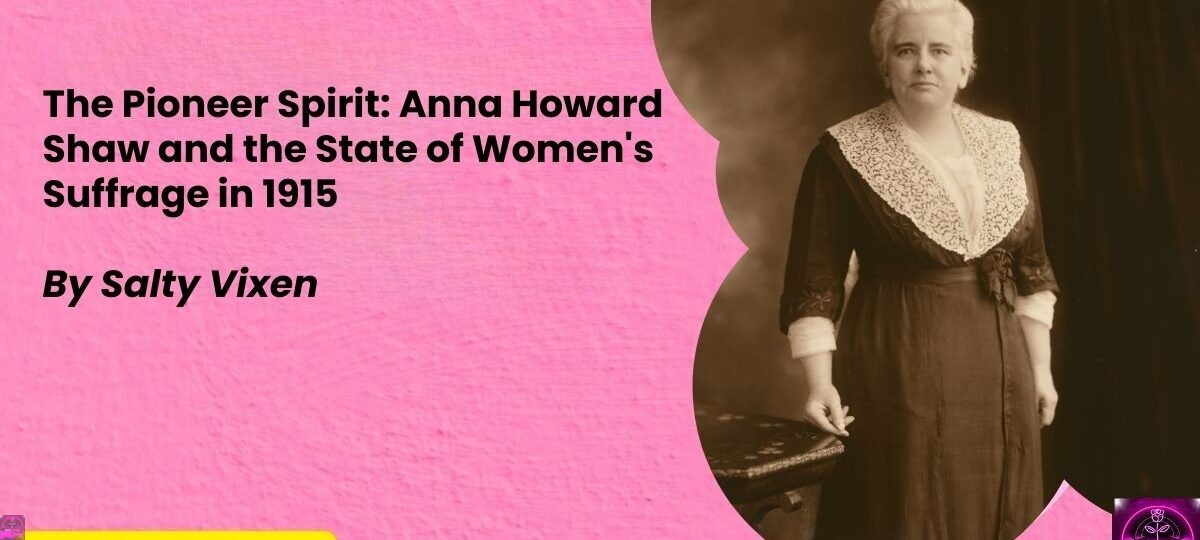
Introduction: A Voice from the Frontier
In the annals of American history, few figures embody the relentless pursuit of equality as vividly as Anna Howard Shaw. Born in 1847 in Newcastle-on-Tyne, England, Shaw immigrated to the United States as a child, enduring the hardships of pioneer life in Michigan’s wilderness. Her autobiography, The Story of a Pioneer, published in 1915, is not merely a personal memoir but a testament to the broader struggle for women’s rights. As a physician, ordained minister, and president of the National American Woman Suffrage Association (NAWSA) from 1904 to 1915, Shaw was at the epicenter of the suffrage movement during a pivotal era.
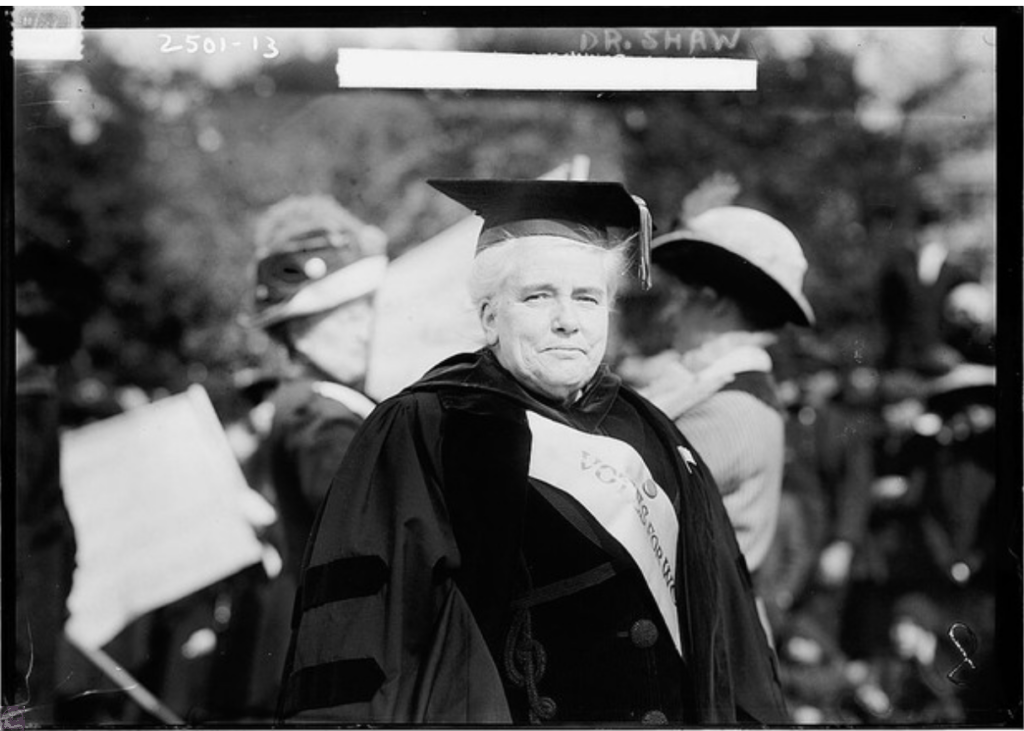
By 1915, the year Shaw’s book was released, the fight for women’s suffrage had spanned nearly seven decades, beginning with the Seneca Falls Convention in 1848. This movement, fueled by Enlightenment ideals, abolitionism, and emerging feminist thought, sought to dismantle the legal and social barriers denying women the vote. Shaw’s narrative captures the momentum building in the West while highlighting the stubborn resistance in the East. Her statistics on suffrage status, drawn from firsthand experience, paint a picture of uneven progress: full voting rights in a dozen Western states and territories, partial suffrage in Illinois, and amendments pending in several Eastern strongholds. These figures underscored a strategic shift—suffragists increasingly focused on state-by-state wins to pressure Congress for a federal amendment.
The year 1915 was a turning point. World War I loomed, diverting national attention, yet suffragists like Shaw pressed on, organizing parades, petitions, and lobbying efforts. Shaw’s resignation from NAWSA that year marked the end of an era, paving the way for more militant tactics under leaders like Carrie Chapman Catt and Alice Paul. Her book, written amid these transitions, offers a reflective lens on victories won and battles ahead. This article delves into the suffrage landscape of 1915 through Shaw’s eyes, exploring the challenges, triumphs, and human stories that defined the movement. At approximately 4200 words, it aims to honor Shaw’s legacy while providing a comprehensive historical overview.
The Roots of Suffrage: From Seneca Falls to Western Victories (1848-1900)
The women’s suffrage movement did not emerge in isolation but from the fertile ground of 19th-century reform. The Seneca Falls Convention of 1848, organized by Elizabeth Cady Stanton and Lucretia Mott, issued the Declaration of Sentiments, modeled after the Declaration of Independence, asserting that “all men and women are created equal.” This bold statement challenged the patriarchal norms of the time, where women were legally subordinate to men, unable to own property, sue in court, or vote.
Post-Civil War, the movement intersected with abolitionism. The 14th and 15th Amendments, granting citizenship and voting rights to African American men, ignited debates among suffragists. Stanton and Susan B. Anthony opposed these amendments for excluding women, leading to a split in 1869. Anthony and Stanton formed the National Woman Suffrage Association (NWSA), advocating for a federal amendment, while Lucy Stone and others created the American Woman Suffrage Association (AWSA), focusing on state-level campaigns. This division, though contentious, diversified strategies and expanded reach.
The first major victory came in 1869, when Wyoming Territory granted women full suffrage to attract settlers and promote equality. Shaw, in her book, reflects on this as a beacon of progress: “Wyoming led the way in 1869, proving that women could vote without disrupting society.” Colorado followed in 1893 after a hard-fought referendum, where suffragists mobilized miners’ wives and leveraged populist sentiments. Idaho and Utah joined in 1896, with Utah’s inclusion tied to its statehood and Mormon influences, though federal interventions had temporarily revoked women’s votes there in 1887.
These Western triumphs were no accident. The frontier’s egalitarian ethos, scarcity of women, and progressive politics created fertile ground. As Shaw notes, “In the West, where women shared the burdens of pioneering, men recognized their right to share in governance.” By 1900, these states demonstrated that female voters improved laws on education, labor, and temperance without the chaos opponents predicted. However, Eastern states remained resistant, viewing suffrage as a threat to traditional gender roles.
Challenges abounded. Anti-suffragists, often elite women, argued that voting would “unsex” females and disrupt homes. Liquor interests funded opposition, fearing women’s support for prohibition. Internal rifts persisted until the 1890 merger of NWSA and AWSA into NAWSA, with Shaw emerging as a key lecturer. Her oratory skills, honed as a minister, drew crowds and converted skeptics. One anecdote from her book recounts a grueling speaking tour in Kansas, where she faced hostile audiences but won hearts through logic and humor.
Accelerating Momentum: Suffrage Gains in the 1910s
The early 20th century saw a surge in suffrage activity, influenced by Progressive Era reforms. Shaw’s leadership at NAWSA emphasized education and lobbying, contrasting with the militancy of British suffragettes like Emmeline Pankhurst, whom American activists admired but adapted cautiously.
Washington state granted full suffrage in 1910, followed by California in 1911—a major win given its population and 13 electoral votes. Shaw describes the California campaign as exhaustive: “We canvassed every precinct, spoke in every town, and faced down opposition from saloonkeepers and conservatives.” Arizona, Kansas, and Oregon followed in 1912, with Alaska Territory in 1913. Nevada and Montana joined in 1914, bringing the total to 12 areas with full suffrage by 1915.
These states, mostly Western, controlled about 62 electoral votes, a significant bloc in national elections.
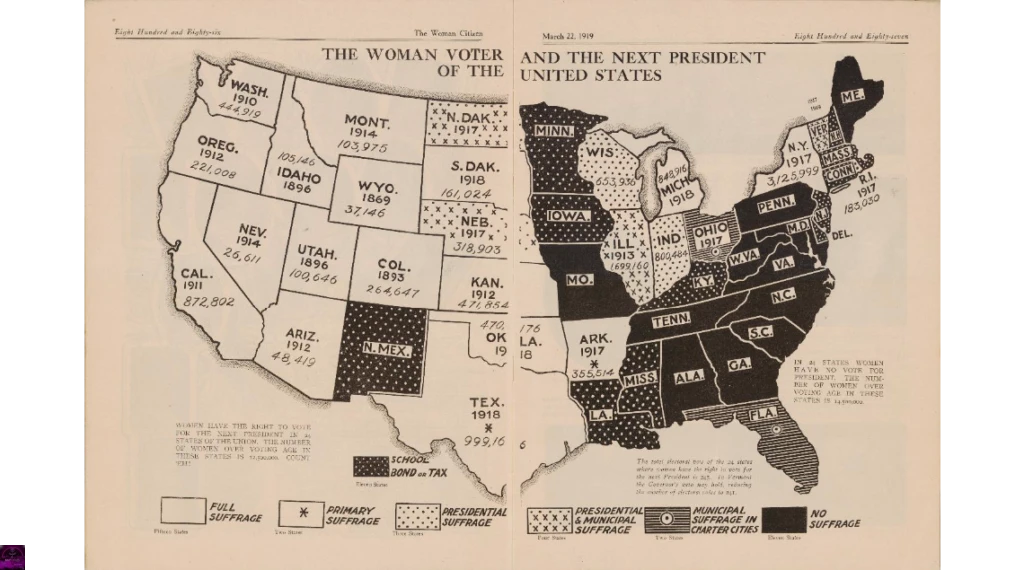
As Shaw’s statistics show:
Full Suffrage for Women
- Wyoming (1869): 3 electoral votes
- Colorado (1893): 6
- Idaho (1896): 4
- Utah (1896): 4
- Washington (1910): 7
- California (1911): 13
- Arizona (1912): 3
- Kansas (1912): 10
- Oregon (1912): 5
- Alaska (1913): —
- Nevada (1914): 3
- Montana (1914): 4
This Western dominance is vividly illustrated in historical maps, where suffrage states glow in contrast to the dark, unenfranchised East.
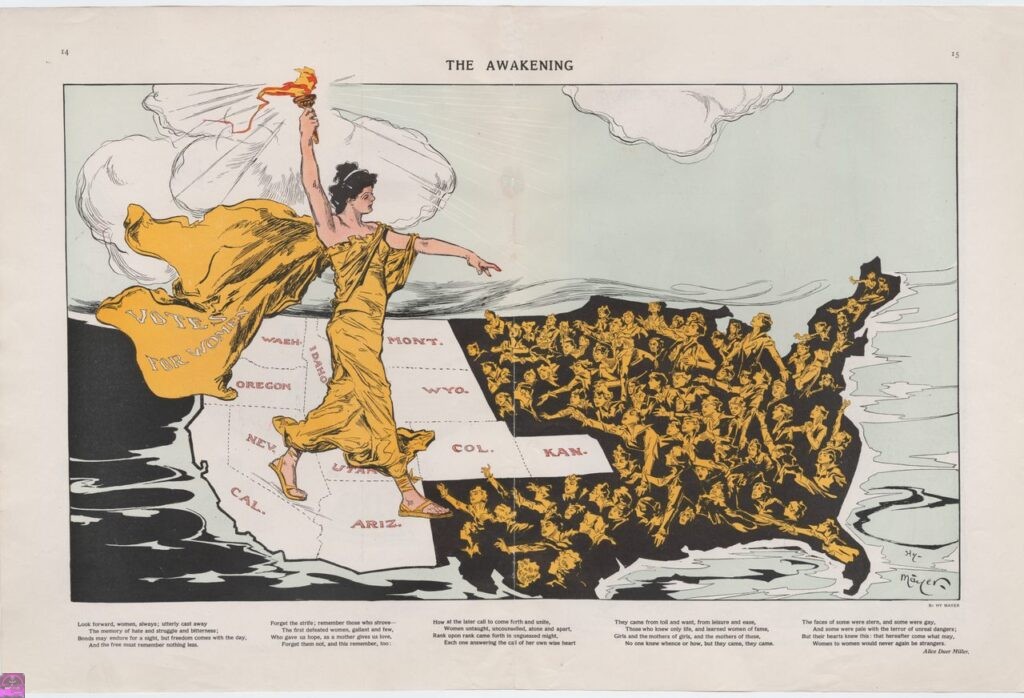
Illinois stood as an outlier with presidential and municipal suffrage in 1913, wielding 29 electoral votes. Shaw hailed this as a “crack in the Eastern wall,” allowing women to influence national politics without full state rights.
Pending amendments in six states signaled Eastern progress:
States Where Amendment Has Passed One Legislature
- Iowa: House 81-26, Senate 31-15, to voters 1916 (13 votes)
- Massachusetts: 169-39, 34-2, 1915 (18)
- New Jersey: 49-4, 15-3, 1915 (14)
- New York: 125-5, 40-2, 1915 (45)
- North Dakota: 77-29, 31-19, 1916 (5)
- Pennsylvania: 131-70, 26-22, 1915 (38)
These legislative victories, with lopsided votes in some cases, reflected growing support. New York’s 45 votes made it a prize target.
Victories came amid challenges. The 1915 referendums in Massachusetts, New Jersey, New York, and Pennsylvania failed, often due to immigrant and working-class opposition manipulated by anti-suffrage forces. Shaw recounts personal setbacks, like mud-slinging campaigns accusing her of being “unwomanly.” Yet, she persevered, drawing strength from mentors like Anthony, who died in 1906, urging, “Failure is impossible.”
Shaw’s Personal Journey: From Pulpit to Podium
Shaw’s life story, woven throughout her book, humanizes the movement. Raised in poverty, she taught school at 15, preached at 23, and earned medical and theology degrees despite barriers. Ordained in 1880, she faced Methodist rejection but found purpose in suffrage.

Inspired by Anthony, Shaw joined NAWSA in 1885, becoming vice president in 1892 and president in 1904. Her tenure focused on unity and expansion, growing membership to over two million. Anecdotes abound: In South Dakota’s 1890 campaign, she braved blizzards to speak in barns; in California, she debated opponents who claimed women voting would lead to family dissolution.
Shaw’s views on intersectionality were progressive for her time, though the movement often marginalized women of color. She advocated for inclusive strategies but acknowledged tensions, as when NAWSA distanced from Black suffragists to appease Southern whites. Her book includes poignant quotes: “The suffrage stream is widening, carrying us toward the ocean of freedom.”
Internal Divisions and External Opposition
The movement’s challenges were multifaceted. Internally, generational clashes emerged. Shaw’s moderate approach clashed with Alice Paul’s militancy. In 1913, Paul organized a massive Washington parade, but racial segregation marred it, excluding Black participants like Ida B. Wells. Paul split from NAWSA in 1916, forming the National Woman’s Party (NWP), which picketed the White House during WWI, leading to arrests and hunger strikes.
Externally, anti-suffragists formed groups like the National Association Opposed to Woman Suffrage, arguing women’s influence was purer without politics. Economic interests, particularly brewers, funded anti-campaigns, linking suffrage to prohibition. Societal diversions—Civil War reconstruction, economic panics, immigration waves—delayed progress.
Yet, victories mounted. Suffrage correlated with reforms: In suffrage states, child labor laws strengthened, public health improved, and women’s wages rose. Shaw’s data showed legislative responsiveness post-suffrage, with spending on education and welfare increasing 35% in some areas.
The Road to 1920: From 1915 to Ratification
Post-1915, momentum accelerated. New York passed suffrage in 1917, tipping the scales. WWI provided leverage: Women’s war work, coordinated by Shaw as head of the Woman’s Committee of the Council of National Defense, earned her the Distinguished Service Medal.
President Wilson, initially opposed, endorsed suffrage in 1918. Congress passed the 19th Amendment in 1919, ratified in 1920. Shaw died in 1919, missing the triumph, but her efforts were foundational.
Conclusion: Legacy of a Pioneer
Anna Howard Shaw’s The Story of a Pioneer captures the suffrage movement at a crossroads in 1915—a time of Western gains, Eastern promise, and unyielding resolve. Her statistics reveal not just numbers but the human cost and triumph of the fight. Today, as we reflect on the centennial-plus of the 19th Amendment, Shaw’s story reminds us that progress is incremental, often fraught, but ultimately transformative. The movement’s international ties, diverse strategies, and persistent challenges offer lessons for contemporary struggles for equality.
In Shaw’s words: “The cause of freedom is not the cause of a race or a sect, a party or a class—it is the cause of humankind.” Her pioneer spirit endures, inspiring future generations to widen the stream of justice.
- Shaw, Anna Howard; Jordan, Elizabeth Garver and Catt, Carrie Chapman (1915) The Story of a Pioneer, New York and London: Harper & Brothers.
- “Dr. Anna H. Shaw, Suffragist, Dies”. New York Times. July 3, 1919. Retrieved March 8, 2016.
- Zink-Sawyer 2003, p. 56.
- Zink-Sawyer 2003, p. 57.
- Zink-Sawyer 2003, p. 58.
- Willard, Francis; Livermore, Mary. Great American Women of the 19th Century. pp. 651–652.
- Schmidt, Jean Miller (1999). Grace sufficient: a history of women in American Methodism, 1760–1939. Nashville, TN: Abingdon Press. pp. 185–189. ISBN 978-0-687-15675-7.
- Whitman, Alden, ed. (1985). American Reformers. New York: The H. W. Wilson Company. pp. 734–735. ISBN 0-8242-0705-X.
- Bilhartz, Terry D. “Anna Howard Shaw.” Great Lives from History: The Nineteenth Century. Ed. John Powell. 4 vols. Salem Press, 2007. Salem History Web. September 26, 2011.
- The Lariat (Waco, Texas), Vol. 20, No. 27, Thursday, April 17, 1919.
- “Pennsylvania Commission for Women, Legendary Ladies, A Guide to Where Women Made History in Pennsylvania” (PDF).
- “Anna Howard Shaw: The Forgotten Suffragist”. The Gay & Lesbian Review. June 27, 2020. Retrieved February 16, 2025.
- Michigan History. Vol. 9–10. Michigan Historical Commission Lansing. 1925. p. 259.
- Crew, Danny O. (2015). Suffragist Sheet Music: An Illustrated Catalogue of Published Music Associated with the Women’s Rights and Suffrage Movement in America, 1795–1921, with Complete Lyrics. McFarland & Company. p. 337. ISBN 9781476607443.
- “2020 Honorees”. National Women’s History Alliance. Archived from the original on January 15, 2020. Retrieved January 8, 2020.
- Anna Howard Shaw Women’s Center. Archived June 3, 2019, at the Wayback Machine.
- “About Anna Howard Shaw — Anna Howard Shaw Center | Boston University”. www.bu.edu.
- The Rev. Dr. Anna Howard Shaw 1847–1919, retrieved February 5, 2016.
- Zink-Sawyer, Barbara (2003). From Preachers to Suffragists: Woman’s Rights and Religious Conviction in the Lives of Three Nineteenth-Century Clergywomen. Westminster John Knox Press. ISBN 0-664-22615-9.
- Shaw, Anna Howard; Elizabeth Jordan (1915). The story of a pioneer. Harper & Brothers. p. 337. (autobiography)
- Pellauer, Mary D. Toward a Tradition of Feminist Theology: the religious social thought of Elizabeth Cady Stanton, Susan B. Anthony, and Anna Howard Shaw. Brooklyn, NY: Carlson, 1991.
- Franzen, Trisha. Anna Howard Shaw: The Work of Woman Suffrage. University of Illinois, 2014.
- Linkugel, Wil A.; Solomon, Martha (1991). Anna Howard Shaw, Suffrage Orator and Social Reformer. New York: Greenwood Press. ISBN 0-313-26345-0.
Wikimedia Commons has media related to Anna Howard Shaw. English Wikisource has original text related to this article: Woman of the Century / Anna H. Shaw. Wikiquote has quotations related to Anna Howard Shaw.
- Works by Anna Howard Shaw at Project Gutenberg
- Finding Aid for the Anna Howard Shaw Papers
- Anna Howard Shaw letter from the Anna Howard Shaw Papers, 1917–1919 at The University of North Carolina at Greensboro
- Anna Howard Shaw quotation from the Anna Howard Shaw Papers, 1917–1919 at The University of North Carolina at Greensboro
- The Anna Howard Shaw Center at Boston University School of Theology
- Papers in the Woman’s Rights Collection, 1908–1943. Schlesinger Library, Radcliffe Institute, Harvard University.
- The Story of a Pioneer from the Library of Congress
- American National Biography Online, Ann D. Gordon. “Shaw, Anna Howard”, February 2000. Access Date: March 8, 2016.
