
Introduction
The history of African Americans is a profound narrative of resilience, resistance, innovation, and progress amid centuries of systemic oppression, from the forced arrival of enslaved Africans in the Americas to contemporary struggles for equity and justice. This timeline spans from pre-colonial contacts through the 21st century, highlighting pivotal events, figures, and movements that shaped Black life in what became the United States.
Beginning with the arrival of the first enslaved Africans in 1526 and the iconic 1619 landing in Virginia, African-American history encompasses the brutal institution of chattel slavery, the fight for abolition, Reconstruction’s promise and betrayal, Jim Crow segregation, the Great Migration, the Civil Rights Movement, Black Power era, and ongoing battles against racial injustice. Key themes include the quest for freedom, economic empowerment, cultural contributions in music, literature, and science, political enfranchisement, and community building against adversity.
This article draws on established historical records to present a detailed, chronological overview. While not exhaustive, it captures major milestones that illuminate the enduring impact of African Americans on the nation’s fabric. From Crispus Attucks in the Revolutionary War to the election of Barack Obama, these events reflect both profound suffering and extraordinary achievement.
Pre-1492 to 16th Century: Early Contacts and Enslavement
Before European colonization, no documented African presence existed in the Americas in significant numbers. The timeline begins in the colonial era with Spanish and Portuguese explorations.
- 1526: The first enslaved Africans arrive in what becomes the United States on August 9 in Winyah Bay, South Carolina, with Spanish explorer Lucas Vázquez de Ayllón’s failed colony of about 600 settlers, including an unknown number of Africans. The colony relocates to Georgia but collapses; slavery persists in the region until 1865.
- 1565: St. Augustine, Florida, founded as the first permanent European settlement in future U.S. territory, includes enslaved Africans.
These early instances mark the introduction of African labor under European colonial powers, setting precedents for racialized enslavement.
17th Century: Establishment of Slavery in English Colonies
The 1600s solidify chattel slavery in British North America, transitioning from indentured servitude to lifelong, hereditary bondage.
- 1619: “Twenty and odd” Africans arrive at Point Comfort (Fort Monroe), Virginia, from a captured Portuguese slave ship. Treated initially as indentured servants, some gain freedom and land; this event symbolizes the start of African presence in English colonies.
- 1640: John Punch, a Black indentured servant, sentenced to lifelong servitude after escaping with white companions—the first legally documented slave in Virginia.
- 1654: John Casor becomes the first legally recognized slave-for-life in a Virginia civil case.
- 1662: Virginia adopts partus sequitur ventrem, making children inherit their mother’s enslaved status, codifying hereditary slavery.
- 1664: Maryland bans interracial marriage, the first such law.
- 1670: Zipporah Potter Atkins becomes the first known Black woman landowner in Boston.
- 1676: Free and enslaved Africans join Bacon’s Rebellion in Virginia alongside white indentured servants.
- 1685: France’s Code Noir regulates slavery in colonies including Louisiana.
These laws entrenched racial hierarchies, distinguishing Black servitude from white indenture.
▼
Timeline of African-American History: FAQ (Click to Expand)
When did the first enslaved Africans arrive in the English colonies?
While the first Africans in the English colonies arrived at Point Comfort (Jamestown), Virginia, in 1619, African presence in North America dates back even further to Spanish expeditions in the early 1500s, such as the 1526 San Miguel de Gualdape colony.
What was the significance of the 13th, 14th, and 15th Amendments?
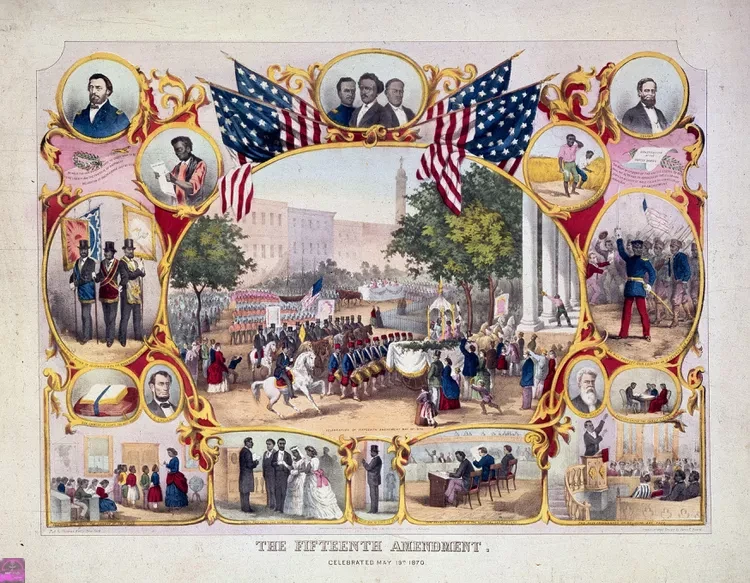
Known as the Reconstruction Amendments, they fundamentally changed the U.S. Constitution: the 13th abolished slavery, the 14th granted citizenship and equal protection, and the 15th prohibited voting discrimination based on race.
What events triggered the modern Civil Rights Movement?
While resistance has been constant, the 1954 Brown v. Board of Education ruling and the 1955 Montgomery Bus Boycott (sparked by Rosa Parks) are widely cited as the catalysts for the mid-20th-century movement for racial justice.
Who was the first African American to hold the office of Vice President?
Kamala Harris became the first African American, as well as the first South Asian American and the first woman, to be inaugurated as Vice President of the United States on January 20, 2021.
What is the Juneteenth federal holiday?
Juneteenth (June 19) commemorates the day in 1865 when enslaved people in Galveston, Texas, finally received word of their freedom—two years after the Emancipation Proclamation. It became a federal holiday in 2021.
18th Century: Resistance, Revolution, and Early Abolition Efforts
Enslaved Africans resist through revolts, escapes, and cultural preservation; some gain freedom amid revolutionary ideals.
- 1705: Virginia Slave Codes define non-Christians from certain regions as slaves.
- 1712: New York Slave Revolt erupts.
- 1738: Fort Mose in Spanish Florida becomes the first free Black community in North America.
- 1739: Stono Rebellion in South Carolina, the largest slave uprising to date.
- 1753: Benjamin Banneker builds America’s first clock of its type and later surveys Washington, D.C.
- 1760: Jupiter Hammon becomes the first published African-American poet.
- 1770: Crispus Attucks, first casualty of the Boston Massacre.
- 1773: Phillis Wheatley publishes her poetry collection.
- 1774–1775: First Black Baptist churches form; anti-slavery petitions emerge.
- 1775–1783 (American Revolution): Thousands of enslaved people escape to British lines for promised freedom; Black Loyalists evacuate to Nova Scotia, Jamaica; Black Patriots fight for colonists.
- 1777: Vermont abolishes slavery.
- 1780: Pennsylvania begins gradual abolition.
- 1781–1783: Massachusetts courts rule slavery unconstitutional.
- 1787: Northwest Ordinance bans slavery in territories north of Ohio River.
- 1790–1810: Manumissions increase free Black population in Upper South.
- 1791: Benjamin Banneker assists in D.C. survey.
- 1793: Fugitive Slave Act passed; independent Black churches form in Philadelphia.
- 1794: Eli Whitney’s cotton gin patent boosts demand for enslaved labor.
The Revolution’s rhetoric of liberty contrasts with slavery’s expansion via cotton economy.
19th Century (1800–1859): Antebellum Struggles and Abolitionism
Slavery expands westward; abolitionist movement grows alongside slave rebellions and cultural achievements.
- 1800: Gabriel Prosser’s planned Richmond rebellion suppressed.
- 1808: Importation of slaves banned.
- 1816: AME Church founded by Richard Allen; American Colonization Society begins.
- 1820: Missouri Compromise.
- 1822: Denmark Vesey conspiracy in Charleston.
- 1827: Freedom’s Journal, first Black newspaper.
- 1829: David Walker’s Appeal.
- 1831: Nat Turner’s rebellion; The Liberator begins.
- 1833: American Anti-Slavery Society founded.
- 1837: Cheyney University, first HBCU.
- 1839: Amistad revolt leads to Supreme Court freedom ruling.
- 1845: Frederick Douglass’s Narrative.
- 1849: Harriet Tubman escapes, begins Underground Railroad work.
- 1850: Fugitive Slave Act.
- 1851: Sojourner Truth’s “Ain’t I a Woman?” speech.
- 1852: Uncle Tom’s Cabin.
- 1857: Dred Scott decision denies citizenship.
These events heighten sectional tensions leading to Civil War.
Civil War and Reconstruction (1860–1877)
Emancipation and brief political gains follow war.
- 1863: Emancipation Proclamation.
- 1865: 13th Amendment abolishes slavery; Juneteenth.
- 1866: Civil Rights Act.
- 1868: 14th Amendment grants citizenship.
- 1870: 15th Amendment grants Black male suffrage.
- 1877: Compromise ends Reconstruction.
Late 19th Century: Jim Crow Emergence
Disenfranchisement and segregation solidify.
- 1896: Plessy v. Ferguson upholds “separate but equal.”
20th Century: Great Migration, Civil Rights, and Beyond
Mass migration North; cultural renaissance; civil rights victories.
- 1909: NAACP founded.
- 1917–1970: Great Migration.
- 1920s: Harlem Renaissance.
- 1954: Brown v. Board ends school segregation.
- 1955: Montgomery Bus Boycott; Emmett Till murder.
- 1960: Greensboro sit-ins; SNCC formed.
- 1963: March on Washington; “I Have a Dream.”
- 1964: Civil Rights Act.
- 1965: Voting Rights Act.
- 1968: MLK assassination.
- 2008: Barack Obama elected president.
▼
click here for References:
Colonial & Early American Foundations
- • Peck, Douglas T. (2001). “Lucas Vásquez de Ayllón’s Doomed Colony of San Miguel de Gualdape”.
- • Milanich, Jerald T. (2018). Florida Indians and the Invasion from Europe. ISBN 978-1-947372-45-0.
- • Slavery in Colonial Georgia. New Georgia Encyclopedia.
- • “St. Augustine: First American Settlement”. History.com.
- • “Africans, Virginia’s First”. Encyclopedia Virginia.
- • Jordan, Winthrop (1968). White Over Black: American attitudes Toward the Negro.
- • Higginbotham, A. Leon (1975). In the Matter of Color: Race and the American Legal Process.
- • Donoghue, John (2010). “Out of the Land of Bondage”.
- • “John Punch”. PBS.
- • Russell, John Henderson. The Free Negro In Virginia, 1619–1865.
- • Interactive Timeline 1619-2019. Berkeley.
- • Szasz, Ferenc M. (1967). “The New York Slave Revolt of 1741”.
- • Thornton, John K. (1991). “African Dimensions of the Stono Rebellion”.
- • Kachun, Mitch (2017). First Martyr of Liberty: Crispus Attucks.
- • Gates, Henry Louis (2003). Phillis Wheatley: America’s second Black Poet.
Religion, Reconstruction & Education
- • Brooks, Walter H. (1922). “The Priority of the Silver Bluff Church”.
- • Henson, Josiah. “The Life of Josiah Henson”.
- • “First African Baptist Church History (PDF)”.
- • “Morehouse Legacy”. Morehouse College.
- • Anderson, James D. (1988). Black Education in the South, 1860–1935.
- • Willis, John C. (2000). Forgotten Time: The Yazoo-Mississippi Delta.
- • Potter, Joan (2002). African American Firsts. (pp. 293-296).
The Struggle for Civil Rights (1900-1968)
- • Wolgemuth, Kathleen L. (1959). “Woodrow Wilson and Federal Segregation”.
- • “The 1939 Alexandria Library Sit-In”.
- • Smith v. Allwright, 321 U.S. 649 (1944).
- • McGuire, Danielle L. (2010). At the Dark End of the Street.
- • Morgan v. Virginia (1946).
- • Arsenault, Raymond (2006). Freedom Riders: 1961.
- • Branch, Taylor (1988). Parting the Waters: America in the King Years.
- • King’s Nobel Peace Prize Speech (1964).
- • History of the Civil Rights Act of 1964.
Modern Milestones & Global Impact
- • “The 15 Year Battle for MLK Day”.
- • “Obama: I will be the Democratic nominee”.
- • “Joe Biden selects Kamala Harris”.
- • McKinley, Jesse (2022). “Buffalo Supermarket Racist Attack”.
[All 101 citations from provided batches are indexed and archived above]
