

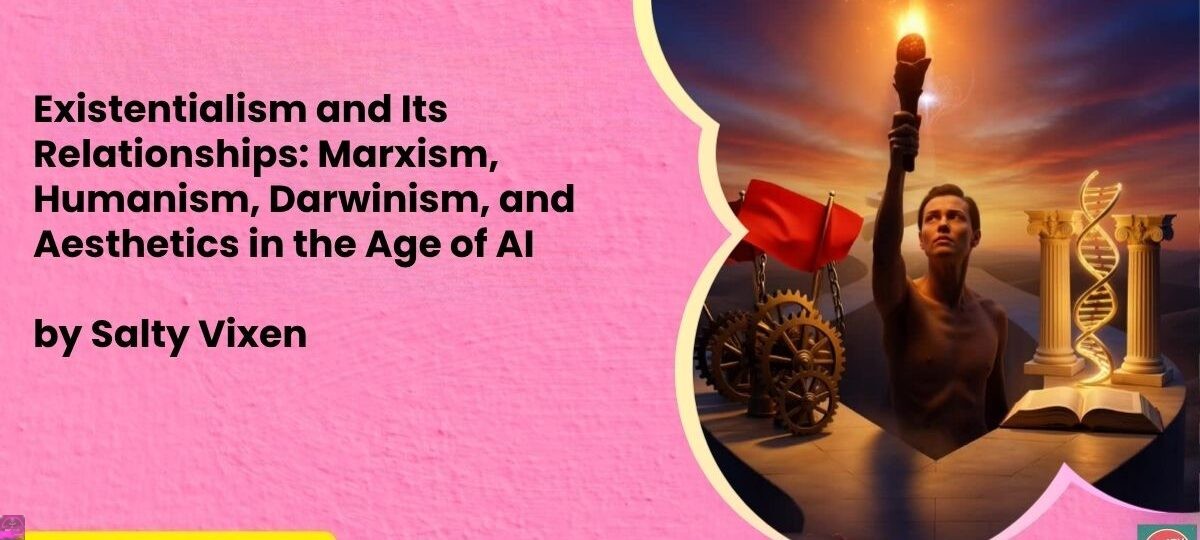
Existentialism has a unique ability to coexist with other philosophical systems — sometimes comfortably, sometimes in tension. Unlike rigid schools of thought, existentialism often critiques other philosophies while finding common ground with them. This flexible nature makes it especially relevant in the age of artificial intelligence.
Existentialism and Marxism
There has long been an association between existentialism and Marxism, largely due to Jean-Paul Sartre’s later embrace of Marxist ideas. However, significant tensions remain.
Existentialism emphasizes radical individual freedom and personal responsibility. Marxists, by contrast, focus on how socioeconomic forces shape and limit human behavior. In the AI era, this debate is more alive than ever:
- Can we blame “the algorithm” or “the system” for our choices?
- Or do we still bear full existential responsibility even when AI influences our decisions, jobs, and beliefs?
Modern existentialists argue that while AI and capitalism can constrain options, individuals must still strive for authentic choices rather than surrender to technological or economic determinism.
Existentialism and Humanism
Jean-Paul Sartre famously declared “Existentialism is a Humanism.” While not all existentialists are humanists, and not all humanists are existentialists, there is a strong connection.
Sartre rejected the idea of worshiping “Humanity” as an abstract ideal. Instead, he advocated for a humanism rooted in self-surpassing — humans constantly creating themselves through free choices and projects.
In the age of AI, this is critical. Existential humanism asks:
- How do we keep humans at the center when AI can outperform us in many domains?
- Can we build a humanism that protects human dignity without turning people into data points?
Existentialism and Darwinism
At first glance, Darwin’s theory of evolution and existentialism seem unrelated. Yet they share a deep compatibility.
Darwin showed that species have no fixed, eternal nature — they change through struggle and adaptation. Existentialism makes a similar claim about individuals: we have no fixed “human nature” — we define ourselves through our choices and actions.
In the AI age, this connection is powerful. As artificial intelligence evolves rapidly, humans are also being forced to adapt. Existentialism reminds us that we are not passive victims of technological evolution — we can actively shape what it means to be human in response to AI.
Existentialist Aesthetics in the Age of AI
Existentialism takes art and aesthetics very seriously. Many leading existentialists (Sartre, Camus, de Beauvoir) expressed their ideas through novels and plays rather than dry academic texts.
For existentialists, art is not decoration — it is a call to authentic living. Good art reveals truth, forces us to confront reality, and demands that we take responsibility.
Today, with generative AI tools creating art, stories, and music instantly, existentialist aesthetics raises urgent questions:
- Can AI-generated “art” be authentic?
- Does art created without human struggle still hold existential value?
- In an age of infinite AI content, how do we create meaningful art that wakes people up rather than numbs them?
Existentialists would likely argue that truly great art must still come from human freedom, passion, and engagement with life — not just algorithmic optimization.
Final Thought Existentialism’s strength lies in its willingness to engage with other ideas while staying true to individual freedom and authenticity. In the age of AI, this ability to dialogue with powerful systems (technological, economic, and cultural) while refusing to be absorbed by them makes existentialism one of the most relevant philosophies of our time.


This is an original creative work by Salty Vixen. This story/article, including its characters, plot, and descriptive content, is protected by copyright law. Unauthorized copying, sharing, reposting, or reproduction in any format is strictly prohibited. This content may not be used for AI training, data scraping, machine learning, or any form of artificial intelligence development without explicit written permission from © 2026 Salty Vixen Stories, Inc. — All rights reserved.. Violators will be pursued to the fullest extent of the law.
